
24/7 Customer Support

Free returns

Same-day & Next-day Delivery

Quality Guaranteed

Unlock Your Welcome Offers: FREE Delivery | Up to 80% OFF | Free 30-day JoyPlus trial
Download the APP
A 10000mAh magnetic power bank can be useful for commuting, travel, workdays and evenings away from a socket. It can attach to a compatible phone, charge wirelessly and still provide a wired connection for faster top-ups. However, not every compact charger offers the same level of convenience.
Before buying, UK shoppers should look beyond capacity figures and attractive product images. Wireless output, magnetic alignment, USB-C performance and heat management all affect how practical a power bank feels in everyday use.
A 10000mAh label describes the battery cells inside the power bank, not the exact amount your phone will receive. Energy is lost during voltage conversion and wireless charging, while cable and device limitations also affect the result.
Capacity is still useful for comparing products, but it should be considered alongside:
A magnetic wireless charger needs two things: a compatible charging standard and a secure magnetic connection. iPhone models with built-in magnetic alignment are generally straightforward, while Android users may need a magnetic case or an adhesive magnetic ring.
A standard Qi-enabled device may charge wirelessly without attaching securely. Thick, non-magnetic cases can also weaken the grip and increase the distance between the charging coil and phone. Check whether the listing states MagSafe compatibility, Qi support or simply magnetic attachment before ordering.
A 22.5W power bank does not make every phone charge at 22.5W. The phone, cable and charging protocol must all support the advertised rate. Similarly, a 20W PD power bank is suitable for many compatible phones, but the actual speed will vary according to the device and its battery level.
Wireless charging also tends to generate more heat than wired charging. A well-designed power bank should include suitable temperature and charging protection, but users should avoid covering the charger, placing it in direct sunlight or leaving it inside a hot car.
For an iPhone power bank, confirm whether the product supports magnetic alignment for your model and case. Some products provide up to 15W wireless output for compatible devices, while iPhones may operate at a lower wireless rate depending on the model and charging system.
For an Android power bank, check whether your phone supports Qi wireless charging and whether a magnetic case is required. AirPods and other small Qi-enabled accessories may also work, although output can be lower than for a phone.
A USB-C power bank is a practical choice for modern phones, tablets, earbuds and other accessories. Look for the following details:
Remember that “fast charging” is not a universal speed rating. A USB-C to USB-C cable may be needed for USB-C phones, while some iPhones require a USB-C to Lightning cable.
A slim power bank is easier to carry in a coat pocket or small handbag, but a very thin design may leave less room for cooling or a large display. Compare dimensions and weight rather than relying on phrases such as “pocket-sized”.
A battery display can be more useful than four simple indicator lights because it gives a clearer idea of remaining capacity. A power bank with phone stand functionality may also suit desk workers, train passengers and hotel-room use, allowing the phone to remain visible while charging.
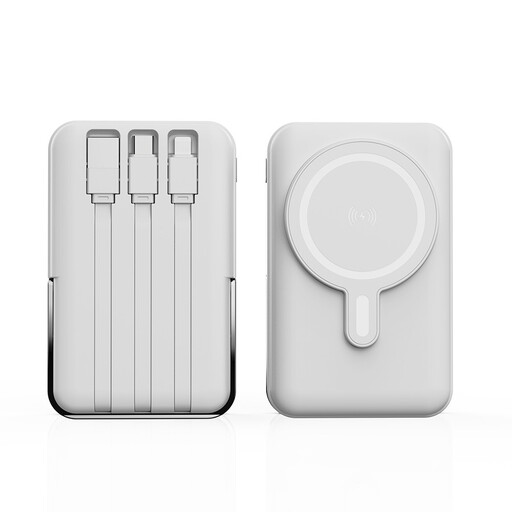
Why This Fits Their Persona: A straightforward option for commuters and occasional travellers who want magnetic wireless charging, a 10000mAh capacity and a built-in phone stand without prioritising a metal finish.
Its listed 22.5W maximum output is presented alongside the magnetic and stand functions, making it easier to assess the complete feature set rather than focusing only on capacity.
10000mAh capacity; adjustable mobile phone stand; wireless charging compatibility is listed for multiple devices.
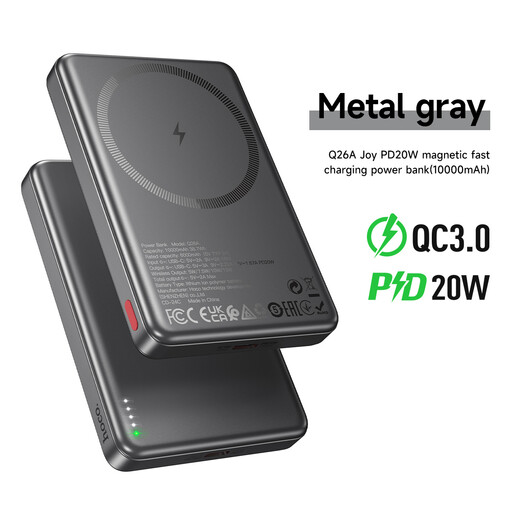
Why This Fits Their Persona: Suitable for users who want an aluminium alloy body, clear battery information and both wireless and wired charging for daily use or business travel.
The four-LED display shows remaining power, while the USB-C port is specified for 20W PD wired output rather than leaving charging speed unclear.
Up to 15W wireless output; 20W PD USB-C output; dual charging for one wireless and one wired device.
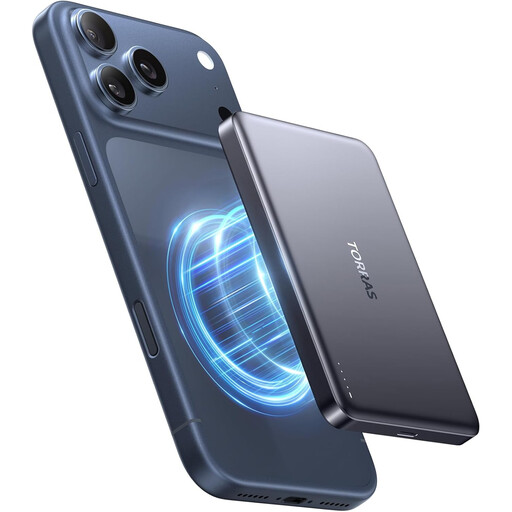
Why This Fits Their Persona: A practical match for frequent travellers and pocket-carry users who want a slim magnetic charger with wired support for phones and accessories.
The listed wireless rates distinguish between up to 15W output and 7.5W for iPhone, avoiding the assumption that one wireless speed applies to every phone.
22.5W wired output; 15W maximum wireless output; NTC temperature control and overcharge protection are listed.
We have compiled a complete, real-time list of products that fully satisfy these strict selection criteria and UK safety regulations.
It can provide useful additional battery for many phones, but the practical amount varies by phone capacity, charging losses, wireless efficiency and how heavily the device is used. Wired charging generally transfers energy more efficiently than wireless charging.
Yes, if the Android phone supports wireless charging and has a compatible magnetic case or magnetic ring. Without magnetic alignment, the charger may still work as a wireless power bank, but it may not stay attached securely.
The electricity cost is usually small, but wireless charging can consume more energy than wired charging because of conversion and alignment losses. Keeping the coils correctly aligned and using USB-C wired charging when speed matters can reduce wasted energy.