
24/7 Customer Support

Free returns

Same-day & Next-day Delivery

Quality Guaranteed

Unlock Your Welcome Offers: FREE Delivery | Up to 80% OFF | Free 30-day JoyPlus trial
Download the APP
A 10000mAh magnetic power bank can make commuting, travelling and working away from a plug socket far easier. It can attach to a compatible phone for wireless charging, while USB-C or USB-A connections provide a wired alternative when speed matters.
However, capacity alone does not tell you whether a portable charger will suit your routine. A slim-looking model may charge slowly, a magnetic charger may not hold securely through a thick case and a headline wattage may only apply under specific conditions. The following guide explains what to check before buying and highlights suitable options for different UK users.
A label such as 10000mAh describes the battery cell capacity, not necessarily the amount delivered to your phone. Energy is lost during voltage conversion, cable charging and wireless charging. Wireless charging can also be less efficient than wired charging because of alignment and heat.
Check whether the listing provides a rated capacity, watt-hour figure or output details. For example, the HOCO Q26A is listed at 37Wh, while some products also state a lower nominal or rated capacity. These figures give a more realistic picture than the headline number alone.
A MagSafe power bank is generally designed around magnetic alignment for compatible iPhones, but Android phones vary considerably. Some support Qi wireless charging without built-in magnets; others require a magnetic case or adhesive ring.
Before ordering, check:
A thick, non-magnetic case can weaken the attachment and reduce wireless charging efficiency.
A product described as a 22.5W power bank or 45W power bank may reach that output through a particular USB-C port, cable or charging protocol. Using multiple ports at once can reduce the power available to each device.
Wireless charging speeds also depend on the phone, temperature and alignment. A model advertised with 15W wireless output may provide a different speed to an iPhone or a Qi-enabled Android handset. Read the port-by-port specifications rather than relying only on the largest number in the title.
For iPhone users, look for clear compatibility information rather than assuming that every magnetic wireless charger offers the same experience. The HOCO Q26A, for example, is described as compatible with MagSafe-compatible iPhones in the 12–15 series and supports Qi-enabled devices at stated 5W, 7.5W, 10W and 15W levels.
Wireless charging is convenient for navigation, short top-ups and use on a train or at a desk. Wired charging remains preferable when you need the quickest available charge or want to charge a device without magnetic alignment.
A USB-C power bank should state its input and output capabilities. USB Power Delivery (PD) is widely used by modern phones, tablets and some laptops. Other protocols, including QC, FCP and AFC, may improve compatibility with particular devices.
A 20W power bank can be suitable for many phones, while a 22.5W power bank may offer additional headroom for compatible handsets. A 45W model is more appropriate when you want to charge selected tablets or smaller laptops, although the charger, cable and device must all support the required standard.
A slim power bank is easier to carry in a coat pocket, but slim designs may offer fewer ports or lower output. A digital display provides a more precise battery reading than four indicator lights, which usually represent broad percentage ranges.
Useful features include:
For air travel, check the watt-hour rating and the airline’s current requirements. Lithium power banks should normally be carried in cabin baggage rather than checked luggage. The HOCO Q26A listing states a 37Wh capacity, which is below the commonly used 100Wh cabin threshold, but airline policies should still be confirmed before departure.
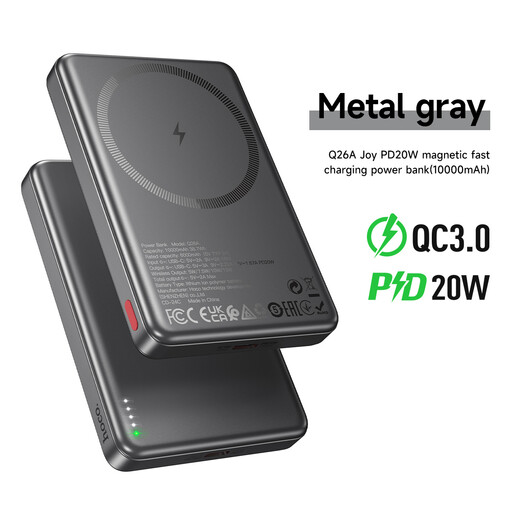
Why This Fits Their Persona: A practical choice for students, commuters and first-time magnetic charger buyers who want wireless and wired options in one compact unit.
It states both its 20W PD wired output and wireless output levels, rather than presenting magnetic charging as the only option.
Four LED indicators, aluminium alloy casing, 171g weight and support for charging one wireless and one USB-C device together.
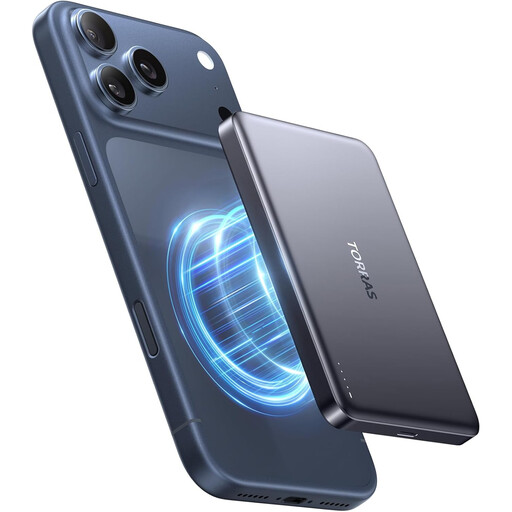
Why This Fits Their Persona: Suits business professionals and frequent travellers who prioritise a slim format, magnetic alignment and a refined finish.
The listing separates wired output of up to 22.5W from wireless output, including a stated 7.5W wireless level for iPhone.
Listed dimensions are approximately 4.01 x 2.5 x 0.5 inches, with USB-C charging and LED battery indicators.
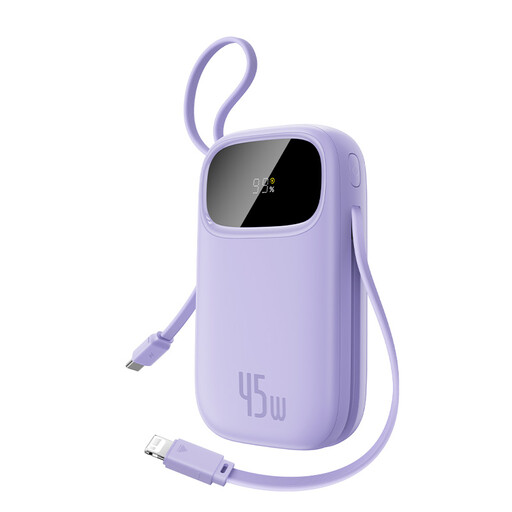
Why This Fits Their Persona: Designed for users carrying several devices, such as a phone, tablet, laptop or older iPhone, who value integrated cables.
Its specifications state that 45W is available through USB-C or the built-in USB-C cable with one device; simultaneous charging reduces total output.
Digital percentage display, built-in USB-C and iPhone cables, USB-A output and support for charging up to four devices.
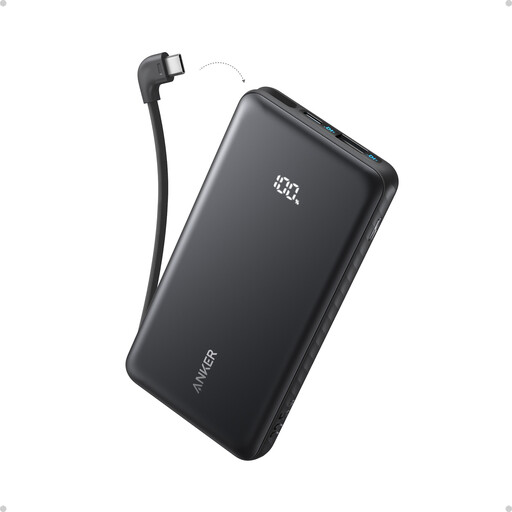
Why This Fits Their Persona: A useful option for commuters and students who regularly forget charging cables but still need wired charging flexibility.
The stated 22.5W output is paired with separate USB-A, USB-C and built-in USB-C connections, making the charging setup clear.
Two-way charging, a real-time interactive screen and stated temperature monitoring features.
We have compiled a complete, real-time list of products that fully satisfy these strict selection criteria and UK safety regulations.
For many users, yes. It can provide useful extra charge during a working day, commute or short trip. The actual number of phone charges depends on battery size, conversion losses, wireless efficiency and whether you use wired or wireless charging. Wired charging generally makes more of the stored energy available.
It can, provided the Android phone supports Qi wireless charging and has suitable magnetic alignment. Some Android models need a magnetic case or ring for secure attachment. If your phone does not support wireless charging, use the USB-C or USB-A output instead.
The wattage affects charging speed rather than automatically increasing electricity costs in a direct one-to-one way. A faster charger may shorten charging time, but the total energy needed depends on the device and charging losses. Use a compatible certified adapter and cable, and avoid leaving a damaged, swollen or unusually hot power bank connected.