
24/7 Customer Support

Free returns

Same-day & Next-day Delivery

Quality Guaranteed

Unlock Your Welcome Offers: FREE Delivery | Up to 80% OFF | Free 30-day JoyPlus trial
Download the APP
A 10,000mAh power bank is a practical middle ground for commuters, students, travellers and office workers. It can provide useful extra battery for a smartphone, earbuds or other USB-C devices without the bulk of a larger battery pack.
However, capacity alone does not tell you whether a portable charger will suit your daily routine. The advertised figure is only one part of the decision. Charging speed, connector compatibility, wireless performance, size and safety information can all affect the value you receive.
A power bank labelled 10,000mAh does not usually deliver 10,000mAh directly to your phone. Energy is lost during voltage conversion, cable charging and heat management. Rated capacity may therefore be noticeably lower than the headline capacity.
Look for the Wh rating, output specifications and rated capacity where available. For example, the Baseus model below lists 36.5Wh, while the Lofree model lists 38.5Wh and a rated capacity of 5,500mAh at 5V/3A.
A 22.5W power bank or 45W power bank may only reach that output through a particular USB-C port or built-in cable. Charging several devices at once can also reduce the available power.
Before buying, check:
A magnetic power bank may align with MagSafe-compatible iPhones or phones using a suitable magnetic case. Standard Qi devices may need careful positioning and may charge at a different speed.
Wireless charging can also produce more heat than wired charging. Thick or non-magnetic cases may weaken attachment, while metal objects between the phone and charger can create a safety risk. If dependable speed matters more than convenience, a wired USB-C connection is generally the more predictable option.
For everyday smartphones, 20W to 22.5W output can offer a useful speed improvement over basic 5W charging, provided the phone, cable and charger support it. A fast-charging power bank should clearly state its output profiles rather than only displaying a large wattage figure.
If you want to charge a tablet, handheld console or compatible laptop, consider a 45W power bank. Check whether the 45W output is available from the USB-C port with one device connected. On the Baseus EnerFill FC31, the supplied information states that simultaneous charging reduces total output.
A USB-C power bank is convenient for newer Android phones, iPhone models with USB-C, tablets and earbuds. A power bank with built-in cable reduces the chance of forgetting a separate lead, but inspect the cable type carefully.
Some models include USB-C and Lightning-style cables, which can be useful in households with both newer and older devices. iPhone users should check whether their phone uses USB-C or requires a suitable cable for the charging port. Android users should check USB-C compatibility and the supported fast-charging protocol.
A slim 10,000mAh model may fit a coat pocket, handbag or work bag more comfortably than a larger high-output design. Weight also matters: a feature-rich model with several cables, a stand or a metal shell may be more convenient in some situations but less comfortable for pocket use.
For flights from UK airports, lithium power banks should generally be carried in hand luggage rather than checked baggage. The HOCO Q26A is listed as 37Wh, below the commonly referenced 100Wh threshold, but airline rules can vary. Check the current policy of your airline before travelling.

Why This Fits Their Persona: Its compact 84 × 67 × 30mm design, four-level battery display, USB-C cable and travel pouch suit students, commuters and handbag users who want a straightforward daily charger.
The specifications state both maximum output and rated capacity, helping you distinguish headline capacity from practical output.
22.5W USB-C output; includes a USB-C to USB-C cable and drawstring pouch.
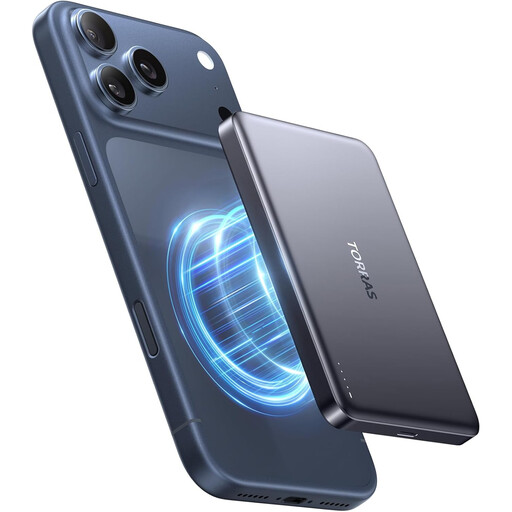
Why This Fits Their Persona: It suits iPhone users who prioritise a slim magnetic design for commuting, travel and one-handed use.
The listing separates wired output of up to 22.5W from wireless output, including 7.5W wireless charging for iPhone.
Magnetic attachment; USB-C wired charging; listed NTC temperature control and overcharge protection.
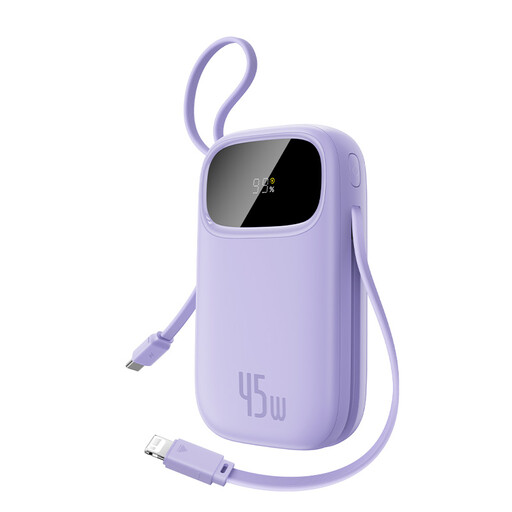
Why This Fits Their Persona: Its 45W USB-C output and multiple integrated cables are suitable for professionals, tablet users and travellers carrying several device types.
The listing specifies that 45W applies through USB-C with one device, while simultaneous charging reduces total output.
Digital percentage display; built-in USB-C and iPhone-compatible cables; up to four-device charging.
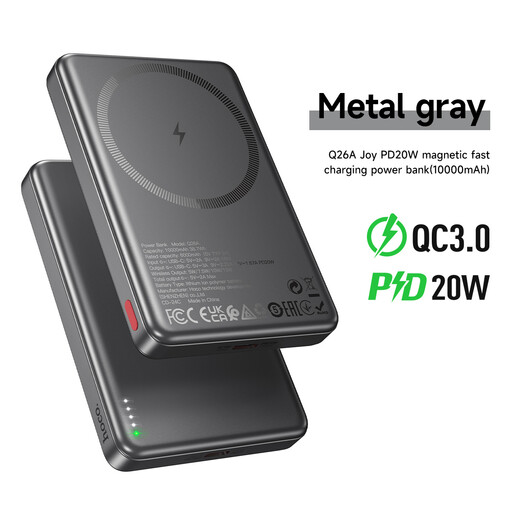
Why This Fits Their Persona: It matches iPhone users and Qi-device owners who want wireless charging alongside a wired connection for flexible daily use.
It states separate wired and wireless ratings, plus case, heat and foreign-object precautions for magnetic charging.
20W PD wired output; up to 15W wireless output for compatible Qi devices; four-LED battery display.
We have compiled a complete, real-time list of products that fully satisfy these strict selection criteria and UK safety regulations.
The number varies by phone battery size, conversion losses, charging temperature and the power bank’s rated capacity. As a general guide, it may provide around one to two useful smartphone charges, but this should not be treated as a guaranteed figure.
Power banks are normally carried in hand luggage, not checked baggage. A 10,000mAh model is commonly below the 100Wh limit used by many airlines, but policies differ. Check your airline’s latest lithium-battery requirements before departure.
No. The phone controls how much power it accepts. A 45W power bank can charge compatible devices quickly, but a phone limited to a lower input will not necessarily charge at 45W. Use a suitable cable and check compatibility with USB-C PD or the required charging standard.