
24/7 Customer Support

Free returns

Same-day & Next-day Delivery

Quality Guaranteed

Unlock Your Welcome Offers: FREE Delivery | Up to 80% OFF | Free 30-day JoyPlus trial
Download the APP
Carrying a separate charger for your laptop, phone and tablet is a familiar hassle for many professionals and frequent travellers. The tangle of cables and bulky power bricks can quickly clutter a bag or workspace. A powerful, compact 100W GaN charger offers a streamlined solution, capable of powering all your essential devices from a single wall socket.
As a Joybuy Product Recommendation Officer, my role is to help you navigate the options and find a charging solution that genuinely fits your needs. This guide will walk you through what to look for in a modern charger and present our top recommendations for 2026, focusing on performance, portability and versatility.
Before diving into specific products, it's useful to understand the key features that differentiate them. Keep these points in mind to make an informed decision.
A multi-port GaN charger with a 100W total output doesn't necessarily mean every port can deliver 100W simultaneously. The charger's internal chipset intelligently distributes power among the connected devices. For instance, when charging a laptop and a phone, it might allocate 65W to the laptop and 30W to the phone. Check the manufacturer's specifications to understand how power is shared, ensuring it can meet the demands of your primary device, such as a fast laptop charger for a MacBook Pro, even when other ports are in use.
The combination of ports is crucial. Most modern devices, including laptops and tablets, use USB-C with Power Delivery (PD). A charger with multiple USB-C ports offers the most future-proof versatility. Some models also include a USB-A port for legacy devices like smartwatches or wireless earbuds. Look for support for the latest standards like PD 3.0 and Programmable Power Supply (PPS), which allow for more efficient and optimised fast charging for compatible devices, particularly modern smartphones.
For those constantly on the move, a USB-C travel charger should be both lightweight and compact. Gallium Nitride (GaN) technology is what makes these powerful chargers significantly smaller than traditional silicon-based models. Also, consider what accessories are included. A good travel charger will often come with interchangeable plugs for different regions (EU, AU, etc.), making international trips much simpler. A compact wall charger with foldable prongs is another excellent feature for saving space and preventing damage in your bag.
Here are a few standout 100W GaN chargers that balance power, design and functionality for UK users.
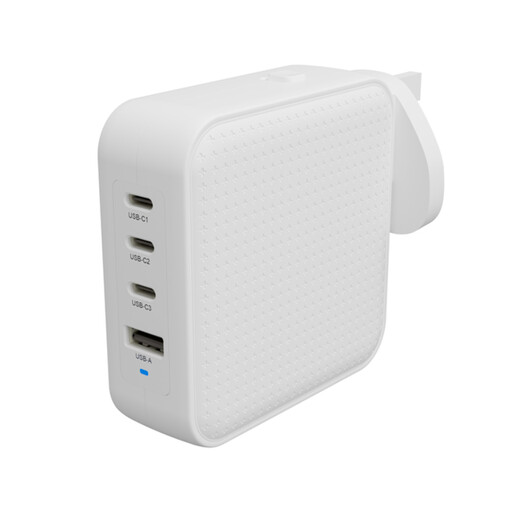
Why It Stands Out: The HyperJuice is a true all-in-one solution designed for the global traveller. Its standout feature is the combination of four ports (three USB-C, one USB-A) and a comprehensive set of included travel adapters (EU, UK, AU). This eliminates the need to carry any other charger or adapter on international trips. The included C8 desktop adapter is a clever addition, transforming it from a wall charger into a tidy desktop hub.
Pros:
Who is it for? Digital nomads, international business travellers and anyone who needs to power a full suite of devices without carrying multiple chargers and adapters.
View the Hyper HyperJuice 100W Charger
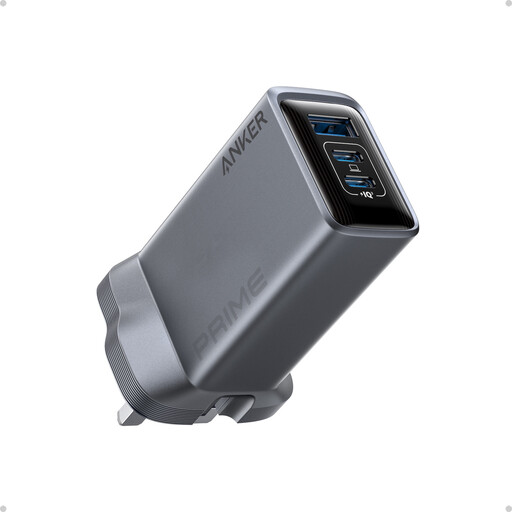
Why It Stands Out: Anker is a well-regarded name in charging, and this 100W PD charger demonstrates why. It focuses on delivering maximum power in a highly portable form factor. With two USB-C ports and one USB-A port, it can deliver a full 100W from a single USB-C port, making it an ideal MacBook Pro charger. The foldable prongs and compact design make it exceptionally easy to pack.
Pros:
Who is it for? Professionals and students who need to reliably fast-charge a high-performance laptop alongside a phone and another accessory and who prioritise a compact, pocketable design.
View the Anker Prime 100W Charger
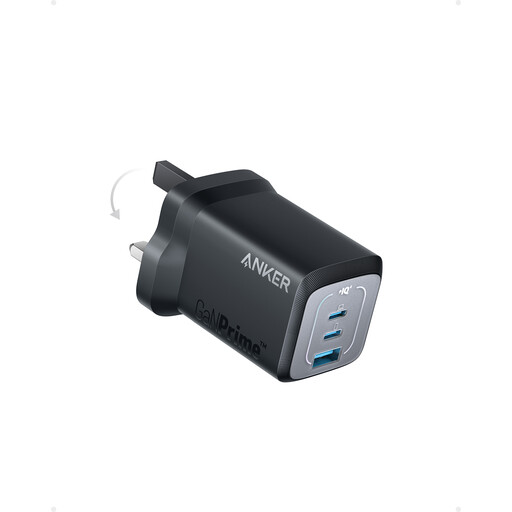
Why It Stands Out: Not everyone needs the full 100W of power. For users with less demanding laptops (like a MacBook Air) or those who prioritise an even smaller size, this 67W model is an excellent choice. It offers the same three-port configuration (two USB-C, one USB-A) and ActiveShield 2.0 safety system as its more powerful sibling but in a remarkably compact package—Anker states it is 51% smaller than an original 67W MacBook charger.
Pros:
Who is it for? Commuters, students and travellers whose primary device is a tablet or ultrabook, and who value maximum portability above all else.
View the Anker Prime 67W Charger
The chargers highlighted here represent some of the most versatile solutions available. However, the market offers a wide range of configurations, power levels and designs. If you have different requirements or want to explore more choices, you can browse our complete collection.
Explore Our Full Range of Multi-function Chargers
GaN stands for Gallium Nitride, a semiconductor material that is more efficient at conducting electricity than traditional silicon. In chargers, this means less energy is lost as heat. This higher efficiency allows manufacturers to build chargers that are significantly smaller, lighter and more powerful than their silicon-based counterparts, creating the compact wall charger form factor we see today.
No, a high-wattage charger will not damage your devices. Modern chargers and devices use protocols like USB Power Delivery (PD) to communicate. The charger will only supply the maximum amount of power that the device can safely handle. So, when you plug your smartphone into a 100W PD charger, it will negotiate and draw only the power it needs, for example, 25W, without any risk of damage.
Yes, to get the full 100W charging speed, you need a USB-C cable that is rated for 100W (or 5A). Standard USB-C cables are often rated for only 60W (3A). Using an underrated cable will not damage your devices, but it will limit the charging speed, preventing you from taking full advantage of your powerful new charger. Always check that your cable supports the wattage you need.