
24/7 Customer Support

Free returns

Same-day & Next-day Delivery

Quality Guaranteed

Unlock Your Welcome Offers: FREE Delivery | Up to 80% OFF | Free 30-day JoyPlus trial
Download the APP
Juggling a laptop brick, a phone plug and a tablet adapter has become a familiar frustration for professionals and travellers across the UK. The promise of a single, powerful 100W GaN travel charger is appealing, but the market is filled with options that often fail to deliver. Many buyers find themselves with a charger that can't power their laptop, overheats or isn't truly compatible with international travel.
As a Joybuy Product Recommendation Officer, my role is to help you navigate these choices. Before you invest in a new charging solution, be aware of these common pitfalls that lead to wasted money and continued frustration.
To ensure you get a charger that performs as expected, focus on these essential technical specifications.
A modern charger's intelligence lies in its communication protocols. Look for chargers that explicitly state support for Power Delivery (PD) 3.0 or the newer PD 3.1. This standard allows the charger to negotiate with your device to deliver the optimal voltage and current. For a fast charger for MacBook Pro or other high-performance laptops, a single port should be capable of delivering at least 90-100W.
Additionally, support for Programmable Power Supply (PPS) is a significant advantage. This extension of the PD standard allows for micro-adjustments in voltage, enabling faster and more efficient charging for compatible devices, particularly many modern Android smartphones.
The number and type of ports determine a charger's versatility. A capable multi port USB-C charger should offer at least two or three USB-C ports, as these are the modern standard for fast charging.
More importantly, verify how the charger handles smart power allocation. A quality 4-port PD charger will dynamically distribute its total wattage based on the needs of the connected devices. For example, when only your laptop is connected, it should receive the full 100W. When you add a phone, the power might intelligently split to 65W for the laptop and 30W for the phone, ensuring both charge efficiently. Avoid chargers that simply divide the power equally, as this compromises performance for high-demand devices.
For a charger to be a true travel companion, it must be both physically and electrically compatible with global standards.
Based on these practical criteria, here are several charging solutions matched to different user needs.
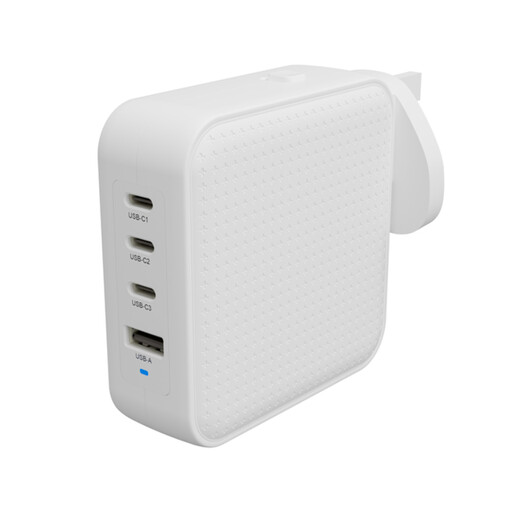
Why This Fits Their Persona: This charger is built for the person living out of a suitcase. Its compact, credit-card-sized form factor and included EU, UK and AU adapters mean it's ready for any destination without extra clutter. The three USB-C ports and one USB-A port cover every device from a laptop to a smartwatch.
It directly counters the "travel-ready deception" by including secure, interchangeable international plugs. Its smart power distribution ensures your primary device gets the power it needs, avoiding the shared wattage pitfall.
True All-in-One Design: Includes UK/EU/AU plugs and a C8 adapter for use as a desktop charging station.
High Power Density: Delivers 100W from a remarkably compact and lightweight body.
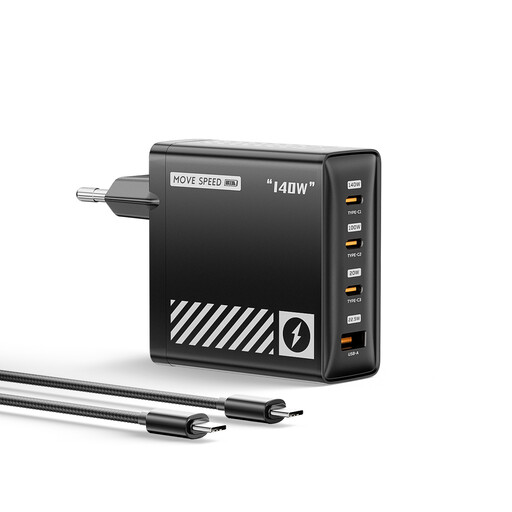
Why This Fits Their Persona: For the user with a high-performance 16-inch MacBook Pro, a tablet, phone and headphones, 100W might not be enough. This 140W charger offers maximum power, supporting the latest PD 3.1 standard to charge even the most demanding laptops at full speed while powering other devices.
This model demolishes the "shared wattage" pitfall by providing a massive 140W total output and intelligent allocation. It can sustain two laptops at 65W each simultaneously, a feat most 100W chargers cannot manage.
Future-Proof Power: Supports the PD 3.1 standard and 140W single-port output for next-generation laptops.
Advanced Thermal Management: Built with UL94 V-0 flame-retardant materials to prevent overheating and performance throttling.
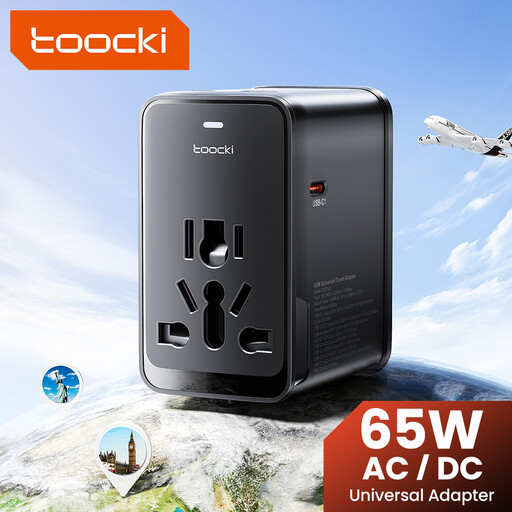
Why This Fits Their Persona: Not everyone needs 100W. For those with a MacBook Air, an iPad and a phone, 65W is ample power. This model combines a capable 65W GaN charger with a fully integrated international plug adapter system, offering maximum convenience in a single, cost-effective unit.
It provides a realistic power level for its target user and excels where many others fail: true, all-in-one global plug compatibility. The built-in sliders for EU, UK, US and AUS plugs are far superior to loose, easy-to-lose adapters.
Ultimate Portability: Combines a 4-port charger and a universal adapter into one compact device.
Sufficient Power: 65W is ideal for charging ultrabooks, tablets and phones simultaneously without paying for unneeded wattage.
We have compiled a complete, real-time list of products that fully satisfy these strict selection criteria and UK safety regulations.
Yes, it is completely safe. Modern chargers with Power Delivery (PD) technology are "smart." They communicate with the connected device to determine the maximum power it can safely handle and will only supply that amount. A 100W charger will not damage a phone that can only accept 20W; it will simply provide 20W.
No, the opposite is often true. GaN semiconductors are more efficient than traditional silicon, meaning they lose less energy as heat. Running cooler reduces stress on the internal components, which can contribute to a longer operational lifespan compared to older, hotter chargers.
Absolutely. Many high-power GaN chargers are designed with this dual purpose in mind. Their ability to power a laptop, tablet and phone from a single wall outlet makes them an excellent tool for decluttering a desk. Some models even come with an optional extension cord or stand to function as a more permanent desktop charging station.