
24/7 Customer Support

Free returns

Same-day & Next-day Delivery

Quality Guaranteed

Unlock Your Welcome Offers: FREE Delivery | Up to 80% OFF | Free 30-day JoyPlus trial
Download the APP
A separate charging lead is useful for electric vehicle and plug-in hybrid owners who regularly use untethered public chargers. However, choosing an 11kW 16A 3-phase EV charging cable is not simply a matter of selecting the longest or highest-rated option.
A cable may be incompatible with your vehicle, too short for a particular parking arrangement or rated for a charging speed your car cannot use. Marketing descriptions can also blur the difference between AC Type 2 charging and DC rapid charging. Before buying, check the connector type, your vehicle’s onboard charger and the cable’s construction.
Most UK and European electric cars use a Type 2 socket for AC charging. Vehicles with a CCS2 inlet use the upper Type 2 section for AC charging, while the lower DC contacts are used by a separate CCS2 rapid-charging connector.
A Type 2 to Type 2 charging cable is therefore suitable for compatible AC charge points. It is not a substitute for a tethered CCS2 DC cable and will not connect to J1772, CCS1 or CHAdeMO sockets. Always check both the vehicle inlet and the public charger before purchasing.
An 11kW cable does not make a vehicle charge at 11kW if its onboard charger is rated lower. Charging speed is limited by the least capable part of the system: the vehicle, charge point, supply or cable.
The GONEO 11kW version is specified for vehicles with an 11kW onboard charger, using 16A across three phases. According to the product information, it is not intended for 7kW charging. Drivers with a 6–7.68kW onboard charger should consider a suitable 7kW, 32A single-phase cable instead.
A short lead may be awkward when the charge point is positioned at the front or rear corner of a parking bay. Conversely, an unnecessarily long cable adds weight and takes more space in the boot.
For many UK public charging locations, 7 metres provides useful reach without the bulk associated with a 10m cable. Look for practical protection too, including a durable jacket, connector caps and a stated ingress rating. An IP rating describes resistance to dust and water under specified conditions; it does not mean the cable should be submerged or left in standing water.
An 11kW 3-phase Mode 3 electric vehicle charging cable normally carries up to 16A per phase. This makes it appropriate for compatible three-phase AC charging equipment and vehicles.
Mode 3 refers to charging through dedicated AC charging equipment, such as a wallbox or public charge point, rather than a domestic socket. Confirm the vehicle’s onboard charger specification in its handbook or manufacturer information before ordering.
The GONEO cable uses a Type 2 male connector for the charging station and a Type 2 female connector for the vehicle. This arrangement is common for untethered European-style AC charge points.
The listing states compatibility with Type 2 and CCS2 electric vehicles and plug-in hybrids, including examples such as Tesla, Audi, BMW, Mercedes, Volkswagen, Hyundai and Kia. It specifically excludes J1772, CCS1 and CHAdeMO connections, as well as certain older models. Vehicle compatibility should still be checked individually, particularly for imported cars.
For a frequently carried 7m electric car charging cable, construction affects everyday use. The GONEO 11kW model is listed with:
These are product specifications rather than a guarantee of performance in every situation. Inspect the cable regularly, avoid driving over it and keep the connectors clean and dry when not in use.
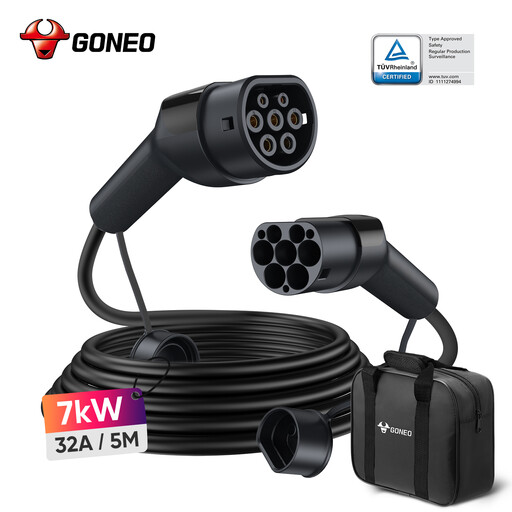
Why This Fits Their Persona: A practical option for drivers whose home charger or regular station allows close parking and whose vehicle uses single-phase AC charging.
The 5m length avoids paying for excess cable where a longer lead is unnecessary. Check your vehicle’s OBC before ordering.
7.2kW rating, 32A current specification, Type 2-to-Type 2 format and carry bag.
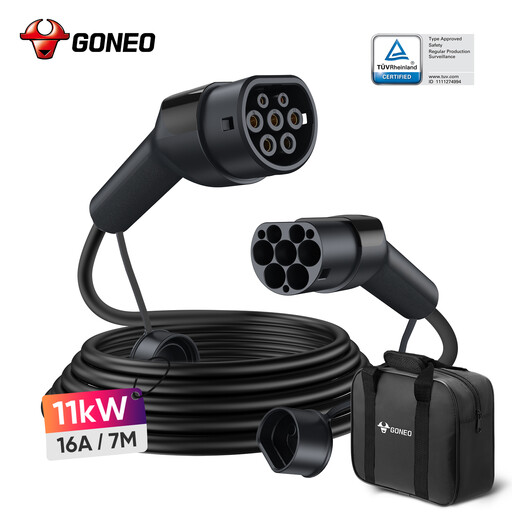
Why This Fits Their Persona: Suitable for drivers wanting a durable, flexible lead for UK public charge points, home wallboxes and variable parking positions.
The 7m reach helps reduce awkward parking adjustments, while the listed IP54 rating and protective cap address everyday outdoor handling.
11kW, 16A, three-phase specification; TÜV Rheinland safety certification is listed, alongside CE, UKCA, RoHS, ISO and IEC compliance information.
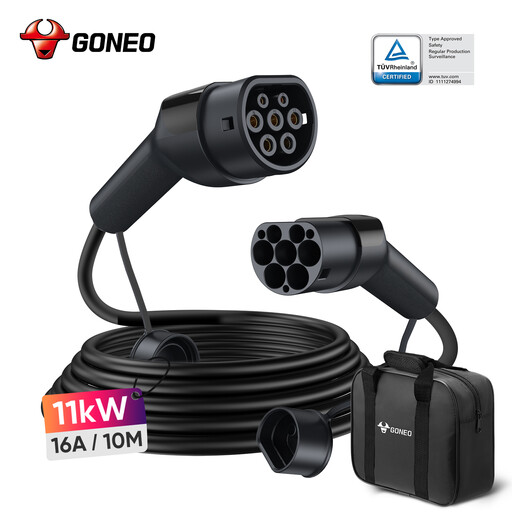
Why This Fits Their Persona: Designed for drivers who regularly encounter distant charge points, unusual bay layouts or difficult parking angles.
The extra length reduces dependence on precise parking, although it should be coiled loosely and stored securely to manage its added bulk.
11kW three-phase rating, 10m reach, TPU jacket, IP54 rating and carry bag.
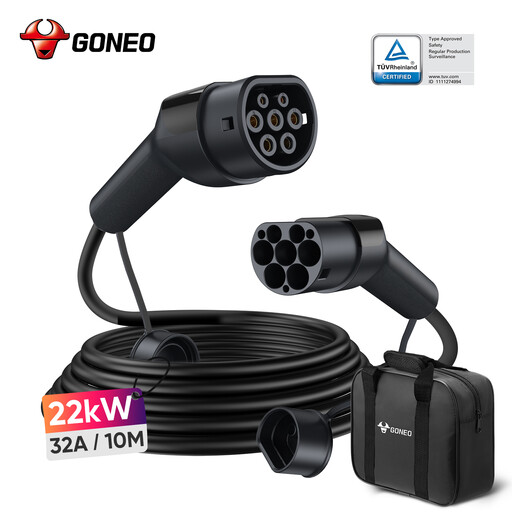
Why This Fits Their Persona: An option for compatible vehicles and three-phase charge points where a higher cable rating is useful for future charging arrangements.
It avoids buying an 11kW lead where the vehicle and charging setup specifically require a 22kW-rated cable. Confirm the vehicle OBC and charger output first.
22kW, 32A, three-phase specification, 10m length and the same listed TPU, IP54 and carry-bag features.
We have compiled a complete, real-time list of products that fully satisfy these strict selection criteria and UK safety regulations.
Check the cable and vehicle specifications before use. The referenced GONEO 11kW model is described for vehicles with an 11kW onboard charger and is stated not to support 7kW charging. A 7kW single-phase setup should use a cable specifically rated for that arrangement.
Lifespan depends on bending, storage, moisture, dirt and connector handling. A TPU jacket and stated bend rating can support regular use, but these figures are not a guarantee of service life. Replace the cable if the insulation, pins or handles show damage.
The cable itself does not set the electricity tariff. Running cost depends mainly on the energy added, the vehicle’s efficiency and the charge-point or home electricity rate. An appropriately rated cable can help you use compatible three-phase AC charging, but it cannot increase the vehicle’s onboard charging limit.