
24/7 全天候客户支持

免费退货

当日/次日达

品质保障

开启新人专享福利: 全场免邮 | 低至 2 折 | 免费试用 30 天 JoyPlus 会员
下载 Joybuy
A portable 12V car fridge freezer can make camping, long-distance driving and boat trips considerably easier. Unlike an insulated cool box, a compressor model can actively chill food and drinks, and selected units can also freeze contents without relying on ice.
However, product listings often focus on headline capacity or minimum temperature while leaving out practical details. Before buying a 12V compressor cooler box, check how it will connect to your vehicle, whether it protects the battery and whether its physical size suits your trip.
An 18-litre portable car refrigerator may suit drinks, packed lunches and short weekends, but it will not offer the same storage flexibility as a 49.4-litre dual-zone unit. Internal basket arrangements, compressor space and insulation can reduce the room available for larger containers.
Think about what you normally carry:
Some electric cool boxes provide cooling and warming but are not compressor freezers. A genuine 12V car freezer should state its cooling method and temperature range clearly. Compressor models such as the Alpicool C9PT and EUHOMY units listed below specify temperatures down to -20°C.
A thermoelectric mini car fridge may be useful for keeping pre-chilled drinks cool, but it should not be treated as an ice-free camping freezer box unless the listing explicitly confirms freezer operation.
A 12V camping fridge normally connects to a cigarette lighter or accessory socket. That socket may switch off when the ignition is off, which means the fridge will stop cooling unless the vehicle has a continuously powered outlet or you use a suitable auxiliary battery.
Compressor coolers also release heat. Allow the manufacturer’s recommended clearance around the ventilation area, keep the vents unobstructed and secure the unit so it cannot slide during sharp turns. For boats, caravans and campervans, check the installation position before purchase.
A compressor provides active cooling rather than depending on ambient temperature. For versatile travel use, look for a stated range such as -20°C to +20°C, allowing the unit to operate as either a refrigerator or freezer.
Fast-cooling claims should be read as indicative rather than guaranteed for every situation. Starting temperature, ambient heat, ventilation and how frequently the lid is opened all affect performance. Pre-chilling food and drinks can reduce the workload on the compressor.
Capacity is measured in litres, but dimensions and weight matter just as much. A compact 9-litre unit can fit on a passenger seat, while a larger RV refrigerator may need a boot, storage compartment or dedicated mounting position.
Also check:
A practical portable fridge with AC and DC power is suitable for both vehicle and home use. DC support may include 12V and 24V connections, which is useful for cars, campervans, lorries, buses and some boats. AC compatibility can help at a campsite with mains electricity or during home backup use.
A car fridge with battery protection should offer selectable protection levels. These settings help reduce the risk of excessive vehicle-battery discharge, but they are not a replacement for monitoring the battery or using a leisure battery for extended off-grid operation.
For products sold in the UK, check that the supplied power accessories are suitable for the intended socket and that the listing provides appropriate conformity and safety information. Do not connect a DC-only appliance directly to household mains.
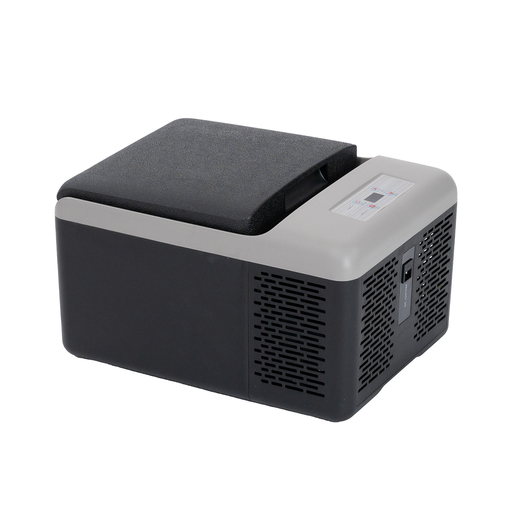
Why This Fits Their Persona: Its 9-litre format is suited to solo travellers, couples and drivers who need a compact freezer box without taking up much cabin space.
It uses compressor cooling and states operation down to -20°C, distinguishing it from cooling-and-warming electric cool boxes that may not freeze.
9-litre capacity, 6.7kg weight, three-level battery protection and temperature memory.
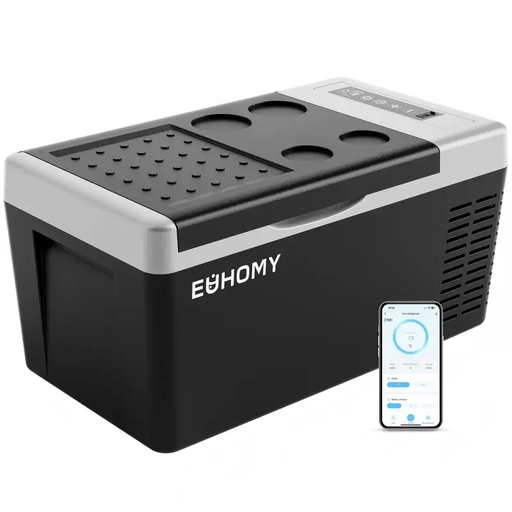
Why This Fits Their Persona: A balanced option for campers and road-trippers wanting freezer capability, app control and both household and vehicle power.
The listing identifies a compressor system, -20°C to +20°C range, 12/24V DC and 100–240V AC operation, plus three-stage battery protection.
18-litre capacity, Bluetooth app control, stated 42dB operating noise and magnetic lid seal.
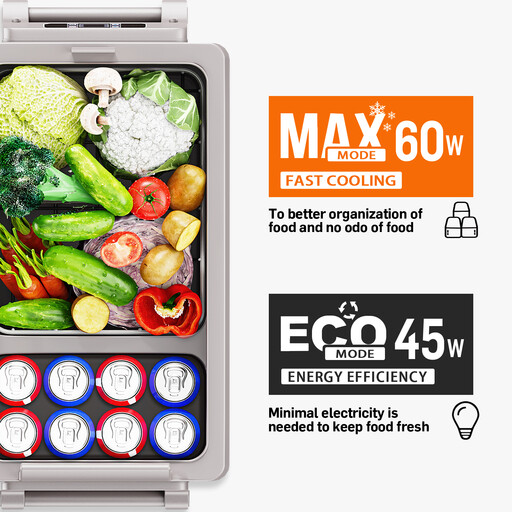
Why This Fits Their Persona: Its larger capacity is designed for families, caravanners, anglers, boat owners, truck drivers and extended trips requiring more provisions.
The dual storage layout helps separate chilled and frozen goods, while the specification identifies 12/24V DC and 240V AC compatibility.
49.4-litre capacity, two storage areas, LCD controls, Bluetooth app connection and three battery-protection levels.
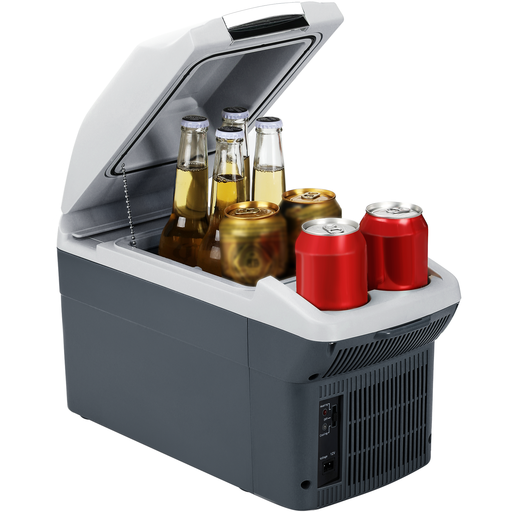
Why This Fits Their Persona: This compact unit is suited to day trips, commuting, lunches and passenger-seat use where freezer capacity is not essential.
Its listing clearly describes cooling and warming rather than freezer operation, helping buyers match expectations to the product type.
9-litre capacity, approximately 40dB noise, dual cup holders, carrying strap and 12V DC operation.
We have compiled a complete, real-time list of products that fully satisfy these strict selection criteria and UK safety regulations.
It can, provided the accessory socket remains powered and the battery has sufficient capacity. For overnight or multi-day use, an auxiliary leisure battery or suitable portable power station is generally more appropriate than relying on a standard starter battery. Use the fridge’s battery-protection setting and follow the vehicle manufacturer’s guidance.
Power use varies with ambient temperature, insulation, target temperature, ventilation and compressor cycling. The EUHOMY product information states average power consumption of approximately 45W for its listed models, but this is not necessarily continuous consumption. A cooler working as a freezer in warm weather may use more energy than one maintaining chilled drinks.
Yes, many models support 12V DC, while some also support 24V systems and household AC. Confirm the voltage, connector, available space and mounting requirements before installation. Keep ventilation clear, secure the unit against movement and avoid exposing the appliance or power connections to water.