
24/7 Customer Support

Free returns

Same-day & Next-day Delivery

Quality Guaranteed

Unlock Your Welcome Offers: FREE Delivery | Up to 80% OFF | Free 30-day JoyPlus trial
Download the APP
A 12V car power inverter can turn a vehicle battery into a practical source of mains-style electricity for laptops, chargers, small appliances and outdoor equipment. However, choosing by the largest wattage printed on the box can lead to poor performance, blown vehicle fuses or an inverter that is unsuitable for your intended device.
The main buying traps are easy to miss:
The continuous rating is the figure to use when matching an inverter to an appliance. A 300W car inverter is intended for devices whose total operating demand remains within 300W. Its peak or surge figure may briefly support a higher startup demand, but it is not a safe substitute for continuous capacity.
Motors, compressors and heating elements can draw more power when starting. A fridge, drill or coffee machine may therefore need more headroom than its normal running figure suggests. Add the wattage of all devices connected at the same time, including USB charging, and stay below the inverter’s continuous rating.
A 2000W power inverter is a different class of product from a plug-in car accessory. It normally requires direct connection to a suitable 12V battery using heavy-duty cables. Do not attempt to draw this level of power through a cigarette lighter socket.
A pure sine wave inverter produces a smooth alternating-current waveform that is closer to the electricity supplied by the mains. This can be a sensible choice for laptops, audio equipment, monitors, small refrigeration systems and other electronics that may behave unpredictably with modified sine wave output.
Modified sine wave models can be adequate for simple loads such as some lamps or basic chargers, but compatibility varies. Check the appliance manufacturer’s guidance rather than assuming that every 230V device will operate correctly.
For UK use, look for a clearly stated 12V to 230V inverter or 12V to 240V power inverter, together with a UK 3-pin plug or Type G socket. Product descriptions may use 220V, 230V or 240V terminology, so confirm the actual output specification before ordering.
Small vehicle power inverters commonly connect through a car cigarette lighter inverter plug. Check the vehicle socket rating and the inverter’s instructions. For example, the 300W BESTEK model specifies a socket rated for at least 15A, while another 300W pure sine wave model advises direct battery connection for AC loads above 150W.
For larger loads, use battery cables connected to the correct terminals. The engine may need to run during extended use to reduce the chance of flattening the starter battery. Keep the unit dry, ventilated and away from flammable materials.
Useful protection features include:
Always follow the supplied instructions and stop using the unit if the plug, cable or casing becomes excessively hot.
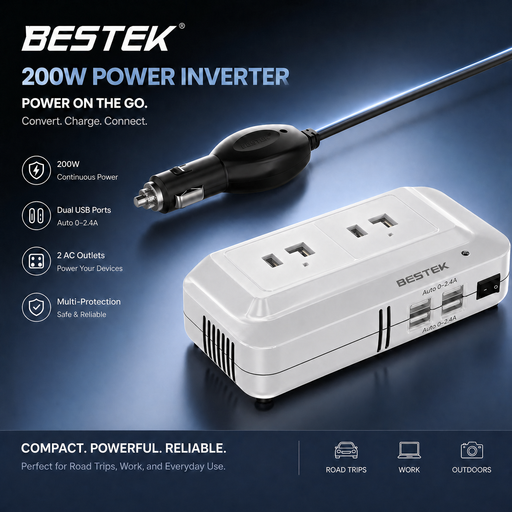
Why This Fits Their Persona: A compact option for students, commuters and occasional road-trippers who mainly need to charge personal electronics from a standard 12V socket.
Its stated 200W rated output is clearer than relying on a peak figure, while the dual AC outlets and 4 USB ports reduce the need for multiple adaptors.
165 × 82 × 40mm body; 230V output; up to 4.8A total USB output; built-in protection features.
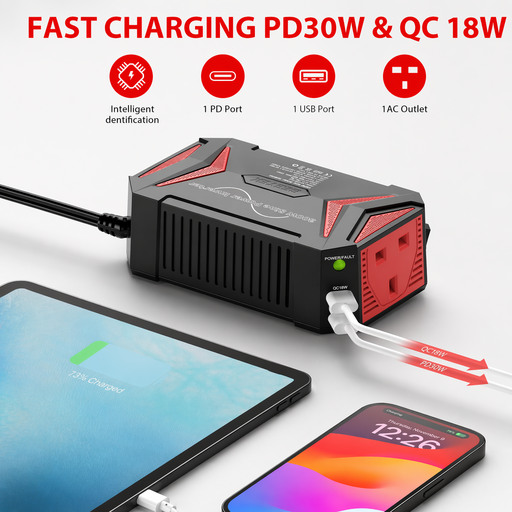
Why This Fits Their Persona: Suitable for drivers and campers wanting pure sine wave output alongside more capable charging ports for phones, tablets, cameras and compatible laptops.
The pure sine wave specification addresses waveform uncertainty, while the stated 300W continuous and 700W peak figures distinguish usable capacity from surge output.
PD Type-C output up to 20W and QC USB output up to 18W; 12V-only compatibility; automatic cooling fan.
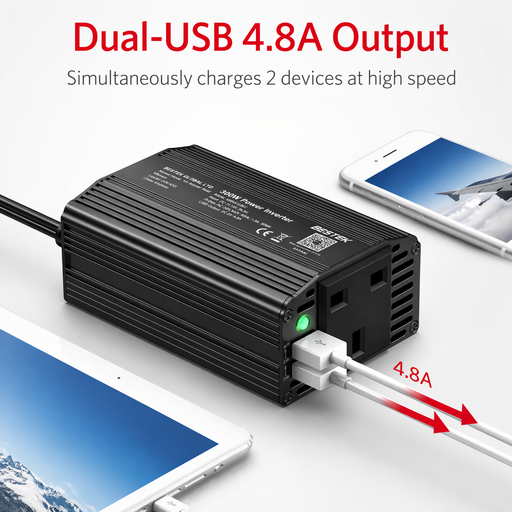
Why This Fits Their Persona: A straightforward choice for UK road trips, campsite charging and university move-in journeys where a familiar 3-pin socket is useful.
It states 300W continuous power and specifies a UK AC outlet, helping buyers avoid confusing a generic socket with a UK 3-pin connection.
Dual USB ports rated at 2.4A each; 24-inch cigarette-lighter cable; compact aluminium-alloy housing; automatic low-battery shutdown.
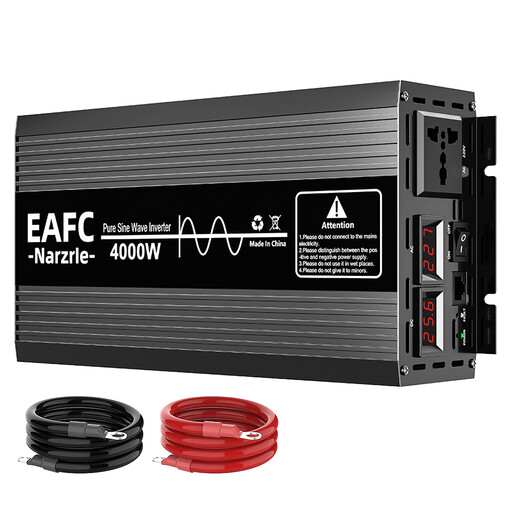
Why This Fits Their Persona: Designed for caravan, motorhome, truck, camping and outdoor-work users who need substantially more capacity than a plug-in vehicle inverter provides.
The listing separates 2000W rated power from 4000W peak power and specifies direct battery connection for loads exceeding 150W.
Pure sine wave output; dual digital voltage displays; temperature-controlled fans; protection against overload, overheating and reverse polarity.
We have compiled a complete, real-time list of products that fully satisfy these strict selection criteria and UK safety regulations.
A vehicle power inverter does not create energy; it converts energy from the battery and usually loses some power during the process. Higher loads therefore reduce battery voltage more quickly. For regular camping or emergency use, consider a leisure battery or a properly sized auxiliary battery rather than repeatedly draining a starter battery.
Before connecting equipment:
Not necessarily. The socket, fuse and wiring must support the required current. A 300W load at 12V can require considerably more than 25A after conversion losses, so some models recommend direct battery cables for higher loads. Follow the product instructions and your vehicle handbook.
It can be worthwhile when powering sensitive or higher-value electronics, audio equipment, laptops or devices with motors. For basic charging and simple loads, a lower-cost waveform may be sufficient, but compatibility should be checked before purchase.
Runtime depends on battery capacity, appliance wattage, battery condition, conversion losses and whether the engine is running. A higher-wattage appliance drains a battery faster. For extended use, calculate the expected load and use a suitable leisure-battery system with appropriate ventilation and charging support.