
24/7 Customer Support

Free returns

Same-day & Next-day Delivery

Quality Guaranteed

Unlock Your Welcome Offers: FREE Delivery | Up to 80% OFF | Free 30-day JoyPlus trial
Download the APP
A 12V kids’ electric ride-on car can make a memorable birthday or Christmas present, but choosing one based only on colour or a realistic badge can lead to disappointment. Parents and gift buyers in the UK should look beyond appearance and check the controls, battery details, seat dimensions and intended surface before ordering.
Marketing descriptions can also make similar cars appear very different. The practical differences usually come down to three areas: how much control adults have, whether the battery suits the expected playtime and whether the car fits the child and available space.
A licensed Lamborghini toy car may have authentic design details such as butterfly doors, a branded body shape or a recognisable colour scheme. However, licensing does not automatically indicate longer battery life, stronger motors or improved control.
Treat the Lamborghini styling as a design preference, then check the specifications separately. A Lamborghini ride-on car for kids should still be assessed for speed, maximum load, seat size, remote-control range and charging time.
Voltage is only one part of the specification. Motor arrangement, terrain, child weight and battery capacity all influence how the car feels in use. A 12V model may be suitable for flat paving, asphalt, cement or wooden surfaces, but it may struggle on grass, slopes or loose ground.
Also check the stated run time. The listed models provide approximately 45 minutes of use, although actual performance varies according to surface, load and driving style.
These toys are not small. Dimensions of roughly 105–108cm long and 60–62cm wide may affect garage storage, indoor use and access through gates or doors. Auxiliary wheels can make a switched-off car easier to move, but they do not remove the need for a suitable storage area.
Assembly is another practical consideration. Allow time to fit the bodywork, wheels and electrical components, then inspect the steering, seat belt and remote control before the first ride.
For children aged approximately three to five, a children’s electric car with remote control gives an adult the option to guide, stop or steer the car when necessary. Look for:
Remote controls commonly require separate batteries. For example, one listed model requires two AAA batteries, which are not included.
A typical specification in this category is a 12V 4.5Ah battery. Charging may take around 8–12 hours during regular use, while playtime is listed at about 45 minutes. This means the car is more practical for planned outdoor sessions than continuous all-day play.
To reduce battery wear:
The electricity used for one charge is generally modest, but the exact running cost depends on the battery, tariff and charging frequency. Replacement batteries and chargers should also be considered when comparing long-term value.
Many cars in this selection state a recommended age of 37–60 months, while the wider approved age range may extend further. Always prioritise the child’s height, weight and ability to follow instructions over the upper age number.
Check the maximum load carefully. The supplied listings state a 25kg weight capacity for the Lamborghini models. Seat dimensions also matter, particularly if the child is tall or likely to use the car for more than one season. A two-seater-style electric ride-on toy may look spacious, but it should not be treated as suitable for two children unless the manufacturer specifically says so.
For UK use, operate the car under adult supervision on a private, level surface away from roads, ponds, steps and traffic. Check the product information for relevant markings and standards, such as EN71 and EN62115, where provided. These references should be treated as product documentation details, not as a substitute for safe supervision.
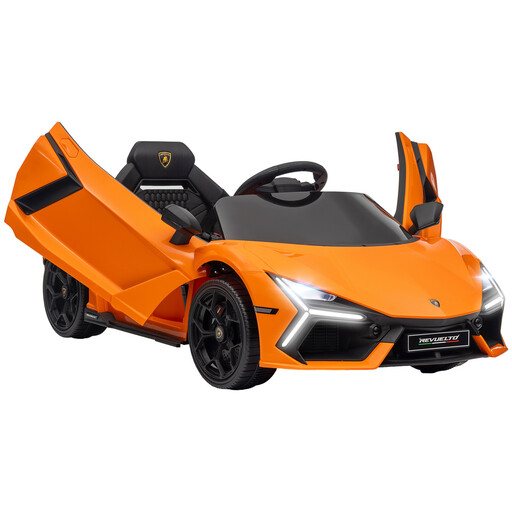
Why This Fits Their Persona: A straightforward option for families seeking a realistic orange ride-on car with adult control, entertainment features and a manageable 3–5km/h speed range.
It lists a slow-start function, remote control, safety belt and battery indicator rather than relying on styling alone.
Butterfly-opening doors, LED lights, music and a stated 25m remote distance.
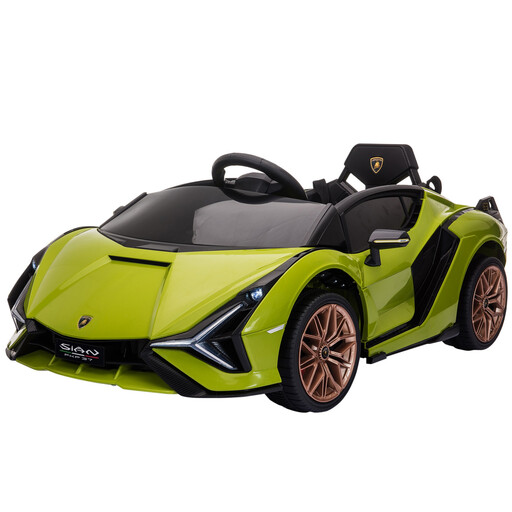
Why This Fits Their Persona: Suitable for buyers who place value on a fuller feature list and a green licensed design for supervised driveway or garden play.
The listing clearly provides battery, motor, charging, load and age information, helping buyers compare beyond the Lamborghini badge.
Dual 12V motors, USB and TF card inputs, working lights, taillights and auxiliary wheels.
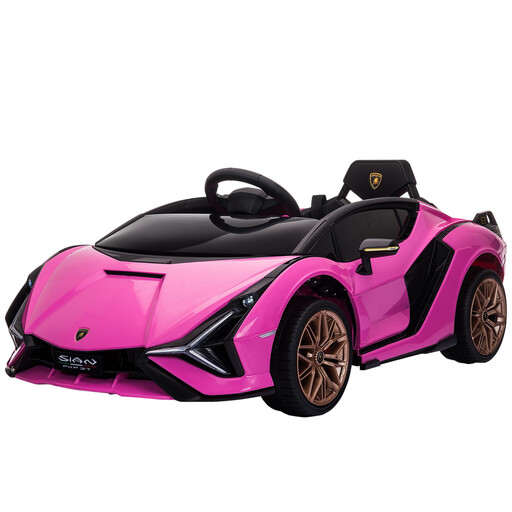
Why This Fits Their Persona: A practical match for families wanting repeated supervised play, built-in music and easy movement when the car is switched off.
The dual-control setup allows parents to guide the car, while the specified run time and charging details set realistic expectations.
12V dual motors, a seat belt, USB and TF inputs, plus a stated 45-minute run time depending on use.
If outdoor ride-on sessions need to be balanced with quieter activities, an 11-inch Android tablet can support streaming, learning apps and general family use. The DOOGEE U11 Pro tablet includes Android 15, a Unisoc T7200 octa-core processor, 256GB storage expandable up to 2TB, a 90Hz IPS display and Widevine L1 for compatible 1080p streaming.
Its 8,580mAh battery, 3.5mm headphone jack, face unlock and parental-control features make it a flexible household device. Check the DOOGEE U11 Pro Android tablet listing for the complete specification and safety information.
We have compiled a complete, real-time list of products that fully satisfy these strict selection criteria and UK safety regulations.
Many models are listed for children from around 37 months, with a recommended range of approximately 37–60 months. Check the individual product’s age, height and weight guidance, and supervise every journey.
The models above list around 45 minutes of run time, but terrain, child weight, speed and repeated stopping affect the result. Charging commonly takes 8–12 hours, so charging overnight may be convenient when permitted by the instructions.
Their size, turning circle, noise and speed make outdoor use on a private, level surface more practical. If using one indoors, measure doorways and available floor space first, remove obstacles and follow the manufacturer’s surface guidance.