
24/7 Customer Support

Free returns

Same-day & Next-day Delivery

Quality Guaranteed

Unlock Your Welcome Offers: FREE Delivery | Up to 80% OFF | Free 30-day JoyPlus trial
Download the APP
A 12V power inverter can turn a vehicle battery or standalone 12V battery system into usable AC electricity for laptops, chargers, small appliances and work equipment. However, choosing one by its headline wattage alone can lead to wasted money, blown fuses or equipment that will not operate properly.
For UK drivers, caravan owners, campers, van users and outdoor workers, the main buying traps are usually easy to overlook:
The right choice depends on what you intend to power, how long you need to run it and whether your vehicle has a 12V or 24V electrical system.
The continuous or rated wattage is the practical figure to use when matching an inverter to an appliance. Add together the running wattages of the devices you expect to use at the same time, then leave some headroom.
Motors, compressors, fridges, drills and some pumps can draw considerably more power when starting. This is where peak or surge wattage matters. For example, a 2000W-rated inverter with a 4000W peak rating may handle a brief start-up surge, but it should not be treated as a 4000W continuous unit.
For phone charging, cameras and laptops, a 150W to 300W car power inverter may be sufficient. Coffee makers, power tools and larger appliances require a substantially higher-rated 12V battery inverter, plus a suitable battery and direct connection.
A pure sine wave inverter produces a smoother AC waveform and is generally the more suitable option for sensitive electronics, audio equipment, laptops and appliances with motors or regulated power supplies. Modified-wave models can be adequate for simpler loads, but compatibility varies between devices.
UK mains equipment commonly uses a nominal voltage around 230V AC, while product listings may describe output as 220V, 230V or 240V. Check the appliance label and the inverter specification before purchase. Also confirm whether the outlet is a UK Type G socket or a universal socket.
A 12V to 230V inverter with a UK socket is convenient for domestic plugs. A 12V to 220V AC converter with a universal socket may accept plugs from different regions, but an adapter may still be needed for some devices.
Do not connect a high-output inverter to a cigarette lighter socket unless the vehicle manufacturer and inverter instructions confirm that the socket can safely support the load. The supplied 300W BESTEK model, for example, specifies a 12V accessory outlet rated for at least 15A and a maximum total load of 300W.
For higher loads, use the supplied heavy-duty cables or an appropriate direct-battery cable set. Confirm:
USB ports are useful for phones and tablets, but their output should be considered separately from the AC wattage. A USB car inverter may charge several smaller devices while its AC outlet powers a separate low-draw appliance.
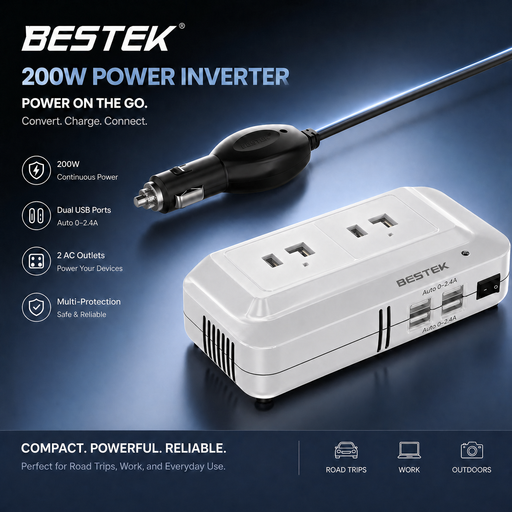
Why This Fits Their Persona: A compact option for commuters, occasional road trips and drivers who mainly need AC charging plus multiple USB connections.
Its 200W rated output is clearly defined, helping buyers avoid treating a short-term maximum as continuous capacity. It also includes over-voltage and low-voltage shutdown specifications.
Two AC outlets, four USB ports and a compact 165 × 82 × 40mm body support several low-power devices at once.
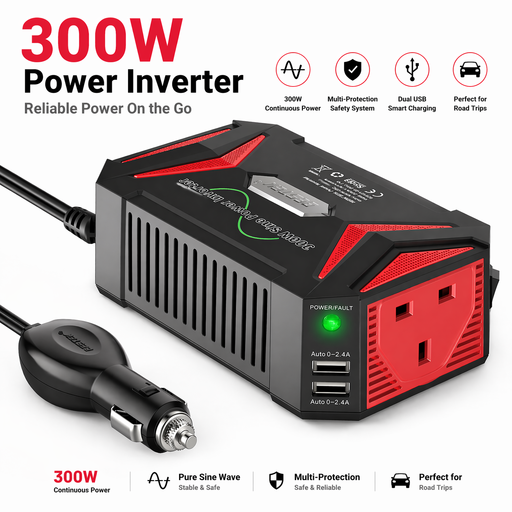
Why This Fits Their Persona: Suitable for drivers who want a compact pure sine wave model for laptops, TVs, game consoles and other low-power electronics.
The pure sine wave output addresses the waveform compatibility issue. Its specifications also state that loads above 150W should use a direct battery connection rather than a typical 12V port.
It provides 300W rated output, dual USB ports and built-in protection against overload, short circuit, low voltage and overheating.
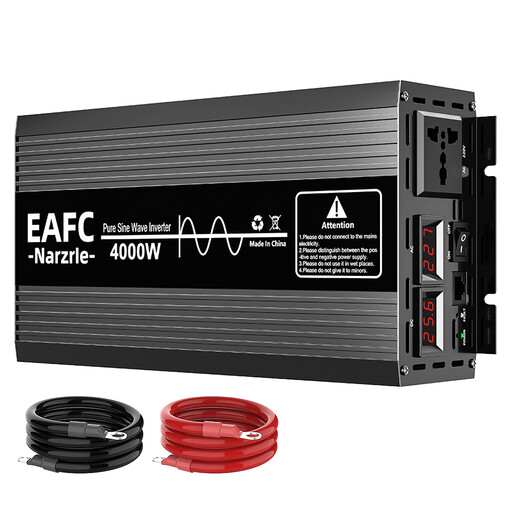
Why This Fits Their Persona: Intended for caravans, motorhomes, trucks, marine, camping and emergency backup use where higher continuous power is required.
The listing separates 2000W continuous capacity from 4000W peak capacity. It is designed for direct connection to a 12V battery for loads above 150W, rather than a cigarette-lighter socket.
Pure sine wave output, dual digital voltage displays, intelligent cooling fans and multiple protection functions support higher-load installations.
A 12V inverter does not create unlimited energy. Its input comes from the vehicle or leisure battery, and conversion losses mean the battery supplies more power than the appliance consumes. A 100W appliance running for two hours requires roughly 200Wh before allowing for conversion losses.
High loads can drain a starter battery quickly, particularly when the engine is switched off. For camping or off-grid use, a leisure battery, suitable battery monitor and correctly rated cables are more appropriate than relying on a car battery. Never operate an inverter in a wet area, cover its ventilation openings or use it near fuel and other flammable materials.
For simple charging, a portable car inverter with USB and one AC socket may be all that is required. For caravans, boats, work vans or emergency backup, compare battery capacity, installation requirements, cable length, cooling and protection features alongside wattage.
We have compiled a complete, real-time list of products that fully satisfy these strict selection criteria and UK safety regulations.
Only if the vehicle has a compatible 12V DC system and a suitable accessory socket or battery connection. Many cars, SUVs and vans use 12V systems, but some trucks use 24V. Check the vehicle handbook and inverter instructions before connecting.
This depends on battery capacity, appliance wattage, vehicle condition and inverter efficiency. Low-power charging may be practical for short periods, but high-power appliances can flatten a starter battery rapidly. Start the engine when the product instructions permit and avoid leaving the inverter connected while the vehicle is unattended.