
24/7 Customer Support

Free returns

Same-day & Next-day Delivery

Quality Guaranteed

Unlock Your Welcome Offers: FREE Delivery | Up to 80% OFF | Free 30-day JoyPlus trial
Download the APP
A 12V to 230V car power inverter can turn a vehicle’s 12V accessory socket into a practical source of mains-style power for laptops, cameras, game consoles and other small electronics. For UK drivers, campers, commuters and caravan owners, it can be a useful road trip power adapter—but only when the inverter’s output, socket rating and safety features match the equipment being used.
The main risk is buying based on a large wattage number alone. A product labelled “300W” may not be suitable for a 300W load through a cigarette lighter socket, while a compact unit with several USB ports may still lack the AC output required for a laptop charger. Use the following checks before choosing a car power inverter UK shoppers can rely on for everyday travel.
Many listings promote peak or surge output because it is a larger figure. This is the short burst a device may provide when starting. Continuous or rated wattage is the more useful measurement for normal operation.
For example, a 300W car inverter may state 700W peak power, but connected equipment should remain within the 300W continuous limit—and sometimes below the vehicle socket’s own fuse rating. Add the wattage of all connected devices rather than relying on the output of just one port.
A standard car, SUV, van or motorhome with a 12V accessory socket is generally the intended environment for these products. However, many larger commercial vehicles use 24V systems. Connecting a 12V DC to 230V AC inverter to a 24V supply can damage the unit and create a safety hazard.
Check the vehicle handbook and accessory socket rating before use. A plug-in model should not be used with a 24V truck unless an appropriate step-down system is installed.
A car cigarette lighter inverter with USB ports is convenient for phones and tablets, but USB output does not automatically mean fast charging. Check whether the unit provides USB-C PD, the maximum wattage and whether the stated output is shared between ports.
Likewise, an AC socket does not mean the inverter can run heaters, hair dryers, kettles or other high-load appliances. These products are designed mainly for small electronics and low-wattage equipment.
For light travel use, a 300W car inverter can provide useful capacity for a laptop, camera charger, lights or small entertainment devices. A 200W model may be more suitable when portability and lower demand matter.
The vehicle’s 12V socket is a separate limitation. Some sockets are fused around 10A to 15A, which can restrict practical output to approximately 120W–180W depending on the vehicle. Follow the inverter instructions and vehicle handbook. For higher continuous loads, a battery-clamp connection may be required if the model supports it.
A pure sine wave car inverter produces a smoother AC waveform and is generally the more compatible choice for sensitive electronics, including some laptops, monitors, audio equipment and game consoles. Modified sine wave models can cost less and may be adequate for basic chargers or simple equipment, but compatibility varies.
The words “pure sine wave” should be supported by clear specifications rather than used as a decorative marketing phrase. Also check the stated output voltage and frequency. UK mains equipment is typically designed around approximately 230V and 50Hz, although some product listings describe the output as 220V–240V.
For phones, tablets and newer laptops, compare:
A cooling fan may become audible under load. This is preferable to blocking ventilation and allowing heat to build up. Never place the unit under clothing, cushions or luggage while operating.
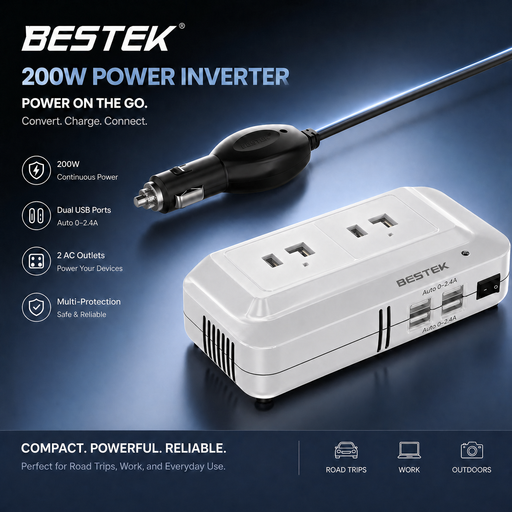
Why This Fits Their Persona: A practical choice for commuters, students moving into accommodation and drivers who mainly need to charge phones, tablets and a laptop during journeys.
Its 200W rated output is clearly specified, helping buyers avoid confusing a high peak figure with everyday capacity.
Two AC outlets, four USB ports, a 73cm cable and a compact 165 × 82 × 40mm body.
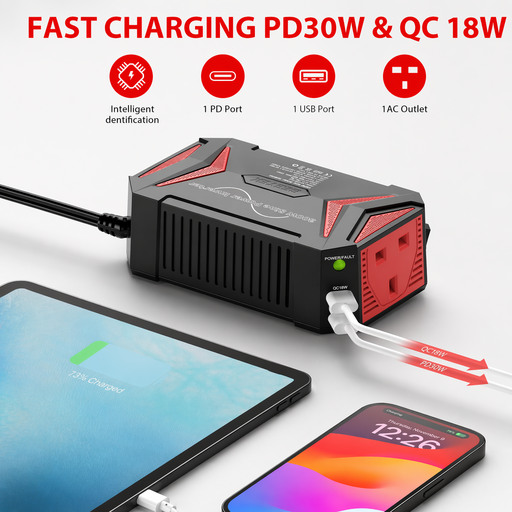
Why This Fits Their Persona: Suited to users who want smoother AC output for computers, cameras and other sensitive small electronics on longer trips or outdoor working days.
The listing identifies pure sine wave output and includes overload, low-voltage, over-temperature and short-circuit protection.
300W rated output, one AC outlet, dual USB ports and a 40A fuse. The USB output is listed at up to 4.8A total.
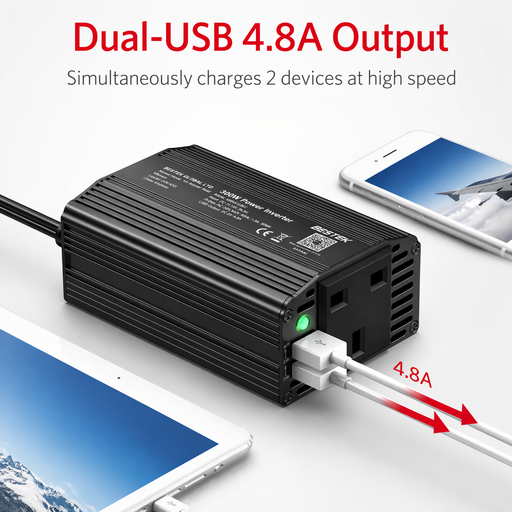
Why This Fits Their Persona: Useful for UK road trips, campsites and university moves where a familiar Type G socket and USB charging are convenient.
The specifications state a 300W continuous limit and warn against exceeding the vehicle socket’s rating.
UK 3-pin AC outlet, dual USB ports, 24-inch cable and stated protection against short circuits, overload, overheating and low voltage.
Place the inverter on a hard, ventilated surface and insert the plug firmly into the 12V socket. Keep the total connected load within the rated output. For extended use, run the vehicle engine where the manufacturer advises, but never operate a vehicle in an enclosed garage or poorly ventilated space.
An inverter does not create free electricity. It draws energy from the vehicle battery and conversion losses mean the battery supplies more power than the device receives. A 100W laptop load can therefore consume more than 100W from the 12V system. Switch the unit off when the engine is stopped unless the vehicle’s battery capacity and usage time have been assessed.
For additional charging flexibility, consider a USB-C PD car inverter or a model with several USB ports. If you only need phone charging, a direct USB car charger may use less energy than converting 12V to AC and then using a mains charger.
We have compiled a complete, real-time list of products that fully satisfy these strict selection criteria and UK safety regulations.
Only use it with a confirmed 12V vehicle system and a compatible accessory socket. Check the socket fuse rating and the inverter’s instructions. It is not suitable for a 24V truck unless used with a properly rated converter.
Runtime depends on battery capacity, engine status, connected wattage, vehicle condition and inverter efficiency. Higher loads drain the battery more quickly. For continuous use, follow the manufacturer’s guidance about keeping the engine running and avoid leaving the inverter powered while the vehicle is unattended.
It can be worthwhile when powering sensitive electronics or equipment that may respond poorly to modified sine wave output. For basic phone chargers and simple low-power devices, a modified sine wave model may be sufficient, but always check device compatibility before purchase.