
24/7 Customer Support

Free returns

Same-day & Next-day Delivery

Quality Guaranteed

Unlock Your Welcome Offers: FREE Delivery | Up to 80% OFF | Free 30-day JoyPlus trial
Download the APP
A 12V to 230V car power inverter can turn a vehicle’s accessory socket into a practical power source for laptops, phones, cameras, small televisions and other low-wattage electronics. However, choosing by the largest number on the packaging can lead to poor performance, blown fuses or an inverter that is unsuitable for your vehicle.
For UK drivers, commuters, campers, caravan owners and outdoor workers, three buying traps deserve particular attention.
A product advertised as a “4000W inverter” may have a much lower continuous rating. Peak or surge wattage normally refers to the short burst available when some appliances start. The continuous rating is the figure to compare with the device you intend to run.
For example, an inverter rated at 2000W continuous and 4000W peak is designed differently from a 300W car inverter, even though both may display a larger peak number. A laptop charger may use relatively little power, while a mini fridge, coffee machine or power tool can demand considerably more, especially during start-up.
Many cigarette lighter-style sockets are fused around 10A to 15A. At 12V, a 15A circuit provides approximately 180W before conversion losses, so a high-output inverter connected through the socket may not reach its headline rating.
Some 300W models advise using battery clamps for higher continuous loads, while compact units are intended for modest devices. Check your vehicle handbook, socket fuse rating and the inverter’s instructions. Do not replace a fuse with a higher-rated one simply to run a larger load.
A modified sine wave output can be adequate for some basic loads, but certain chargers, audio equipment, TVs and other sensitive electronics may operate more smoothly with a pure sine wave car inverter. Pure sine wave output more closely follows mains-style AC, although it does not remove the need to stay within the inverter’s wattage limit.
Also check the socket design. A UK 3-pin power inverter with a Type G outlet is convenient for UK plugs, while a universal socket may accept plugs from several regions but may require closer checking for secure fit and earthing arrangements.
Add the wattage printed on each device you plan to use. Chargers usually show input wattage on their label, but motors and compressors can draw more during start-up. Leave a sensible margin rather than operating at the inverter’s stated limit continuously.
A compact 12V DC to 230V AC inverter is generally suited to electronics and smaller accessories. Higher-power equipment may need a direct battery connection, thicker cables and suitable ventilation. A 12V accessory socket is not automatically suitable for running heaters, hair dryers or kettles.
Confirm that the inverter is for a 12V vehicle system. Cars, SUVs, many vans, caravans and motorhomes use 12V systems, while some trucks use 24V. Connecting a 12V inverter to a 24V vehicle can damage the unit and connected equipment.
Look for protections including low-voltage shutdown, over-voltage protection, overload protection, short-circuit protection and thermal protection. Automatic low-battery shutdown can help reduce the risk of completely flattening the vehicle battery, but it is still wise to run higher loads with the engine operating and to monitor battery condition.
USB ports are useful for phones, tablets, cameras and navigation equipment without occupying the AC socket. If fast charging matters, check whether the unit includes USB-C Power Delivery or another compatible charging standard rather than assuming every USB outlet supports it.
Fans, aluminium housings and adequate airflow can help manage heat. Keep a portable car power adapter away from loose clothing, luggage and direct heat, and avoid covering its vents. A compact inverter may fit neatly in a glove box, but it should be moved into an open, stable position while operating.
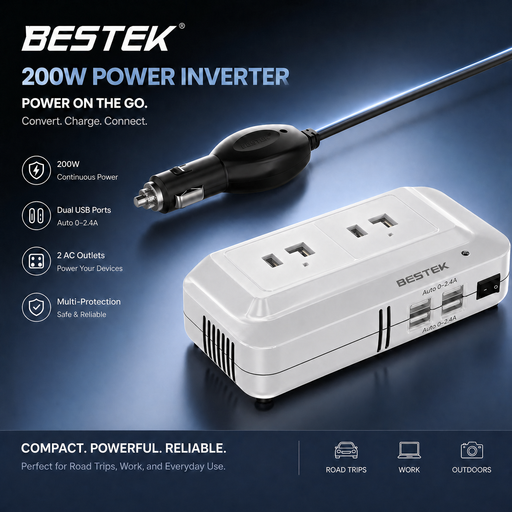
Why This Fits Their Persona: A sensible option for commuters, students moving into accommodation and drivers who mainly need charging for phones, tablets, cameras or a laptop accessory.
Its 200W rated output makes the intended load easier to judge than a product marketed mainly around peak wattage. It is designed for 12V sockets and includes protective shutdown functions.
Two AC outlets, four USB ports and a compact 165 × 82 × 40mm body support several small devices at once.
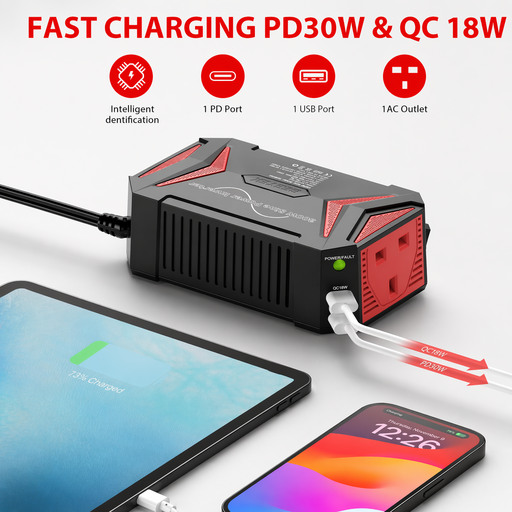
Why This Fits Their Persona: Suitable for users who want smoother AC output and modern charging connections for laptops, cameras, consoles and mobile devices during travel or outdoor work.
The pure sine wave output addresses waveform concerns, while the 300W continuous rating remains clearly separate from its 700W peak figure. It is for 12V systems only.
Includes one AC outlet, PD30W Type-C, QC3.0 USB and an automatic cooling fan.
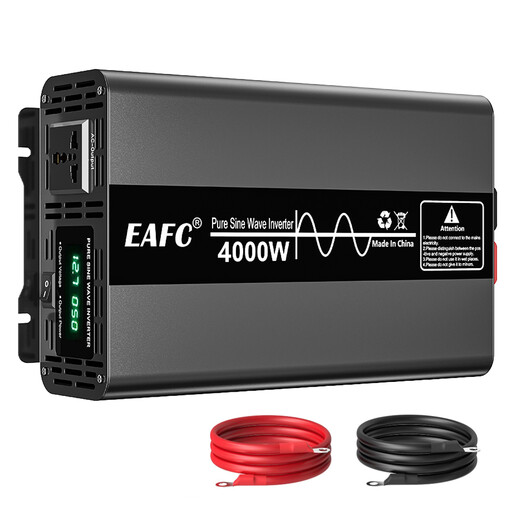
Why This Fits Their Persona: Intended for caravan and motorhome owners, 12V work vehicles, camping setups and emergency backup applications requiring substantially more power than an accessory socket normally supplies.
The specification separates 2000W rated output from 4000W peak capacity. It also lists low-voltage, overload, thermal, short-circuit and reverse-polarity protection; installation should use an appropriate battery connection.
Pure sine wave output, dual cooling fans and a universal socket suit varied RV, truck and camping equipment.
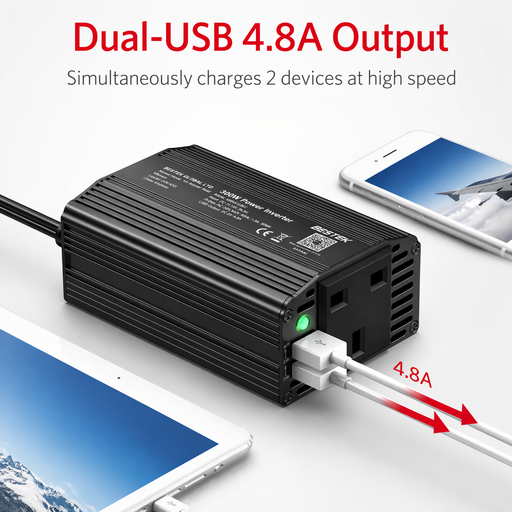
Why This Fits Their Persona: A practical match for UK road trips, university move-ins and campsite use where a familiar three-pin socket and compact storage are priorities.
The UK Type G outlet reduces the need for plug adapters, while the 300W continuous limit makes load planning straightforward. It is compatible with standard 12V outlets rated for at least 15A.
A 24-inch cable, dual 2.4A USB ports, aluminium housing and automatic low-battery shutdown support portable use.
We have compiled a complete, real-time list of products that fully satisfy these strict selection criteria and UK safety regulations.
Usually, yes, provided the laptop charger’s input wattage is below the inverter’s continuous rating. A pure sine wave model may be preferable for sensitive electronics. Check the charger label and allow additional capacity rather than choosing an inverter that operates at its limit.
Yes. The inverter draws power whenever it is switched on, including some standby consumption when little is connected. Extended use with the engine off can prevent the vehicle from starting. For camping or emergency backup, a separate leisure battery or power station may be more suitable.
Lifespan depends on load, heat, ventilation, connection quality and frequency of use. Keeping the total wattage within the continuous rating, avoiding moisture and ensuring the cooling fan can operate freely can support reliable service. Inspect cables, plugs and fuses regularly and stop using the unit if it becomes unusually hot or shows damage.