
24/7 Customer Support

Free returns

Same-day & Next-day Delivery

Quality Guaranteed

Unlock Your Welcome Offers: FREE Delivery | Up to 80% OFF | Free 30-day JoyPlus trial
Download the APP
A 12V to 230V car power inverter can turn a vehicle’s battery supply into mains-style AC power for laptops, chargers, small appliances and work equipment. However, choosing by the largest wattage printed on the box can lead to overheating, blown fuses or an inverter that cannot run the device you actually need.
Before buying a car inverter, check three common marketing traps:
The right choice depends on your vehicle, connected devices and how long you intend to run them.
Add the running wattage of every AC appliance and USB device you plan to connect. Choose an inverter with continuous output above that total, while allowing extra capacity for startup surges.
For example, a 300W car inverter may suit phones, tablets, cameras, a laptop charger, a games console or a small television. It is not intended for high-draw appliances such as kettles, fan heaters, hairdryers or cooking equipment.
A larger vehicle power inverter connected directly to a suitable 12V battery can support more demanding loads. The EAFC model listed below provides 2000W rated output and 4000W peak output, but it requires direct battery connection for higher loads rather than a cigarette lighter socket.
A car cigarette lighter inverter is convenient because it is plug-and-play. Nevertheless, the socket, plug and vehicle fuse must support the expected current. Never assume that a 300W rating means your dashboard socket can safely deliver 300W continuously.
For heavier use, use the supplied cables to connect the inverter directly to the battery terminals, following the manufacturer’s instructions. Confirm that your vehicle uses a 12V DC system. Standard cars, vans, SUVs and many motorhomes do, but some commercial vehicles and trucks use 24V. A 12V DC to AC converter designed for 12V should not be connected to a 24V system unless an appropriate conversion arrangement is used.
A pure sine wave inverter produces a smoother AC waveform than a modified sine wave model. This can be a sensible choice for laptops, televisions, battery chargers, motors and other equipment that may be more sensitive to power quality.
Also look for practical features such as:
The stated AC output may appear as 220V, 230V or 240V in product specifications. UK household supply is nominally 230V, so check the socket type and appliance compatibility rather than focusing only on the number.
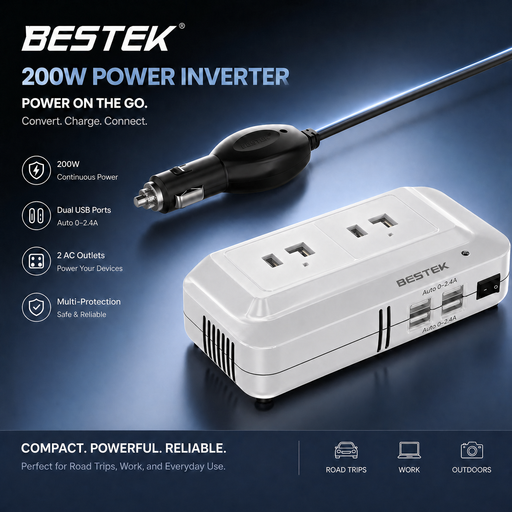
Why This Fits Their Persona: A practical option for students, commuters and occasional road-trip users who mainly need charging for several small devices from a standard 12V socket.
Its stated 200W rated output makes the capacity clearer than relying on an inflated peak figure. It is still important to keep the combined load within the vehicle socket’s rating.
Two AC outlets, four USB ports, a 4.8A maximum USB output and a compact 165 × 82 × 40mm body.
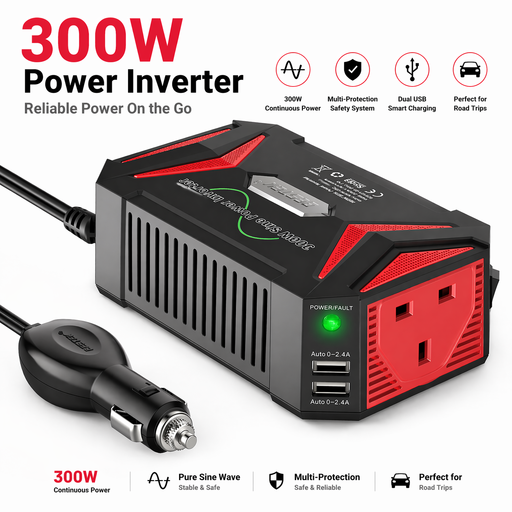
Why This Fits Their Persona: Suitable for drivers carrying laptops, camera chargers, televisions or games consoles who prefer a pure sine wave output in a compact format.
The product specification identifies 300W rated output separately from its 700W peak figure. It also states that loads above 150W should use battery-clamp connection rather than a 12V socket.
Pure sine wave AC output, dual USB ports rated at up to 4.8A total and a small design for cars, boats and limited storage.
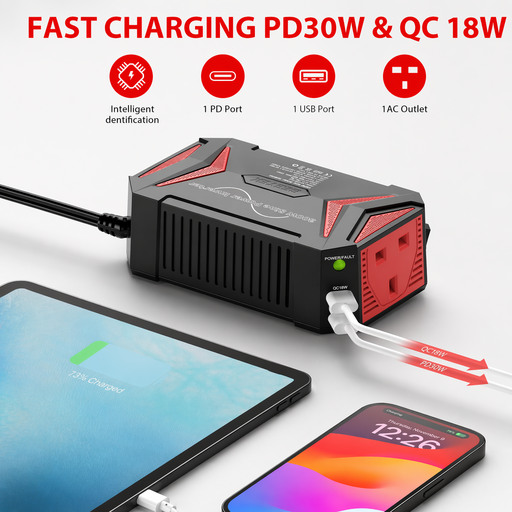
Why This Fits Their Persona: A useful match for road-trip travellers, university students and outdoor workers carrying USB-C phones, tablets, cameras and other portable electronics.
It lists 300W continuous output and separately identifies the USB charging ratings, helping prevent confusion between AC wattage and fast-charging output.
Pure sine wave output, a USB-C PD port listed at up to 20W, QC USB charging and automatic fan operation.
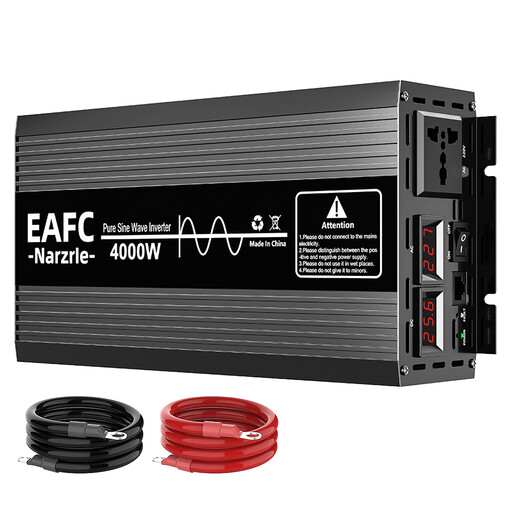
Why This Fits Their Persona: Designed around direct-battery use for motorhome owners, van users, campers, outdoor workers and emergency power backup scenarios requiring substantially more output.
The specification distinguishes 2000W continuous output from 4000W peak output and clearly requires direct battery connection for loads above 150W.
Pure sine wave output, dual digital voltage displays, dual temperature-controlled fans and multiple protection functions.
Use the inverter only with the voltage system specified by the manufacturer. Keep vents clear, place the unit on a dry stable surface and avoid covering it with clothing or bedding. Start the vehicle before using higher loads, but never leave the engine running in an enclosed garage or poorly ventilated area.
Do not exceed the inverter’s continuous rating or the vehicle socket’s fuse rating. If the plug, cable or housing becomes unusually hot, disconnect the load and investigate. A protection shutdown can indicate overload, low battery voltage, poor ventilation or an unsuitable connection.
For more choices, compare USB car inverter models, portable power inverter options and larger motorhome power inverter systems in the wider inverter 12v to 240v category.
We have compiled a complete, real-time list of products that fully satisfy these strict selection criteria and UK safety regulations.
Only if the appliance’s running and startup wattage are within both the inverter’s rating and the vehicle socket’s permitted load. A small charger may be suitable, while a kettle, heater or hairdryer generally requires more power than a cigarette lighter circuit can safely provide.
Yes. The inverter draws energy from the 12V battery, and higher-wattage devices drain it more quickly. Use high loads with the engine running, monitor voltage where possible and switch the inverter off when it is not needed. Avoid leaving it connected overnight unless you have a suitable auxiliary battery system.
It can be worthwhile when powering sensitive electronics, chargers, motors or equipment that needs a smoother AC supply. For simple low-power charging, a basic car inverter may be sufficient. Match the waveform and wattage to the devices rather than paying for specifications you will not use.