
24/7 全天候客户支持

免费退货

当日/次日达

品质保障

开启新人专享福利: 全场免邮 | 低至 2 折 | 免费试用 30 天 JoyPlus 会员
下载 Joybuy
As a Joybuy Product Recommendation Officer, I see many DIY enthusiasts and woodworkers in the UK looking for the right tools. A good 150mm ratchet bar clamp is a workshop staple, perfect for everything from furniture assembly to intricate craft projects. However, the market is filled with options that look similar but perform very differently. Choosing the wrong one can lead to frustration, damaged work and wasted money.
This guide cuts through the marketing jargon to help you identify the key features of a dependable clamp. We will look at the common pitfalls to avoid and the essential specifications to check before you buy, ensuring your next project is held together securely.
Many clamps fail to deliver on their promises. Before you add one to your basket, be aware of these three common issues that can render a tool useless.
To ensure you get a tool that performs reliably, focus on these three non-negotiable parameters. These details separate a dependable workhorse from a workshop disappointment.
Clamping force, often measured in kilograms (kg), tells you how much pressure the clamp can apply. For most woodworking and DIY tasks, a clamp offering around 68 kg of force is a versatile sweet spot. It's strong enough for glue-ups without being overkill for smaller jobs. Throat depth is just as important; it measures the distance from the bar to the centre of the jaw pad. A deeper throat (e.g., 62 mm) allows you to clamp further in from the edge of your workpiece.
A quality one-handed wood clamp should have a bar made from heat-treated steel. This process hardens the metal, preventing it from bending under load. An "I-beam" profile adds further rigidity. The mechanism for a quick release bar clamp should be smooth and intuitive. Look for a design with a distinct trigger for tightening and a separate, easily accessible button for releasing the jaw. This allows for genuine one-handed operation, freeing up your other hand to position the workpiece.
Many modern ratchet bar clamps offer a dual function, converting from a clamp to a spreader. This is an incredibly useful feature, turning one tool into two. A good clamp and spreader set allows you to quickly reverse the fixed jaw to push components apart, which is ideal for tasks like disassembling furniture or creating tension in a frame. Always check if this conversion is tool-free and simple to perform.
Based on these practical criteria, here are some recommendations matched to different user needs.
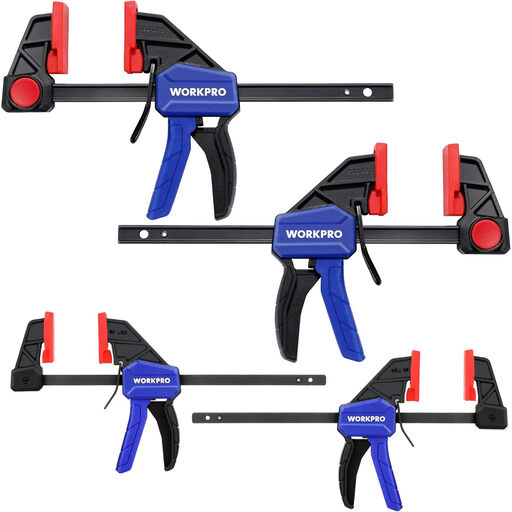
Why This Fits Their Persona: This set is ideal for someone building their first toolkit. It provides four clamps in two of the most useful sizes for small-scale DIY and craft projects, offering excellent value without a large initial outlay.
The reinforced nylon body and heat-treated steel bar offer better durability than entry-level generic clamps. The soft TPU jaw pads prevent the common pitfall of marring your workpiece.
Provides a versatile starter kit with two 150 mm clamps (68 kg force) and two 120 mm clamps (23 kg force). Features one-handed operation and a quick-release trigger.
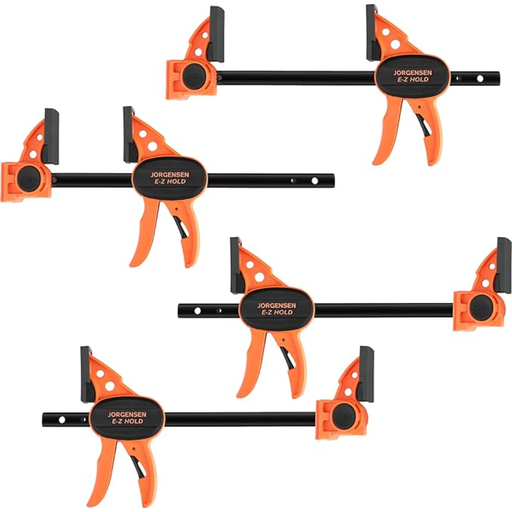
Why This Fits Their Persona: This user appreciates clever design and multi-functionality. The unique ability to join two clamps together solves the problem of needing a long clamp for occasional projects without having to buy and store a large, cumbersome tool.
This clamp's patented expandable design is a genuinely useful innovation, not a gimmick. It provides a practical solution, avoiding the trap of buying single-purpose tools that gather dust.
Its patented design allows two 150 mm clamps to be joined to create a 400 mm clamp. It also functions as a 290 mm spreader and delivers a reliable 68 kg of force.
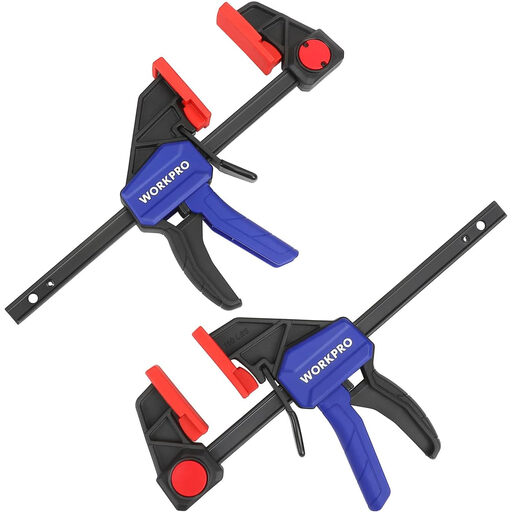
Why This Fits Their Persona: This user needs a reliable, no-fuss tool for consistent performance. This 2-pack of dedicated 150 mm clamps provides the solid clamping force and durability needed for frequent woodworking tasks like cabinet assembly and glue-ups.
It directly counters the pitfalls of weak force and poor durability. The 68 kg load limit is dependable, and the heat-treated steel bar and reinforced nylon body are built for repeated use.
Delivers a solid 68 kg clamping force with a 62 mm jaw depth. The dual-function design easily converts to a 285 mm spreader, adding valuable versatility.
For general DIY and light clamps for woodworking, such as holding pieces for screwing or small glue-ups, a force of 60-70 kg is typically sufficient. This provides a secure hold without being excessive. For heavy-duty structural joinery, you might consider more powerful F-clamps or parallel clamps which can apply greater pressure.
Yes, many modern designs function as a clamp and spreader set. This is achieved via a reversible jaw. On most models, you simply press a release button, slide the fixed jaw off the bar and reposition it on the opposite end. It's a valuable feature, so always check the product description to confirm if it's included.
The primary difference is the tightening mechanism. A 150mm ratchet bar clamp (roughly 6 inches) uses a trigger handle for quick, one-handed wood clamp operation. A traditional 6-inch F-clamp uses a screw handle that you turn to apply pressure. While F-clamps can often generate higher force, they require two hands to operate and are slower to adjust.