
24/7 Customer Support

Free returns

Same-day & Next-day Delivery

Quality Guaranteed

Unlock Your Welcome Offers: FREE Delivery | Up to 80% OFF | Free 30-day JoyPlus trial
Download the APP
As a Joybuy Product Recommendation Officer, my role is to help you navigate the crowded market of tech accessories. For professionals and frequent travellers in the UK, the vehicle has become an extension of the office. Yet, keeping power-hungry devices like laptops and tablets charged on the move remains a significant challenge. Standard car chargers simply can't keep up, leading to frustratingly slow charging speeds or, worse, devices losing power even while plugged in.
Before you invest in a new high-power car charger, it's crucial to understand the common pitfalls that lead to disappointment and wasted money. Many shoppers are caught out by misleading specifications and poor design choices that render a charger ineffective for its intended purpose.
To ensure you get a device that meets your needs, focus on these non-negotiable parameters. Understanding them will help you select a capable and reliable fast car charger for laptop use.
The single most important specification is the maximum wattage a single USB-C port can deliver. For most modern laptops, including MacBooks and high-performance Windows models, you should look for a port that explicitly supports 100W PD (Power Delivery). This is the standard required for effective laptop charging. A charger that only offers 30W or 45W per port will, at best, slow the battery drain on a laptop under load; it will not actively charge it.
If you need to power multiple devices simultaneously, you need a multi-port USB-C car charger with intelligent power distribution. This technology ensures that power is allocated efficiently and dynamically. For instance, when you plug in a laptop and a smartphone, the charger should automatically direct 100W to the laptop via one port and a separate 30W+ to the phone via another. Without this, all ports may default to a lower, shared speed, leaving none of your devices charging effectively. This is the key to a true cigarette lighter charger for multiple devices.
A high-wattage charger handles significant electrical power, making build quality and safety paramount. Look for chargers constructed from durable materials like zinc alloy and flame-retardant PC plastic, which help dissipate heat and ensure longevity. Furthermore, a car charger with a voltage display is an invaluable feature. It not only confirms the power being delivered to your devices but also allows you to monitor your car's battery health, helping you avoid accidentally draining it.
Based on the critical parameters of power, safety and build quality, here are our recommendations matched to specific user needs.

Why This Fits Their Persona: This is for the professional who relies on their vehicle as a mobile base. It’s designed to simultaneously power a high-end laptop, a tablet and a smartphone without compromising on speed for any of them.
It sidesteps the "total wattage" deception by providing a dedicated 100W USB-C port. The smart digital display provides real-time feedback on power output, instantly showing if your cable is the bottleneck.
A massive 165W total output with intelligent power distribution across three ports. Its zinc alloy and PC construction ensures durability and effective heat management.
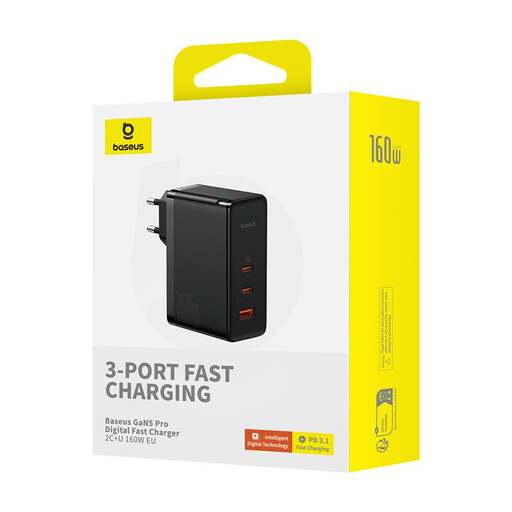
Why This Fits Their Persona: This is the perfect high-power wall charger to complement an in-car setup. It creates a seamless charging ecosystem, ensuring your laptop and devices are fully powered at your home or office desk before you travel.
This wall plug provides dedicated high-wattage ports, including a 100W USB-C port, mirroring the performance of a top-tier car charger. GaN (Gallium Nitride) technology allows for high power in a compact, cool-running unit.
Offers a massive 160W of desktop power with multiple ports to charge an entire suite of electronics from a single plug. The digital display provides clarity on charging status.
We have compiled a complete, real-time list of products that fully satisfy these strict selection criteria and UK safety regulations.
A quality charger will draw minimal power when no devices are connected. However, charging high-power devices like a laptop will draw significant current. It is always recommended to only use such a charger while the engine is running. If you must charge with the engine off, do so for short periods and monitor your car's battery voltage, which is where a charger with a built-in display becomes very useful.
Yes, this is critical. To achieve charging speeds at or above 60W, you must use a USB-C cable that contains an E-Marker chip. This chip communicates with the charger and the device to safely manage the high power level. For 100W charging, you need a cable explicitly rated for 100W (or higher, such as 240W). Using a standard cable will cause the charger to default to a much slower, safer speed.
Absolutely. The display serves two functions. Firstly, it confirms that the charger is receiving stable power from your car. A healthy car battery should read between 12.2V and 12.8V with the engine off, and 13.4V to 14.8V when running. Secondly, it can cycle through the outputs to show the wattage being delivered to each device, helping you confirm that you are getting the fast-charging speeds you paid for.