
24/7 Customer Support

Free returns

Same-day & Next-day Delivery

Quality Guaranteed

Unlock Your Welcome Offers: FREE Delivery | Up to 80% OFF | Free 30-day JoyPlus trial
Download the APP
For professionals, students and remote workers, a 165W laptop power bank 20000mAh can keep a MacBook, Dell laptop, tablet and phone running during a long train journey, campus day or flight. However, high numbers on the packaging do not automatically mean the charger will suit your devices.
The practical choice depends on output distribution, USB-C compatibility, cable quality and travel rules. This guide explains the specifications worth checking and highlights suitable options for different usage profiles.
A power bank advertised at 165W may deliver that figure across several ports rather than through one USB-C socket. For example, a unit may provide 100W from one port and 65W from another, with the total output shared when multiple devices are connected.
Check:
A laptop that normally uses a 100W USB-C charger may charge more slowly if the power bank is also supplying power to a phone or tablet.
The stated 20,000mAh capacity refers to the battery cells, not necessarily the energy delivered to your devices. Voltage conversion, heat and charging losses mean the usable output is lower.
For a general comparison, battery energy can be estimated using:
mAh × nominal voltage ÷ 1,000 = watt-hours
At a nominal 3.7V, 20,000mAh is approximately 74Wh. Actual device runtime depends on conversion efficiency, laptop battery size, workload, screen brightness and whether the power bank is being used while it recharges.
A power bank with built-in retractable cable is convenient, particularly when moving between offices, libraries and cafés. Yet the cable must still support the required current and charging protocol. A retractable lead may also be less convenient if it cannot reach a laptop placed beside you.
Look for a supplied high-wattage USB-C cable for laptops and check whether the integrated lead is suitable for your phone or tablet. Pull retractable cables gently and avoid sharp bends, as damage to the internal mechanism can affect charging reliability.
A USB-C PD power bank negotiates an appropriate voltage and current with a compatible device. This is more relevant to laptops than a basic USB-A fast-charge label. Check that the output profile includes the level your laptop accepts, such as 20V at a suitable current.
A 165W portable charger may be useful for charging two laptops only when its port allocation specifically supports that arrangement. It will not turn a device that lacks USB-C charging into a USB-C laptop.
High-wattage charging requires a suitably rated cable. A 240W USB-C to USB-C cable can provide useful headroom for compatible equipment, while an older or poorly specified cable may limit output. For a high-capacity power bank, use the supplied cable where possible or choose a cable with clearly stated wattage and certification information.
A metal casing can feel more robust than thin plastic, but it may also add weight. During fast charging, power banks can become warm. Keep the unit uncovered and away from bedding, bags and direct sunlight.
A screen showing battery percentage, input wattage, output wattage and remaining time can make a fast-charging power bank easier to manage. Remember that displayed estimates can change according to the connected device and charging conditions.
A 20,000mAh power bank is commonly below the 100Wh threshold used by many airlines for spare lithium batteries, but airline policies can differ. Carry power banks in cabin baggage rather than checked luggage and confirm the current policy with your airline before travelling.
A listing described as TSA-approved should not be treated as universal permission for every airline or route. Keep the capacity and watt-hour information visible, and follow the carrier’s instructions.
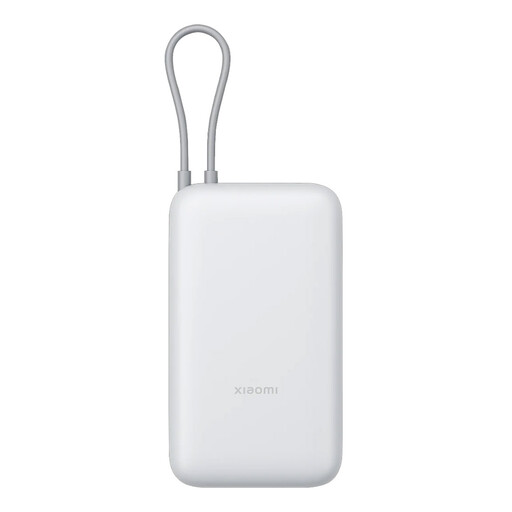
Why This Fits Their Persona: A straightforward option for commuters and students who mainly need to recharge USB-C phones, tablets and smaller devices around the UK.
Its integrated USB-C cable and stated 20,000mAh capacity make the basic specification easier to identify. Its 22.5W maximum output also makes clear that it is not intended as a 165W laptop charger.
USB-C two-way charging cable; up to 22.5W stated output; suitable for compatible Android devices and selected iPhone models.
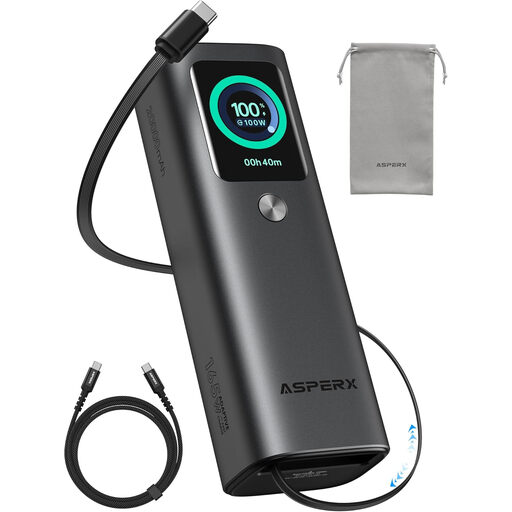
Why This Fits Their Persona: A practical match for remote workers and digital nomads who want laptop-level output, an integrated cable and clearer battery information in one unit.
The listing specifies 165W combined output, with up to 100W from one port and 100W plus 65W for two computers. This makes the output allocation clearer than a total-wattage label alone.
20,000mAh capacity; built-in retractable cables; aluminium alloy casing; TFT display for battery and power information.
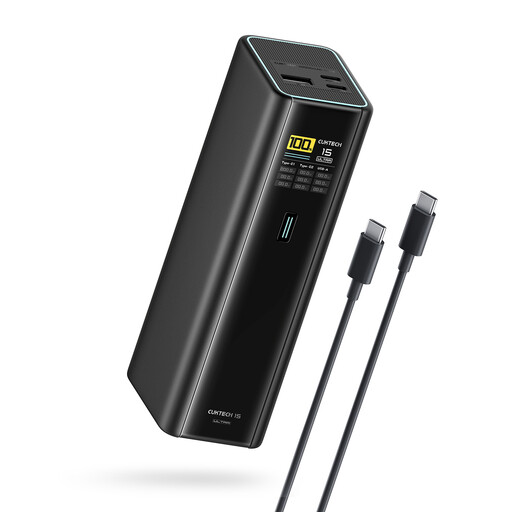
Why This Fits Their Persona: Suitable for users who prioritise substantial USB-C output for a laptop, tablet and phone, while accepting that the listed output is 140W rather than 165W.
Its 140W rating is stated directly, helping buyers compare it honestly with a 165W portable charger. The product information also advises using certified high-wattage cables.
20,000mAh battery; 140W laptop charging; three ports; USB-C PD3.1 support is specified in the product title.
We have compiled a complete, real-time list of products that fully satisfy these strict selection criteria and UK safety regulations.
It can charge a laptop when the laptop accepts USB-C input and the power bank provides a compatible USB-C PD output. Check the laptop’s original charger rating and the power bank’s single-port output. A MacBook power bank or Dell laptop power bank must still match the individual model’s charging requirements.
Runtime varies according to the laptop battery, workload and conversion losses. A 20,000mAh unit may provide a useful top-up rather than a full replacement for a mains charger. Video editing, gaming and intensive software will consume energy more quickly than document work or web browsing.
The main running cost is electricity used to recharge it. Charging efficiency, the wall charger’s power rating and standby losses affect consumption. Recharge it with a compatible PD wall charger, avoid leaving it permanently connected and store it away from high temperatures. For a power bank for iPhone and iPad, lower-output charging may be sufficient; laptop users should prioritise the correct PD profile over capacity alone.