
24/7 Customer Support

Free returns

Same-day & Next-day Delivery

Quality Guaranteed

Unlock Your Welcome Offers: FREE Delivery | Up to 80% OFF | Free 30-day JoyPlus trial
Download the APP
An 18V cordless drill can handle furniture assembly, shelving, garden projects and many routine household repairs. However, choosing by voltage alone can lead to an unsuitable purchase. Battery capacity, chuck size, torque control and hammer functionality often make a greater practical difference than a large accessory count or an impressive-sounding motor description.
Before buying, watch for these common pitfalls:
Battery capacity is commonly shown in Ah, or amp-hours. A 2.0Ah battery may offer more working time between charges than a 1.5Ah battery, although actual runtime depends on the material, bit size, pressure and operating mode.
For occasional household use, one battery with a supplied charger may be sufficient. If you are renovating several rooms or working away from a mains socket, consider a model with two batteries or a compatible battery platform. Check the charging time too: a cordless drill with battery and charger is usually more convenient for first-time buyers than a bare tool.
Lithium-ion batteries are generally lighter than older battery types and can be stored for periods between projects. Follow the supplied charging instructions, keep contacts clean and avoid exposing the pack to extreme temperatures.
Torque is measured in Newton metres (Nm) and indicates the turning force available at the chuck. A higher maximum torque figure can be useful for larger fasteners and tougher materials, but it does not automatically make a drill suitable for every job.
A clutch allows you to limit driving force. More settings can help when switching between delicate furniture panels, softwood and denser materials. A 2-speed cordless drill typically provides a slower range for controlled screwdriving and a faster range for drilling.
Variable-speed triggers are also useful. Starting slowly can help prevent a bit from wandering or a screw from being driven too deeply. For a general cordless drill driver, look for a clear clutch selector, forward/reverse control and a chuck that securely grips the accessories you intend to use.
A 10mm chuck is adequate for many household drill and driver bits. A 13mm chuck may accept a wider range of larger accessories, depending on the specification. Keyless chucks allow changes without a separate chuck key, but the collar must still be tightened firmly before operation.
For a drill for wood, metal and masonry, check that the product specifically includes a hammer-drilling mode. Use masonry bits only in that mode and do not treat hammer action as a substitute for a dedicated rotary hammer when carrying out demanding construction work.
A brushless cordless drill may have a motor design that reduces the need for brush replacement. Still, compare the complete specification, battery provision and price rather than selecting on the motor label alone.
The following options are matched to different buying priorities, from occasional DIY to masonry and broader renovation work.
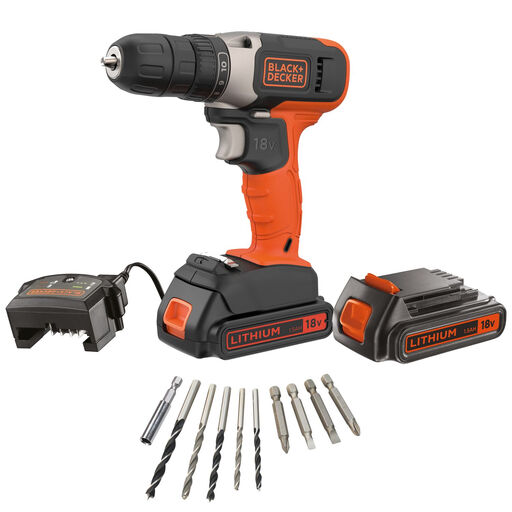
Why This Fits Their Persona: A compact option for flat-pack furniture, picture hanging and routine home maintenance where easy handling matters.
Its 11-position clutch, variable-speed trigger and integrated LED provide practical control instead of relying only on a headline power figure.
18V battery platform, 10mm chuck, compact format and soft-grip handle. The battery is compatible with other tools in the stated POWERCONNECT range.
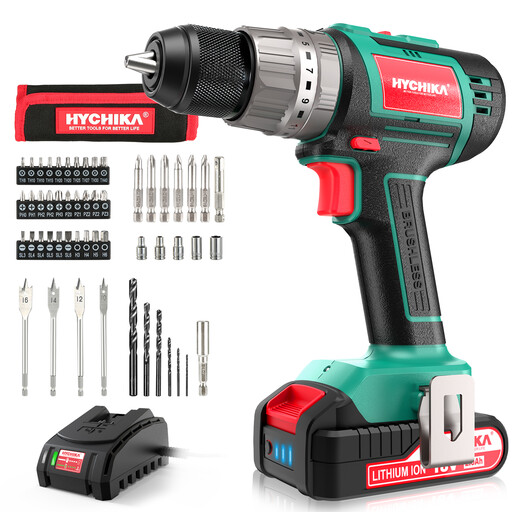
Why This Fits Their Persona: Suits homeowners who want one tool for screwdriving, general drilling and occasional masonry tasks.
The specification clearly identifies three modes, two speed ranges and 21+3 torque levels, making its intended use easier to assess.
Brushless motor, 60Nm maximum torque, 13mm auto-lock chuck, two 2.0Ah batteries and a 53-piece accessory set.

Why This Fits Their Persona: A practical match for renovators and new homeowners drilling into timber, metal, brick and other common project materials.
It specifies hammer action for masonry, separate speed ranges and dedicated wood, metal and masonry bits rather than leaving material compatibility unclear.
104-piece accessory set, 21,000 BPM impact rate, 11-position clutch and a 19-inch toolbox for organised storage.
We have compiled a complete, real-time list of products that fully satisfy these strict selection criteria and UK safety regulations.
Yes, an 18V model is commonly suited to screwdriving, furniture assembly, timber drilling and many metal-drilling tasks. For brick or concrete, choose a model with clearly stated hammer action and use suitable masonry bits.
Runtime varies with battery capacity, material density, bit size and trigger use. A 2.0Ah pack generally stores more charge than a 1.5Ah pack, while having two batteries allows one to charge while the other is in use.
Choose a cordless drill driver if your work is mainly screws, timber, plastic and light metal drilling. Select a hammer drill when wall, brick or masonry work is part of the project. For frequent heavy-duty concrete drilling, a dedicated rotary hammer may be more appropriate.