Frequent family pasta cooks
If shared dinners, leftovers or pasta bakes are regular meals, you need enough pasta for repeat use without taking on a bag that is awkward to store.


Choose the pack weight around how often your household will cook pasta: a 1 kg bag is a lower-commitment cupboard staple, while a 3 kg bag makes more sense for repeated dinners if you have room to store it. Then choose a shape for the planned sauce or bake, and check the current ingredients and allergen label when dietary suitability matters.
If shared dinners, leftovers or pasta bakes are regular meals, you need enough pasta for repeat use without taking on a bag that is awkward to store.
If the dinner is built around a ragù, creamy sauce or bake, the pasta shape may matter as much as the pack weight. Decide on the dish before committing to a large bag of one shape.
If wheat, gluten or another ingredient affects the choice, check the exact product label before choosing a larger standard pasta pack. A range name is not a substitute for the current ingredients and allergen statement.
Start with the quantity your household will use, then narrow the choice by dish and ingredients. Serving guidance belongs to the particular product: Sainsbury's describes its 1 kg spaghetti pack as containing approximately 11 servings.
| Concern | What to check | Who this matters to |
|---|---|---|
| Pack quantity | Check net weight, pack-specific serving guidance and space for storing an opened bag. | If pasta is on the menu repeatedly, I want enough for several dinners without buying more than I can store. About 36% of consumers put pack quantity first. |
| Shape for the dish | Choose the recipe before the pack; check whether a ridged or hollow shape suits a thick sauce or bake. | For a sauce-heavy dinner, I want a shape that works with the sauce rather than choosing by bag size alone. Roughly 29% of consumers make the dish-to-shape match their primary concern. |
| Ingredient suitability | Read the current ingredients and allergen statement on the specific pack. | When an ingredient affects what my household can use, that check comes before the shape or quantity. About 21% of consumers place ingredient suitability first. |
| Preparation | Check the pack's cooking directions and whether your pan suits the amount you plan to cook. | On a busy dinner night, I want a quantity I can prepare using the pack's directions. Around 14% of consumers prioritise straightforward preparation. |
A large bag commits you to that shape across several meals. Tesco describes its hollow, ridged penne as holding sauce well, while Napolina describes rigatoni for thick sauces and pasta bakes.
Plan the dishes you expect to make before choosing a family-size pack.
Standard dried-pasta examples from Tesco and Sainsbury's contain durum wheat. A different shape or pack size does not establish that the ingredients have changed.
If wheat, gluten or another ingredient matters to your household, read the current ingredients and allergen statement for the exact product.
Sainsbury's advises shoppers that product ingredients can change. An earlier listing should not replace the information on the pack you receive.
Check its net weight, ingredients, allergens, storage instructions and best-before date.
These ranges offer different ways to plan the meal; check the individual product rather than assuming every pasta in a brand's range has the same pack weight or ingredients.
Its listed dried-pasta range includes 1 kg spaghetti and fusilli and a 3 kg fusilli option.
Its 1 kg dried-pasta listings include spaghetti and penne, giving a choice of shapes for different dinners.
Its pasta range lists 1 kg standard shapes alongside dietary-specific options.
Barilla's Classic Blue Box line offers a choice of dried-pasta shapes for shoppers selecting around a recipe.
Dolmio is relevant here for planning pasta alongside a family-size sauce, not as an example of a dried-pasta family pack.
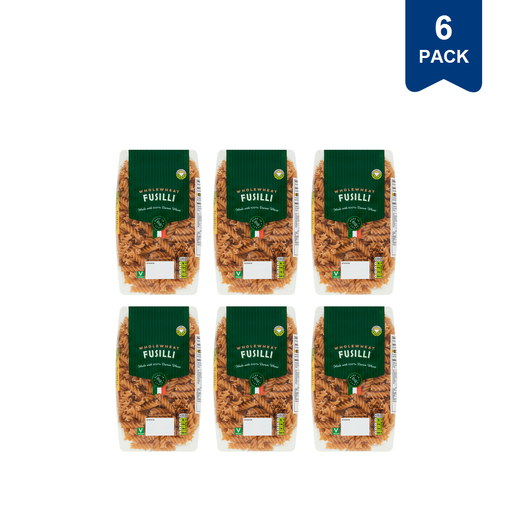
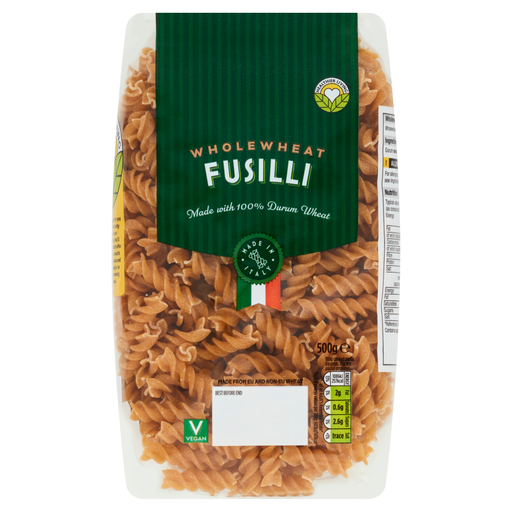
These Morrisons wholewheat fusilli options suit a dinner planned around that shape. Choose between separate bags for repeat meals and a single bag for a smaller commitment; check the current pack label if wheat or gluten is relevant.
 No image available
Consider this multi-bag format if you plan to make fusilli for several dinners and have room to store the bags. It contains six 500g packs; check that you will use that quantity and read the current ingredients and allergen label before purchase.
 No image available
Consider the single 500g bag when you want wholewheat fusilli for a planned dinner without committing to several bags. Check how much your household will cook, and read the current ingredients and allergen label.
Start with guidance for the product and recipe you are using. Dolmio recommends 100 g of dry pasta per person for its family-size Bolognese sauce recipe, while Sainsbury's describes its 1 kg spaghetti pack as approximately 11 servings. Adjust your plan for your household, side dishes and intended leftovers.
Ridged penne or rigatoni are options to consider. Tesco describes its hollow, ridged penne as holding sauce well, and Napolina describes rigatoni for thick sauces, creamy recipes and pasta bakes. Check that the chosen shape also comes in a pack weight you can use.
Yes, if an ingredient matters to your household, check the exact current pack. The standard durum-wheat pasta examples described by Tesco and Sainsbury's contain wheat; a free-from range name does not establish the ingredients of a particular product.
No. A 3 kg bag is a more practical choice when you expect to cook pasta repeatedly and can store it, while a 1 kg or smaller pack involves less commitment for an occasional dish. Check the shape as well as the weight before choosing.
Follow the instructions on the specific pack and keep its best-before information available. Check that you have suitable storage space before buying a large bag or several smaller ones.