
24/7 Customer Support

Free returns

Same-day & Next-day Delivery

Quality Guaranteed

Unlock Your Welcome Offers: FREE Delivery | Up to 80% OFF | Free 30-day JoyPlus trial
Download the APP
The term "AI laptop" is everywhere, but what does it actually mean for your daily use? As we move through 2026, a new category of machine has emerged: the Copilot+ PC. These devices promise to run powerful AI features directly on the hardware, offering a faster, more private and more intelligent computing experience. The 2-in-1 Copilot+ PC adds another layer of versatility, blending the power of a laptop with the convenience of a tablet.
However, navigating this new market can be tricky. With so many brands making bold claims, it's easy to invest in a device that doesn't live up to the hype. Before you decide, it's crucial to understand the common pitfalls that many UK buyers encounter.
To ensure you're getting a capable and future-proof machine, focus on these non-negotiable specifications.
The single most important component of a Copilot+ PC is its Neural Processing Unit (NPU). Think of it as a dedicated brain for AI tasks. While the main processor (CPU) handles general computing, the NPU is optimised for the complex calculations required by artificial intelligence.
For a device to be certified as a Windows 11 Copilot+ machine, its NPU must deliver a minimum of 40 TOPS. This is the key metric that enables features to run locally on your device, rather than relying on a slow and potentially less secure internet connection. An AMD Ryzen AI PC or a device with a Qualcomm Snapdragon X series chip are prime examples of hardware built to meet this standard. This on-device processing is what makes features like instant, screen-aware search and real-time language translation possible.
For a 14 inch AI laptop to succeed as a convertible, its physical design must be flawless. Pay close attention to the hinge mechanism. It should be firm enough to hold the screen steady in any position—laptop, tent, stand or tablet—but smooth enough to transition between modes without excessive force.
Equally important is the weight and balance. A device weighing much more than 1.5 kg starts to become cumbersome to use as a handheld tablet. The display itself should also be high-quality, with a brightness of at least 300 nits for comfortable viewing in different lighting conditions and a responsive touchscreen that feels accurate whether you're using your finger or a stylus. This is especially critical for a laptop for creatives UK who rely on precision for their work.
We've analysed the market to identify devices that meet these strict criteria, matching them to the needs of different UK users.
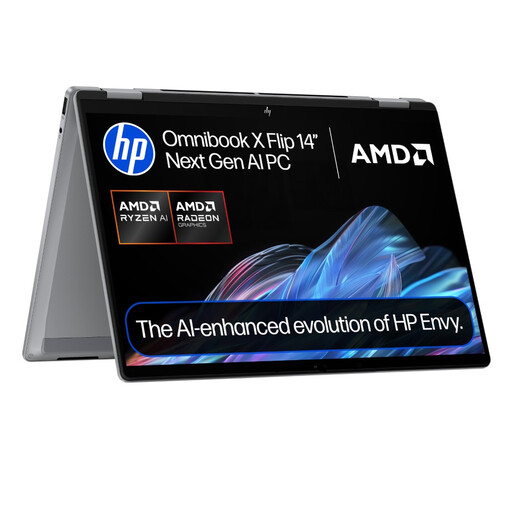
Why This Fits Their Persona: This user needs a single device that can handle a client presentation in laptop mode, content review in tent mode and detailed design work in tablet mode. The HP OmniBook X Flip is built for this exact workflow, offering four distinct modes without compromising on power.
It features an AMD Ryzen AI processor with a class-leading 50 TOPS NPU, far exceeding the Copilot+ minimum. At just 1.39 kg and with a full suite of ports (including 2x USB-A and HDMI), it avoids both the flimsy flip and dongle dependency traps.
Genuine 2-in-1 flexibility with top-tier on-device AI performance. The 400-nit touchscreen display is bright and responsive for creative tasks.
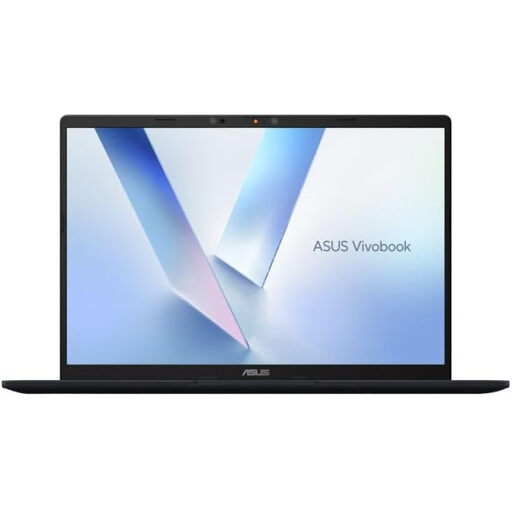
Why This Fits Their Persona: This user prioritises processing power and a traditional laptop experience for intensive multitasking. They want the latest AI capabilities without the need for a touchscreen or convertible hinge, focusing on a lightweight, powerful and reliable workhorse.
It delivers a true Copilot+ experience with its Qualcomm Snapdragon X processor and 45 TOPS NPU. By forgoing the 2-in-1 design, it focuses on providing a robust, classic laptop build while still offering modern connectivity like two USB4 Type-C ports and HDMI 2.1.
A streamlined and powerful Copilot+ PC for users who prefer a traditional clamshell design. It includes a fast PCIe 4.0 SSD and 16GB of RAM for excellent responsiveness.

Why This Fits Their Persona: Ideal for higher-education students and mobile workers who live in the Google ecosystem. Their work is primarily web-based, and they value speed, simplicity, long battery life and robust security for lectures, research and essays.
While not a Windows Copilot+ PC, it avoids the trap of underpowered budget laptops. The Chromebook Plus certification guarantees a high performance standard with an Intel Core 5 processor, 8GB RAM and a fast 512GB SSD, ensuring a smooth, lag-free experience.
Offers a premium, secure and fast cloud-first experience. It includes a high-resolution QHD camera for clear video calls and meets military-grade durability standards.
We have compiled a complete, real-time list of products that fully satisfy these strict selection criteria and UK safety regulations.
In practical terms, the NPU allows your laptop to handle complex AI tasks instantly and without an internet connection. This means you can use the Recall feature to find anything you've ever seen on your screen just by describing it. It also enables real-time translation during video calls, automatic background blurring that looks more natural and faster performance in creative applications that use AI-powered tools for editing images or video.
Modern, well-made 2-in-1s are designed for portability. Look for models with metal chassis (like aluminium) and hinges that are explicitly described as robust or tested for thousands of cycles. A device like the HP OmniBook X Flip, which is both lightweight and sturdily built, is an excellent example of a convertible that is more than capable of handling the demands of a daily commute or travel.
This is a valid concern, and it's why checking the ports is so important. While many ultra-thin laptops only offer USB-C ports, a thoughtfully designed model will include a mix of old and new. The recommended HP OmniBook X Flip, for instance, includes two USB-A 3.2 ports and an HDMI 2.1 port, ensuring you can connect most of your existing peripherals—like a wireless mouse dongle, external hard drive or office projector—without needing an adapter.