Students sharing lunch with classmates
Two litres is roughly six 330ml pours. It is worth considering when several people want the same drink and you have a practical way to carry the bottle, serve it and store what remains.


A 2-litre bottle makes more sense for a lunch shared with classmates, or when you can carry, reseal and refrigerate it, than as a drink to take through lectures alone. Choose the flavour the group wants, then check the exact variant: zero sugar does not necessarily mean caffeine-free, and regular colas can differ considerably in sugar content.
Two litres is roughly six 330ml pours. It is worth considering when several people want the same drink and you have a practical way to carry the bottle, serve it and store what remains.
Check the exact variant rather than the brand alone. Pepsi UK lists 0g sugars per 100ml for Pepsi Max, and The Coca-Cola Company lists 0g per 100ml for Coca-Cola Zero Sugar and Sprite Zero.
Read the ingredient list as well as the sugar figure before buying for a group. Standard Pepsi Max includes caffeine, while Pepsi identifies Pepsi Max Caffeine-Free as a separate no-sugar, no-caffeine variant; sweetener and phenylalanine-source statements also depend on the product.
Start with whether the bottle will be shared, then compare the exact flavour and label information that matter to the people drinking it.
| Priority | What to check | Your needs |
|---|---|---|
| Bottle size | Confirm whether the listing is for one 2-litre bottle or a multipack. Plan how to carry, share and store it after opening. | We are sharing lunch, so a large bottle makes sense if we can serve it and take care of what is left. |
| Sugar | Read sugars per 100ml on the exact variant. Multiply that figure by 20 to find the amount in a full 2-litre bottle. | If only one or two of us will drink it, I want to know how much sugar is in the bottle, not just in a small serving. |
| Caffeine | Check the variant name and ingredients separately from the sugar figure. Pepsi UK lists caffeine in standard Pepsi Max and identifies Pepsi Max Caffeine-Free as a separate product. | I want a cola without caffeine, so a zero-sugar label alone will not settle my choice. |
| Sweeteners | Read the ingredients and any phenylalanine-source statement on the exact bottle; do not assume different zero-sugar drinks use the same recipe. | Before we share a zero-sugar drink, everyone should be able to check its sweetener information. |
| Flavour | Choose between cola, orange and lemon-lime by the named variant. Confirm the bottle size and variant on the current listing. | If the group would rather have a fruit-flavoured drink than cola, I want to check that choice before buying two litres of it. |
A large bottle takes more planning to carry and store when it will not be shared.
Choose it for a group lunch or when you can reseal and refrigerate what remains; otherwise, compare a smaller bottle or cans.
The Coca-Cola Company lists 10.6g sugars per 100ml for Coca-Cola Original Taste, while Pepsi UK lists 4.5g per 100ml for Pepsi Regular. Across two litres, those figures correspond to 212g and 90g respectively.
Read the nutrition panel on the exact bottle and use its per-100ml figure if the amount in the full bottle matters to you.
Pepsi UK lists caffeine in standard Pepsi Max but identifies Pepsi Max Caffeine-Free as a separate variant.
If avoiding caffeine matters, look for an explicit caffeine-free variant and check the bottle label before sharing it.
A familiar brand name is not enough to establish a drink’s sugar, caffeine or sweetener content; compare the named variants.
The regular and zero-sugar cola variants offer different label profiles.
Pepsi’s named cola variants make the sugar and caffeine checks particularly important.
Fanta Zero Orange is an orange-flavoured alternative for a group that does not want cola.
Sprite offers a lemon-lime flavour route, with different sugar figures for the standard and Zero variants.
Tesco lists own-brand 2-litre zero-sugar flavours alongside branded drinks.
These are six-bottle packs of 2-litre zero-sugar cola. Consider the amount you can carry and store before choosing a multipack for a university lunch.
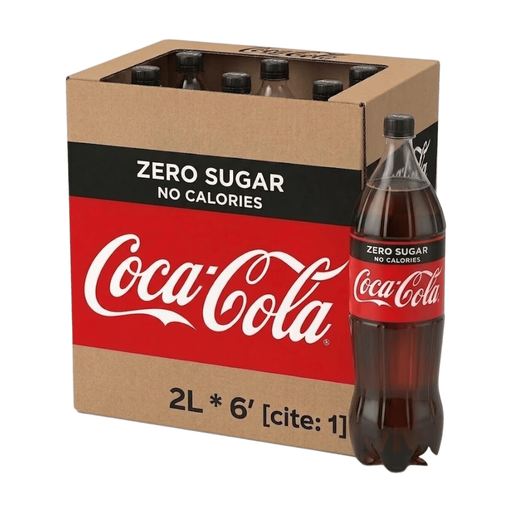 Image unavailable
Six 2-litre bottles suit a group planning to share cola over more than one lunch, provided there is somewhere to carry and store them. The product information lists 0g sugars per 100ml and identifies caffeine and sweeteners, including aspartame; check the phenylalanine-source statement on the label.
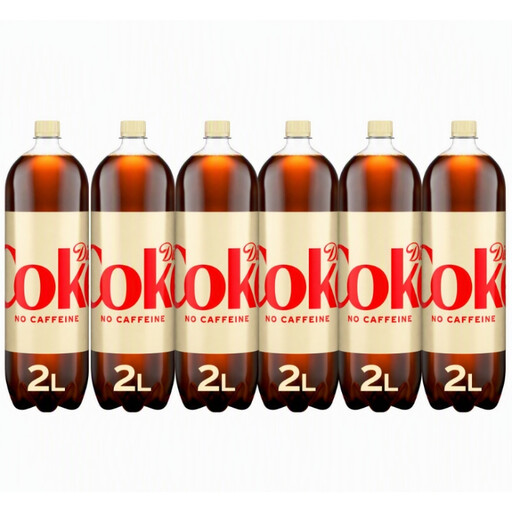 Image unavailable
This six-bottle, 2-litre-per-bottle pack is another large-format cola option for sharing. Its product information lists 0g sugars per 100ml and sweeteners, including aspartame. Although the variant is named Caffeine Free, its description and safety information conflict about caffeine; check the exact bottle label if avoiding caffeine matters. Check the phenylalanine-source statement too.
It depends on the exact cola. The Coca-Cola Company lists 10.6g sugars per 100ml for Coca-Cola Original Taste, equivalent to 212g in two litres; Pepsi UK lists 4.5g per 100ml for Pepsi Regular, equivalent to 90g. Multiply the figure on your bottle’s per-100ml panel by 20 rather than applying either example to every cola.
No. Pepsi UK lists caffeine in standard Pepsi Max, while Pepsi Max Caffeine-Free is a separately named no-sugar, no-caffeine variant. Check both the variant name and the ingredients on the bottle if caffeine avoidance matters.
A 2-litre bottle is generally more practical for sharing or when you can carry it securely, reseal it and refrigerate what remains. If you only need a drink during lectures, compare smaller bottles or cans before committing to the larger format.