
24/7 Customer Support

Free returns

Same-day & Next-day Delivery

Quality Guaranteed

Unlock Your Welcome Offers: FREE Delivery | Up to 80% OFF | Free 30-day JoyPlus trial
Download the APP
A 20000mAh portable power bank can be a practical choice for UK commuters, students, travellers and drivers. It offers more capacity than a small pocket charger without necessarily becoming too bulky for a backpack or glovebox.
However, capacity alone does not tell you whether a power bank will suit your devices. A model designed for a phone may not provide enough output for a laptop, while a car jump starter with a 20000mAh battery is built around short bursts of high current rather than repeated USB charging. Checking the specifications before buying helps avoid paying for features that do not match your routine.
The 20000mAh figure normally refers to the battery cells’ nominal capacity. Power is lost during voltage conversion, heat generation and charging regulation, so the amount delivered to a phone or laptop will be lower. Some products also list a separate rated capacity, which provides a more realistic comparison.
Look for both figures where available, and treat “multiple full charges” statements cautiously unless they specify the device battery size and testing conditions.
A USB-C power bank may use USB-C for input only, or it may support both input and output. Laptop charging also requires sufficient wattage and a compatible USB Power Delivery profile.
For phones and earbuds, 18W to 25W can be adequate. Larger tablets and many laptops may require 45W, 65W or more. A 140W power bank or 165W laptop charger can be useful for compatible laptops, but the device, cable and charging protocol must all support the required output.
A car jump starter is designed to provide a brief high-current boost to a 12V vehicle battery. Its peak current is not equivalent to USB charging wattage. For example, a 3000A jump starter may be suitable for emergency starting applications while offering only 18W USB charging.
Check petrol and diesel compatibility, vehicle voltage, clamp instructions and operating temperature guidance. A 3000A jump starter is not automatically suitable for every engine or battery condition.
A 20000mAh battery is often a useful middle ground for daily carry. It can provide several phone top-ups, depending on the phone’s battery size, charging losses and usage while connected. Dimensions and weight still matter: a device kept in a work bag may be comfortable at around half a kilogram, while a heavier high-output unit may be more suitable for travel or desk use.
For flights, check the watt-hour rating printed on the product and the airline’s current requirements. A nominal 20000mAh lithium battery is commonly around 74Wh when calculated at 3.7V, but the product label and carrier rules take priority.
A fast-charging power bank should state its maximum output and the relevant protocol. Common terms include:
A power bank with a built-in cable can be convenient for commuting, but check whether the cable is USB-C, its current rating and whether it is integrated, retractable or detachable.
Choose a product with clear operating instructions, protection against overcharging and short circuits, and a stated warranty or support route. Stop using a power bank if it becomes unusually hot, swells, leaks or shows physical damage. Do not leave lithium battery products in a hot parked vehicle or expose them to water.
For a tyre inflator jump starter, check the maximum pressure, auto-stop function, hose and nozzle arrangements. A 12V battery booster with a built-in inflator can reduce the number of emergency devices stored in a car, but it may be bulkier than a standard USB battery pack.
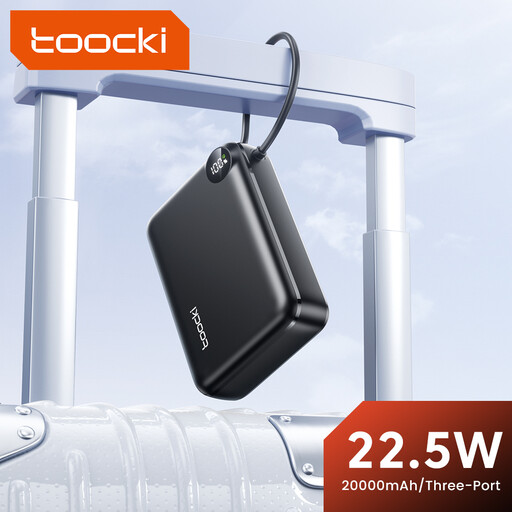
Why This Fits Their Persona: Its 20000mAh capacity and USB-C input/output suit students and commuters who want one general-purpose portable phone charger for everyday trips.
The listed 22.5W PD3.0 and QC4+ support gives shoppers clearer output information than a capacity-only listing.
USB-C in/out; listed 22.5W PD3.0 and QC4+ charging.
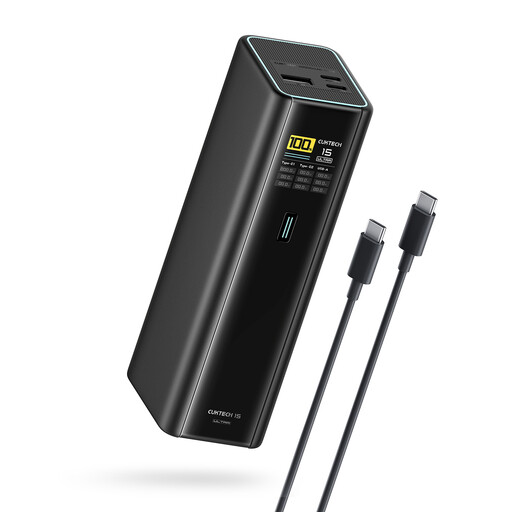
Why This Fits Their Persona: Professionals and frequent travellers can consider its listed 140W output and three USB-C ports for compatible laptops and mobile devices.
The specified high output and port count make it easier to compare with a laptop’s charging requirement instead of relying on 20000mAh alone.
140W laptop charging specification; three USB-C ports.
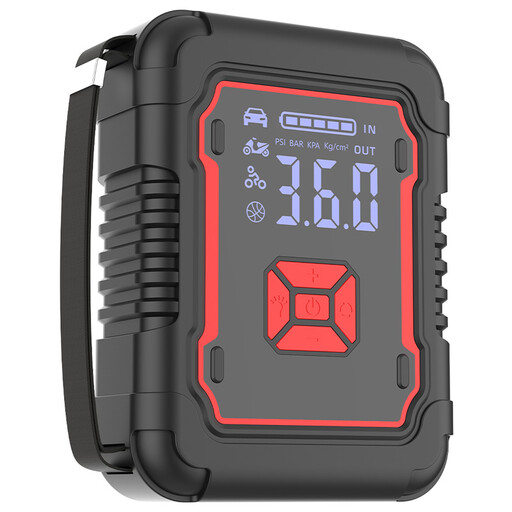
Why This Fits Their Persona: Drivers who want an emergency car power pack, tyre inflator and USB charger in one unit may find this practical for cars, vans, SUVs and motorcycles.
Its separate specifications identify 3000A peak current, 150PSI inflation and 18W QC3.0 USB charging rather than presenting them as one interchangeable power figure.
150PSI air compressor with auto-stop; three LED modes including SOS.
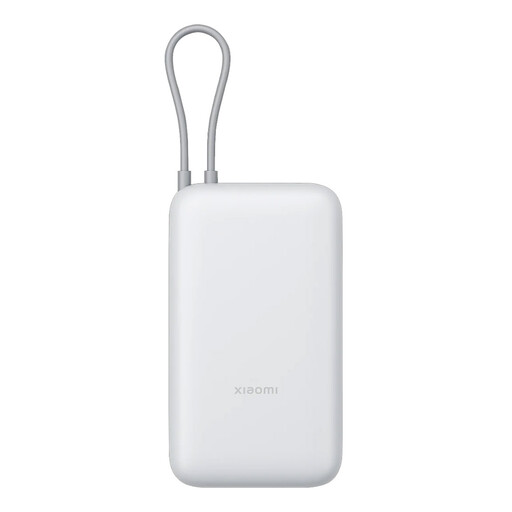
Why This Fits Their Persona: Office workers, commuters and travellers may appreciate an integrated USB-C cable that reduces the need to carry a separate lead.
The product listing identifies the cable type and states that actual 22.5W performance depends on the connected device and charging conditions.
Integrated USB-C two-way cable; listed output up to 22.5W.
We have compiled a complete, real-time list of products that fully satisfy these strict selection criteria and UK safety regulations.
Charging time depends on the input wattage, cable and charger. A basic input may take several hours, while a compatible fast charger can reduce the time. Check the stated input specification rather than assuming that a high output automatically means fast recharging.
Some can, but only if they provide a suitable USB-C PD output and sufficient wattage. Compare the power bank’s single-port output with the laptop’s supplied charger. A laptop power bank rated at 100W or more may suit compatible models, while a standard 18W portable phone charger may not.
Keep it dry and away from direct sunlight, radiators and temperatures inside a parked car. Store it partially charged if it will not be used for an extended period, inspect the casing before use and recharge it periodically so an emergency car power pack or everyday charger is ready when required.