Large households using instant coffee daily
If several people make regular cups, compare jar weight with the maker’s serving guidance to judge how often a jar may need replacing.


For a large household making coffee mug by mug, choose an instant decaf jar in a size the family can use while it remains in good condition. Nescafé estimates about 111 mugs from 200g at its standard 1.8g serving, but stronger cups use more coffee; check that the flavour and preparation format suit the household before choosing a larger jar.
If several people make regular cups, compare jar weight with the maker’s serving guidance to judge how often a jar may need replacing.
An instant decaf jar keeps mug-by-mug preparation simple. Nescafé notes that decaf still contains a small amount of caffeine, so the category name does not mean caffeine-free.
Check whether everyone expects coffee that dissolves in hot water. A brewed decaf such as Taylors Decaffé calls for a different preparation routine.
Start with the preparation format, then consider likely jar use, flavour preferences and storage.
| Priority | What to check | Your needs |
|---|---|---|
| Preparation format | Look for instant or soluble coffee on the jar. Ground coffee and coffee beans require a different preparation method. | I want each person to be able to make a mug with hot water, without brewing a pot. |
| Jar size and servings | Check net weight and the maker’s serving amount. Nescafé estimates about 111 mugs from 200g at 1.8g per mug; a stronger cup uses more. | Several people will use the jar regularly, so I want to judge how quickly we are likely to finish it. |
| Flavour and type | Read the product’s roast and coffee descriptions, and distinguish freeze-dried instant coffee from brewed formats. Descriptions do not establish which flavour everyone will prefer. | Other people in the household need to be happy drinking it, particularly before we commit to a larger jar. |
| Caffeine expectations | Check the exact product information if caffeine avoidance matters. Nescafé says decaf retains a small amount of caffeine. | I want decaf, but I will not assume the word means there is no caffeine at all. |
| Storage | Read the jar’s storage instructions and best-before date. Tesco, Sainsbury’s and M&S specify cool, dry storage for the products described here. | There needs to be a suitable place for the jar, and we should be able to use it while its quality suits us. |
Taylors gives cafetière guidance for Decaffé, while the jars considered here are instant coffee. A brewed product will not fit a kettle-and-spoon routine.
Check for instant or soluble coffee on the pack before buying.
A brewed format also takes different preparation time and equipment.
Nescafé says decaf coffee still contains a small amount of caffeine. The word alone cannot establish that a product meets a requirement to avoid caffeine entirely.
Check the specific product information if complete avoidance matters.
A larger jar may remain open longer than expected if fewer people drink it or the flavour is not widely liked. Product storage instructions also matter after opening.
Consider how quickly the household uses coffee, then follow the jar’s storage and date instructions.
Original Decaf is an instant-coffee option listed by Nescafé in 100g, 190g and 300g sizes.
Kenco Decaff is listed as a 200g instant-coffee jar for shoppers considering a branded roast.
Tesco lists 200g Decaff Gold and Decaffeinated Classic instant-coffee jars.
Gold Roast Decaffeinated Instant Coffee Granules come in a 200g jar.
Gold Decaf Instant Coffee is a 200g option for households interested in its stated coffee and sourcing details.
Decaffé is a brewed-coffee alternative for a household willing to use a cafetière rather than an instant jar.
These Nescafé instant decaf jars offer 300g and 200g sizes for households choosing coffee they can prepare a mug at a time.
 No image available
The 300g jar is a larger soluble-coffee option for repeated household cups. Nescafé says Original Decaf uses water decaffeination; check the jar’s serving guidance when estimating how long it will last, and store it in a cool, dry place.
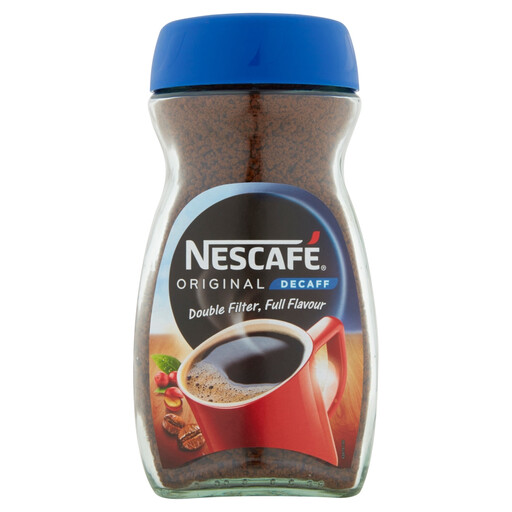 No image available
This 200g soluble-coffee jar suits a household that prefers this pack size for regular cups. Nescafé’s standard guidance estimates about 111 mugs from 200g at 1.8g per serving, rather than guaranteeing that yield for every cup; store the jar in a cool, dry place.
Use the maker’s serving guidance: Nescafé estimates about 111 mugs from 200g at its standard 1.8g serving, while Kenco uses a 1.6g serving basis for its cup calculation. Stronger cups use more coffee, so a household’s actual yield may differ.
A larger jar makes sense when the household regularly drinks that particular coffee and can store it as instructed. Check the stated serving amount and consider whether everyone likes the flavour before choosing a size that could remain open for a long time.
No: Nescafé says decaf still contains a small amount of caffeine. If complete avoidance matters, do not rely on the word decaf alone; check the specific product information.
Follow its label. Tesco, Sainsbury’s and M&S specify cool, dry storage for the products described here; check the jar’s closing instructions and best-before date too. GOV.UK explains that a best-before date concerns quality, unlike a use-by date, which concerns safety.
No. Decaffeination describes processing, not preparation format: Nescafé says its Original Decaf instant coffee uses water decaffeination, while Taylors describes a water process for Decaffé and gives cafetière brewing guidance.