Small groups sharing a late-night snack
If several people will eat from one bag, compare net weights before choosing. Tesco, Waitrose and Sainsbury's list standard 200g bags, giving you a common pack size to consider.


For a small group eating marshmallows straight from the bag, a standard 200g pack is a practical size to compare: Tesco, Waitrose and Sainsbury's each list one. Choose mini mallows if you mainly want toppings for drinks or desserts, and check the exact pack's ingredients before sharing with anyone who has dietary requirements.
If several people will eat from one bag, compare net weights before choosing. Tesco, Waitrose and Sainsbury's list standard 200g bags, giving you a common pack size to consider.
Mini mallows are an option when the bag will also be used as a topping. Marks & Spencer suggests adding its soft marshmallows to hot chocolate or rocky road.
Check ingredients on the exact pack before serving. The listed Waitrose, Sainsbury's and Marks & Spencer products contain beef gelatine; Freedom Confectionery describes its own marshmallow range as gelatine-free and plant-based.
Start with how many people will share the bag and whether the marshmallows are for eating directly or using as toppings. Then check the ingredients and any warnings relevant to your group.
| Priority | What to check | Your needs |
|---|---|---|
| Sharing quantity | Compare net weights on the same basis. Tesco, Waitrose and Sainsbury's list 200g standard bags; Asda lists a 150g mini-mallow bag. | I want enough to pass around a small group without choosing a larger pack than we plan to use. |
| How you will use them | Decide whether the bag is mainly for eating directly or for topping drinks and desserts. Marks & Spencer also suggests hot chocolate and rocky road for its soft marshmallows. | Mini pieces would be useful if we are topping hot chocolate rather than just sharing sweets from the bag. |
| Ingredients | Read the current pack's gelatine source, ingredients and dietary statements. Waitrose, Sainsbury's and Marks & Spencer list beef gelatine in the products discussed here. | Everyone sharing needs to be able to eat the particular product, not just a product described as a marshmallow. |
| Portions | Check the pack's serving size and nutrition per serving or per 100g. Sainsbury's describes its 200g bag as approximately six servings; serving definitions can differ between products. | I would rather use the pack's portion information than assume the whole sharing bag is one serving. |
| Children and heat | Read product-specific age and choking warnings. Marks & Spencer says its soft marshmallows are unsuitable for children under 36 months; Waitrose warns that heated Epic Giant Toastin' Mallows can burn or choke. | If children are present, I need to check the warning on the bag and take particular care with heated marshmallows. |
A 150g mini-mallow bag contains less than a 200g standard bag, even though both may suit a shared snack.
Check the net weight against the number of people sharing, and choose mini pieces for their intended topping use rather than assuming the bags offer the same quantity.
The Waitrose, Sainsbury's and Marks & Spencer products discussed here list beef gelatine, while Waitrose Epic Giant Toastin' Mallows list pork gelatine.
Read the exact pack's current ingredients and dietary statements before serving it to someone with a dietary requirement.
Sainsbury's warns of a choking risk for small children, and Marks & Spencer gives an under-36-month warning for its soft marshmallows. Waitrose warns that hot Epic Giant Toastin' Mallows can burn or choke.
Follow the warning on the product being served, supervise any toasting and let heated marshmallows cool before eating.
England's retail rules on promotions of certain foods high in fat, salt or sugar address promotion and placement. The Requirements for School Food Regulations 2014 separately restrict confectionery provided in schools within their scope; neither rule establishes the classification of every marshmallow bag.
If buying for school food, check the rules for that school, meal and UK nation rather than applying a household-shopping assumption.
Tesco lists a standard 200g own-label marshmallow bag.
Waitrose lists Pink and White Marshmallows in a 200g bag.
Sainsbury's lists a 200g marshmallow bag described as approximately six servings.
Marks & Spencer lists 180g Soft Marshmallows and suggests using them in hot chocolate or rocky road.
Asda lists Pink & White Mini Mallows in a 150g bag.
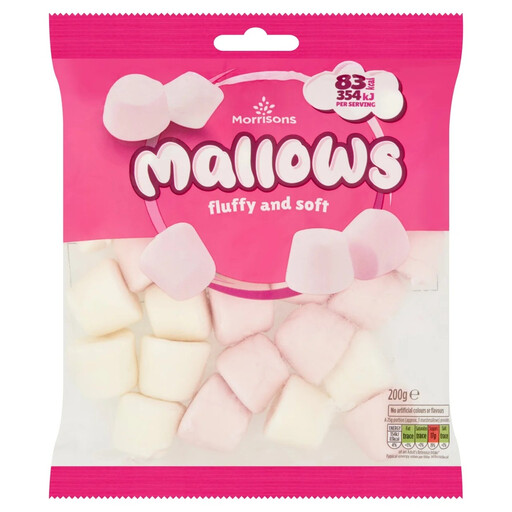
This Morrisons 200g bag is an option for sharing marshmallows directly or adding them to hot chocolate.
 No image available
The 200g bag suits the small-group sharing format and is also described for use with hot chocolate. Its product information says it contains gelatine and is not suitable for vegetarians; check the current pack for the gelatine source, serving information and any child-safety warning relevant to your group.
A 200g bag is a standard size to consider for a small group, but the number of servings depends on the product's stated portion. Sainsbury's describes its 200g bag as approximately six servings; check the exact pack if you are planning portions.
Do not assume they are. The Waitrose, Sainsbury's and Marks & Spencer products discussed here list beef gelatine, while Waitrose Epic Giant Toastin' Mallows list pork gelatine. For a dietary requirement, check an explicit statement and the ingredients on the exact pack; Freedom Confectionery describes its own marshmallow range as gelatine-free and plant-based.
Choose by how you will use the bag. A standard 200g bag provides more marshmallows by weight than Asda's listed 150g mini bag when sharing quantity matters; mini pieces are an option for topping a drink or dessert.
No. Department of Health and Social Care guidance for England addresses the promotion and placement of certain products high in fat, salt or sugar by businesses within its scope, rather than prohibiting ordinary retail sale. The rule does not, by itself, establish whether a particular marshmallow bag falls within those product restrictions.
In England, the Requirements for School Food Regulations 2014 say confectionery must not be provided in schools covered by those regulations. Check the applicable school setting, meal and any exceptions before arranging food; this is not a UK-wide rule about household purchases.