
24/7 Customer Support

Free returns

Same-day & Next-day Delivery

Quality Guaranteed

Unlock Your Welcome Offers: FREE Delivery | Up to 80% OFF | Free 30-day JoyPlus trial
Download the APP
Categories
As our devices become more powerful, the need for charging solutions that can keep up has never been greater. A standard cable that once charged your phone adequately might now struggle with your new high-performance laptop, leading to slow charging speeds and frustration. The market is filled with options, but understanding the differences between them is key to making a smart purchase.
This guide is designed to help you navigate the specifications and find a reliable 240W USB-C to USB-C cable that meets your needs, whether you're powering a demanding workstation or simply seeking a durable, future-proof cable for your everyday gadgets.
Before looking at specific products, it helps to understand a few key features. Keeping these points in mind will ensure you select a cable that is not only fast but also safe and durable.
The term 240W refers to the maximum power a cable can deliver to a device. This high output is made possible by the PD 3.1 EPR (Extended Power Range) charging standard. While your smartphone might only draw 20-45W, power-hungry devices benefit significantly from this. A high-performance gaming laptop charging cable or a MacBook Pro charger cable that supports 240W will enable it to charge at its maximum possible speed, often much faster than with older, lower-wattage cables. A 240W-rated cable is also backwards-compatible, meaning it will safely charge lower-power devices like an iPhone 15 Pro Max or a tablet by delivering only the power they require.
A cable's lifespan is largely determined by its construction. Many standard cables fray near the connector after just a few months of use. For a long-lasting solution, look for cables with reinforced stress points and high bend-cycle ratings.
Material choice also plays a significant role. While braided nylon is a popular option for durability, a silicone USB-C cable offers a unique combination of strength and flexibility. Silicone jackets are highly resistant to tangling, making them a great tangle-free durable cable for travel or tidy desks. They also remain pliable in various temperatures and provide a pleasant, soft-touch feel.
When dealing with high power levels, safety is paramount. In the UK, look for cables that are CE and RoHS certified, indicating they comply with health, safety and environmental protection standards. Advanced cables may also include features like over-temperature protection, which automatically regulates power to prevent the cable and your device from overheating. This is a crucial feature for protecting expensive electronics.
Here are our recommendations, selected to meet a range of power needs and user preferences.
Hyper 1M Silicone 240W USB-C to USB-C Charging Cable - White
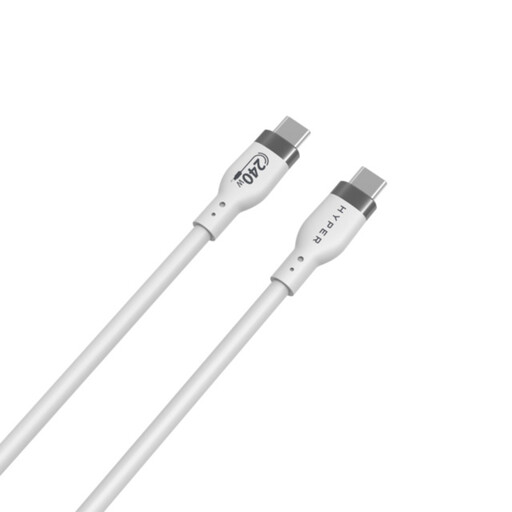
Why It Stands Out: This cable is built for the future of charging. It fully supports the 240W PD 3.1 EPR standard, making it one of the most powerful consumer cables available. Its premium silicone jacket not only feels great but also resists tangles and has been tested to withstand over 25,000 bends. The integrated over-temperature protection adds a layer of safety by monitoring heat and regulating power.
Pros:
Who is it for? Tech enthusiasts, creative professionals and gamers who own or plan to buy power-hungry devices and want a single, future-proof cable that can handle anything.
Anker USB-C to USB-C Cable 0.9M, White
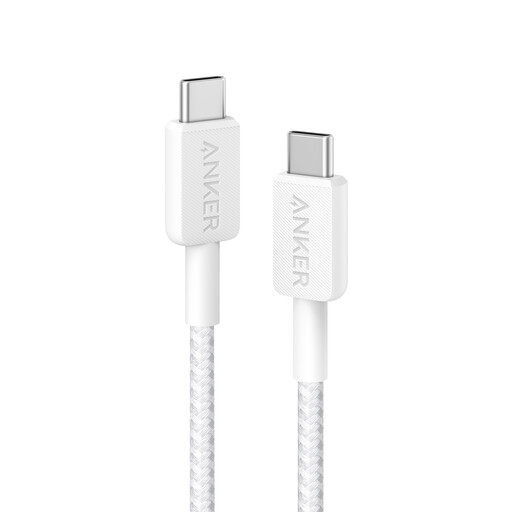
Why It Stands Out: Anker has a strong reputation for reliable charging accessories. This 60W cable is a dependable workhorse for a wide range of devices. While it doesn't offer 240W, its 60W output is more than sufficient for fast-charging smartphones (including the iPhone 15 series), tablets and many ultrabooks. Its double-braided nylon construction is proven to withstand up to 10,000 bends.
Pros:
Who is it for? Users who need a durable and reliable fast charging cable for laptop models like the MacBook Air, as well as for their tablets and smartphones, but do not require the maximum 240W power.
HOCO X82 60W USB-C to USB-C Charging Cable - 1M - Black
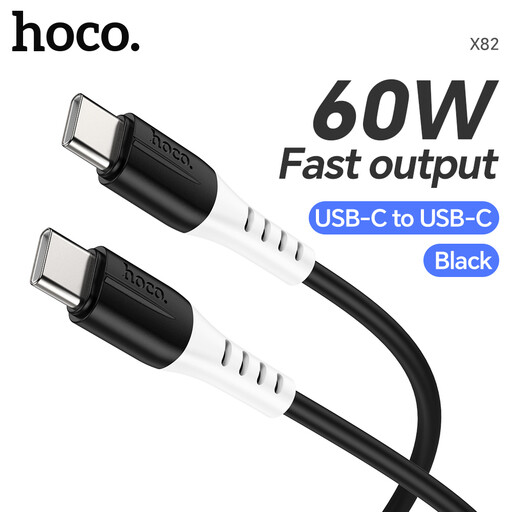
Why It Stands Out: This cable brings the benefits of a silicone USB-C cable to the popular 60W power level. The food-grade silicone jacket is exceptionally flexible, soft to the touch and resists tangling, making it easy to store and use. It delivers up to 60W, perfect for fast-charging phones, tablets and efficient laptops, all while providing a premium, anti-twist user experience.
Pros:
Who is it for? Anyone who values a clean, organised workspace or travels frequently and is tired of dealing with tangled cables. It's an excellent choice for charging phones, tablets and standard laptops.
If you have a specific aesthetic in mind, such as matching your cable to your devices or workspace, we have a wide selection to choose from. Many of our popular high-performance cables come in a clean, minimalist white.
️ Explore our curated selection of white cables to find the perfect match for your setup.
For most users today, a 60W or 100W cable is sufficient. However, a 240W USB-C to USB-C cable is essential for users with high-performance devices that support the PD 3.1 EPR standard. This includes some of the latest gaming laptop models and professional mobile workstations. It is also a great way to future-proof your purchase, ensuring you're ready for the next generation of power-hungry tech.
Yes, it is completely safe. USB-C Power Delivery is a smart technology. The cable, charger and your device communicate to determine the maximum safe power level. A 240W cable will only deliver the amount of power your phone or tablet is designed to accept, so there is no risk of damage.
The primary difference is the maximum power output. The PD 3.0 standard is limited to 100W (20V/5A). The PD 3.1 standard introduced Extended Power Range (EPR), which increases the maximum power capability to 240W (48V/5A). This allows it to charge much more demanding devices that were previously reliant on proprietary barrel-jack chargers.