
24/7 Customer Support

Free returns

Same-day & Next-day Delivery

Quality Guaranteed

Unlock Your Welcome Offers: FREE Delivery | Up to 80% OFF | Free 30-day JoyPlus trial
Download the APP
As high-performance laptops and devices demand more power, the market has been flooded with cables claiming to offer ultra-fast charging. However, not all cables are created equal. For owners of power-hungry devices like the latest MacBook Pro or high-end gaming notebooks, choosing the wrong 240W USB C cable can lead to slow charging, wasted money or even potential damage.
Before you make a purchase, it is important to understand the common pitfalls. Many shoppers are caught out by misleading marketing and design flaws that render a cable ineffective or short-lived. Here are the key issues to watch for:
To ensure you get a cable that performs as expected, focus on these non-negotiable specifications. Understanding them will help you cut through the clutter and select a product that is both safe and effective.
The key to true high-speed charging is the USB C PD3.1 standard. This protocol is what enables a power delivery of up to 240 watts, which is achieved through a 48V/5A electrical current. For a cable to support this, it must contain an E-Marker (Electronic Marker) chip.
This tiny chip is the brain of the cable. It communicates with both your power adapter and your device, confirming that the entire chain is certified to handle 240W safely. If a cable lacks this chip, it will not be recognised as a high-power cable and will be limited to a much lower wattage (typically 60W), no matter what is printed on the box. Always check the product specifications for "PD 3.1" and "E-Marker Chip" compliance.
A cable's lifespan is determined by its physical construction. For a Type C to Type C 240W cable, robust materials are not just a bonus; they are a necessity for safety and performance.
To simplify your choice, we have matched some suitable options to different user needs. These selections are based on their adherence to the critical parameters discussed above.
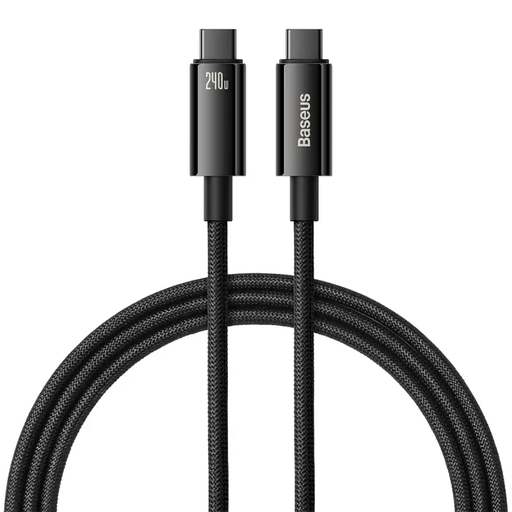
Why This Fits Their Persona: For creative professionals and tech enthusiasts using a fast charging cable for MacBook Pro or Dell XPS, minimising downtime is critical. This cable is built specifically to deliver the maximum power their device can handle, ensuring they can get back to work quickly.
It is fully PD3.1 certified and contains the necessary E-Marker smart chip, sidestepping the "fake 240W" trap and guaranteeing genuine high-speed performance.
Features durable zinc alloy connectors and a dense nylon braid, addressing the need for a long-lasting, reliable accessory for demanding daily use.
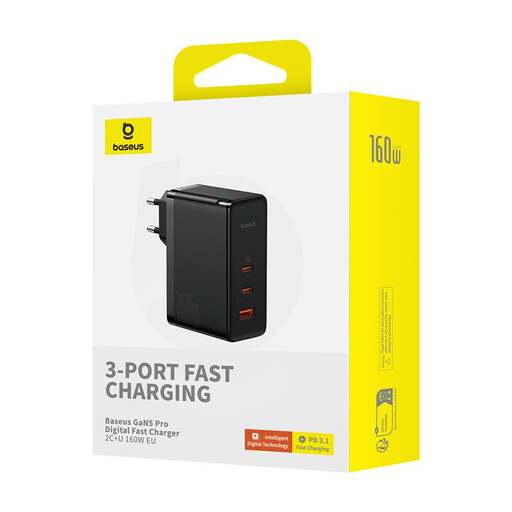
Why This Fits Their Persona: This user is looking to upgrade their entire charging setup. This bundle provides a powerful multi-port GaN charger and a compatible 48V 5A charging cable in one package, removing all compatibility guesswork.
It solves the common problem of pairing a high-spec cable with an underpowered charger. The included cable is guaranteed to work with the charger for optimal performance.
A complete, matched charging solution. The multi-port charger allows you to power a laptop and other devices simultaneously from a single plug.
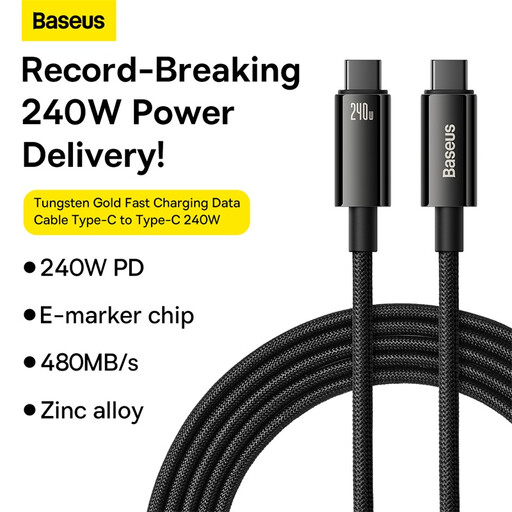
Why This Fits Their Persona: For those who have experienced cable failures from constant packing and unpacking, durability is the top priority. This cable's construction is focused on longevity, and the extra 2-metre length is ideal for use in hotels, airports and offices where power sockets are not always conveniently located.
It directly counters the "flimsy construction" pitfall by using premium materials like zinc alloy and an 8-strand thickened copper core, designed to withstand the rigours of travel.
Excellent build quality combined with a flexible 2-metre length. It is also fully PD3.1 compliant, so there is no compromise on charging speed.
We have compiled a complete, real-time list of products that fully satisfy these strict selection criteria and UK safety regulations.
To achieve the maximum 240W charging speed, you need a complete chain of compatible hardware: a device that can accept 240W, a power adapter that can supply 240W and the 240W cable itself. However, these cables are fully backwards compatible. You can safely use a 240W cable with a 100W or 140W charger, and it will deliver the maximum power that the charger can provide. Investing in a 240W cable is a good way to future-proof your charging setup for your next device upgrade.
Yes, it is completely safe. A certified 240W USB C cable contains an E-Marker chip that intelligently communicates with the connected device. It will negotiate the appropriate voltage and current required. It will not "force" 240 watts into a smartphone that is designed to only accept 25 watts. The system automatically delivers the safest and fastest charge possible for each individual device.
The USB Power Delivery (PD) standard for charging is technically separate from the USB data transfer standard. Most cables designed primarily for high-power charging, including many Type C to Type C 240W models, are built to the USB 2.0 data specification, which has a maximum speed of 480Mbps. This is adequate for syncing photos or small documents but can be a bottleneck for transferring large video files. If you require very high data transfer speeds (e.g., 5Gbps or higher), you would need to search for a cable that explicitly supports USB 3.2 or Thunderbolt standards, which are different products.