Choose a 27-inch display if limited desk space and reading trading interfaces matter most. A 34-inch ultrawide suits a wider cockpit-style view only if it fits the desk, the game supports the intended resolution and the PC can run it satisfactorily. With either format, check the connection and variable refresh rate (VRR) you can use, how room lighting affects the screen, and—if choosing OLED—how you will manage a persistent game HUD.
Who is this for?
Space traders with compact desks
If the bedroom desk is shared, start with the monitor’s full footprint, including its stand. A 27-inch-class 4K display is worth considering when you also spend time reading maps, markets and small interface text; Dell’s AW2725Q and AW2725QF illustrate this screen-size and resolution combination.
Wide-view cockpit builders
A 34-inch ultrawide may appeal if you have room for a wider display and want more horizontal space for the game image. Samsung’s G85SD and MSI’s MAG 341CQP are 3440 × 1440 examples. Check the particular game’s display options and the desk dimensions before committing to this format.
Long-session OLED buyers
Dark space scenes may draw you towards OLED, but a trading game can also leave dashboard elements in fixed positions for long periods. Compare the exact model’s panel-care instructions and warranty terms. MSI describes OLED Care 2.0 and panel-cover terms for its MAG 341CQP; those terms do not extend to other models by default.
What matters when choosing?
Measure the usable desk first, then decide whether a compact screen or a wider game view takes priority. After that, check the game, PC connection and lighting conditions against the exact monitor model.
| Concern |
What to check |
Who this matters to |
| Desk fit and interface text |
Measure usable width and depth with the stand or arm in place; compare the exact screen size and resolution. |
If I share a small desk and regularly read trading screens, I need a manageable footprint without overlooking interface legibility. Around 31% of consumers put desk fit and text reading first. |
| Wider cockpit view |
Check desk clearance, support for 3440 × 1440 in the game, and whether the PC can run it at a frame rate you find acceptable. |
I want more horizontal room for flight and navigation, provided the screen fits and my game uses the format. A wider view is the primary concern for around 25% of consumers. |
| Dark scenes and reflections |
Look for the exact VESA DisplayHDR certification tier, where HDR matters, and assess the screen surface against windows and lamps. |
When I play near a lamp or window, reflections could distract me from dark scenes, so lighting and the display surface matter. Around 25% of consumers place these viewing conditions first. |
| Variable frame rates and static HUDs |
Confirm the GPU output, cable, monitor input and VRR mode; for OLED, read the model’s panel-care and warranty terms. |
I need to know how the display handles changing frame rates and, if I choose OLED, a HUD that stays on screen. Around 19% of consumers make smooth play and panel care their primary concern. |
Buying pitfalls
-
Ordering an ultrawide before measuring the desk
A 34-inch ultrawide needs more horizontal space than a 27-inch display and may leave less room for other equipment on a shared desk.
Measure the usable surface, stand depth and any clearance needed to move a monitor arm before choosing the wider format.
-
Assuming every HDR label means the same thing
The Video Electronics Standards Association (VESA) distinguishes certified DisplayHDR performance tiers from unsupported HDR-style labels; a label alone does not establish comparable performance.
Check the exact model for a stated VESA DisplayHDR or DisplayHDR True Black certification tier.
-
Buying for the maximum refresh rate alone
The mode you can use depends on the PC output, cable, monitor input and game performance. NVIDIA’s G-SYNC Compatible validation concerns VRR display behaviour, not whether a particular PC can deliver every advertised mode.
Check the resolution and refresh-rate combination you intend to use across the whole connection.
-
Treating an OLED warranty as a substitute for panel care
A space-trading HUD can remain static during long sessions. MSI describes care features and burn-in safeguards for the MAG 341CQP, but those model-specific terms do not remove the need to follow its care instructions.
Read the exact monitor’s protection guidance and applicable warranty wording, and allow its prescribed refresh routines to run.
Brands to consider for these monitor formats
Alienware
Its AW2725Q and AW2725QF provide two different 27-inch-class 4K routes for a compact setup.
- Dell specifies a 26.7-inch 4K QD-OLED panel, 240Hz and DisplayHDR True Black 400 for the AW2725Q.
- The IPS-based AW2725QF switches between 4K at 180Hz and FHD at 360Hz. Its mode flexibility should not be mistaken for the AW2725Q’s OLED panel characteristics.
Samsung Odyssey
The G85SD is a 34-inch QD-OLED option for a wider cockpit-style layout.
- Samsung specifies 3440 × 1440 resolution and 175Hz, and says its OLED Glare Free treatment reduces glare from external light.
- Measure the desk and confirm support for the intended ultrawide resolution in your game; a surface-treatment claim cannot establish how the screen will look in every room.
LG UltraGear
The 27GS95QE-B represents a 27-inch QHD OLED route rather than a 4K or 34-inch ultrawide route.
- LG specifies 2560 × 1440 resolution, 240Hz, G-SYNC Compatible and FreeSync Premium Pro support for this model.
- LG says disabling Smart Energy Saving can increase brightness but may also increase power consumption; it is not a setting to change without considering that trade-off.
MSI
The MAG 341CQP is a 34-inch curved QD-OLED ultrawide with manufacturer-described panel-care features.
- MSI specifies 3440 × 1440 resolution, 175Hz, OLED Care 2.0 and a three-year OLED warranty including burn-in safeguards for this model.
- Check the applicable terms and follow the care instructions; these features and cover do not establish identical protection for every MSI monitor.
Joybuy monitor choices
These choices include 27-inch displays for a more compact desk setup and 34-inch displays for a wider view. Compare the exact model’s dimensions, your game’s resolution options and your PC’s connections before choosing between them.
 No image available
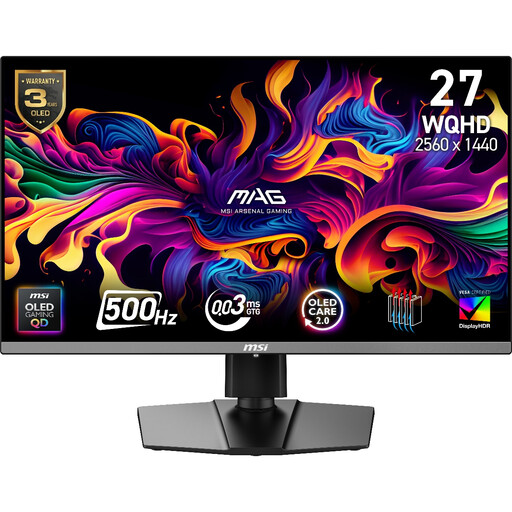
MAG 272QP QD-OLED X50, 27-inch QHD
Consider this 27-inch format if a 34-inch ultrawide would crowd the desk. The product name specifies 2560 × 1440 resolution, 500Hz, 0.03ms response time and AMD FreeSync; check whether your PC and connection can use the mode you want.
For long sessions with a fixed HUD, read the exact panel-care instructions and applicable warranty terms.
View on Joybuy
 No image available
Samsung Odyssey G6 S27DG612, 27-inch QHD OLED
This 27-inch option is relevant when desk width favours a smaller format. Its product name specifies a QHD OLED panel, 240Hz and 0.03ms response time; check the modes your PC can deliver.
If HDR or long static-HUD sessions matter to you, confirm the exact model’s certification, care guidance and warranty terms before ordering.
View on Joybuy
 No image available
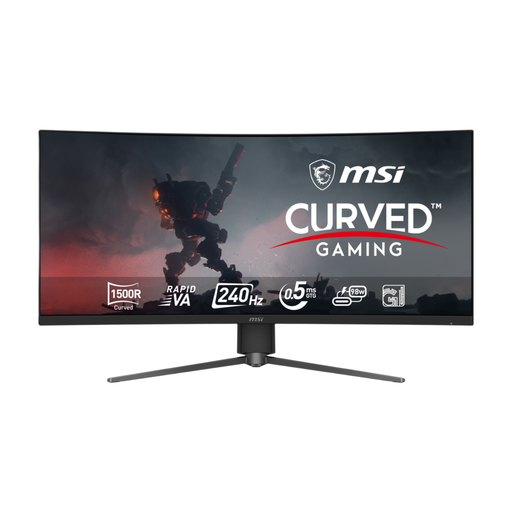
MSI MPG 346CQRF X24, 34-inch curved Rapid VA
Consider this ultrawide route if you have measured room for a 34-inch screen and the game supports your intended widescreen mode. The product name specifies UWQHD, 240Hz, 0.5ms response time and Adaptive Sync.
Its Rapid VA panel is not OLED; confirm the desk fit and the resolution and refresh combination available through your PC connection.
View on Joybuy
 No image available
LG UltraGear 27G850A, 27-inch 4K Nano IPS
This 27-inch 4K IPS format is worth considering if a compact desk setup and reading detailed trading screens take priority over an ultrawide view.
Confirm the exact SKU’s supported resolution and refresh-rate modes before buying, along with the PC output and cable needed for your chosen mode.
View on Joybuy
 No image available
LG UltraGear 34GX900A-B, 34-inch OLED
This 34-inch OLED option is for a wider-view setup where the desk, game and PC can accommodate an ultrawide display. The product name specifies WQHD and 240Hz.
Check the game’s ultrawide support, the monitor’s full dimensions and the exact OLED-care and warranty terms for extended sessions with a fixed HUD.
View on Joybuy
Common questions
Is a 34-inch ultrawide always preferable for a space-trading game?
No. Choose a 34-inch ultrawide for its wider format only if it fits your desk and the particular game supports the resolution you intend to use. Samsung’s G85SD and MSI’s MAG 341CQP are 3440 × 1440 examples, but their specifications cannot establish support in an unspecified game.
What does G-SYNC Compatible mean for a GeForce PC?
NVIDIA says G-SYNC Compatible displays are validated for a basic variable-refresh-rate experience intended to reduce tearing and stutter. You still need to check the monitor’s available mode against your GPU output, cable, ports and settings.
Should I avoid OLED if the game has a fixed HUD?
Not automatically, but a persistent HUD makes the exact OLED model’s care instructions and warranty terms important. MSI describes OLED Care 2.0 and burn-in safeguards under a three-year OLED warranty for its MAG 341CQP; that model-specific statement is not a guarantee against image retention.
What after-sales terms should I check on a Joybuy listing?
Check the return conditions and warranty shown for the exact product before ordering. Joybuy lists a 30-day free-return policy and a one-year manufacturer’s warranty for the Samsung Odyssey G8 LS34DG850SUXXU; do not assume those listing terms apply to another monitor.


