Players choosing their first fight controller
Start with the movement method you want to learn: a lever or directional buttons. Then match the exact model to the console or PC and games you intend to use.


Choose the movement layout before the enclosure: a traditional stick gives you a lever, while a leverless controller uses buttons for directions. If you want a lever without a tether, consider a wireless model, but confirm its connection options for your platform. For any layout, check the exact game and platform compatibility and, if you compete, the event’s current controller rules.
Start with the movement method you want to learn: a lever or directional buttons. Then match the exact model to the console or PC and games you intend to use.
An all-button layout suits players who want to practise directional inputs on buttons rather than a joystick. If you travel to events, check the controller’s carrying arrangement and the organiser’s input rules too.
If you prefer a lever, look at the specific model’s stick-head or gate options, access to internal parts and controls that help prevent accidental button presses.
Decide how you want to enter movement, then confirm compatibility with your games and hardware. Connection, carrying and adjustment features matter once those decisions are settled.
Choose it when: You want directional movement on buttons instead of a joystick lever.
Trade-off: It requires a different movement technique; do not assume the change will improve your results.
Choose it when: You want a conventional arcade lever and can use a wired connection.
Trade-off: Allow room for the stick and its cable where you play or carry it.
Choose it when: You want lever movement without a cable during play and the wireless mode supports your platform.
Trade-off: You must manage charging and any connection equipment the model requires.
| Concern | What to check | Who this matters to |
|---|---|---|
| Movement layout | Choose between a joystick lever and directional buttons. For leverless play at events, check the permitted input settings. | If I am learning movement for 2D fighters, I want a control method I am willing to practise consistently. Roughly 31% of consumers put movement layout first. |
| Platform compatibility | Check the exact model’s stated support for your console or PC, the game you play and any required platform mode. | When I switch between a console and PC, I need the controller to work with my actual games on both. Around 31% of consumers make compatibility their primary concern. |
| Travel and connection | Check the carrying arrangement and cable setup; if you want wireless play, confirm its supported platform. | Taking my controller to other setups makes packing and connection more important than changing its parts. About 19% of consumers prioritise travel and setup needs. |
| Comfort and adjustment | Look at hand support, lock controls and access to the specific parts you intend to adjust. | For long sessions or regular adjustments, I want controls and hardware I can use comfortably and maintain. Roughly 19% of consumers put comfort or customisation first. |
A leverless controller replaces joystick movement with directional buttons. Switching layouts takes adjustment and does not by itself guarantee better results.
Choose the input method you want to practise; if possible, try both layouts at a retailer or local event before committing.
Compatibility belongs to the exact controller model and game setup. Support stated for one stick, or for PS4 use, does not establish PS5 support for another.
Check the manufacturer’s compatibility statement and any required platform mode for the games you intend to play.
Evo’s published rules prohibit hardware-programmable input entry, rapid-fire, modifiers, macros and other hardware-assisted mechanisms. Other organisers may apply their own rules.
Read the current rules for your event and check your controller’s input configuration and lock controls before travelling.
A controller configuration the organiser does not permit could prevent you from using your planned setup.
For applicable UK distance sales of goods, the statutory change-of-mind cancellation period and remedies for faulty goods are separate. Checking the controller against your setup before ordering is still worthwhile.
Confirm compatibility and read the seller’s return instructions. If the controller is faulty, contact the retailer about your statutory remedies rather than relying only on a manufacturer warranty.
The Kitsune is Razer’s all-button arcade controller stated for PS5 and PC.
The wired Daija Arcade Stick is Nacon’s lever-based option stated for PS5, PS4 and PC.
The Pro FS-12 is a leverless model stated for PS5, PS4 and PC.
Qanba’s Titan is a lever-based arcade stick stated for PS5, PS4 and PC.
The FlexStrike Wireless Fight Stick is PlayStation’s lever-based option stated for PS5 and Windows PC.
These two HORI models are options for players choosing lever-based movement. The Series X variant is aimed at an Xbox setup, while the Tekken 8 Edition is a PS5 variant; check exact game and platform compatibility before choosing either.
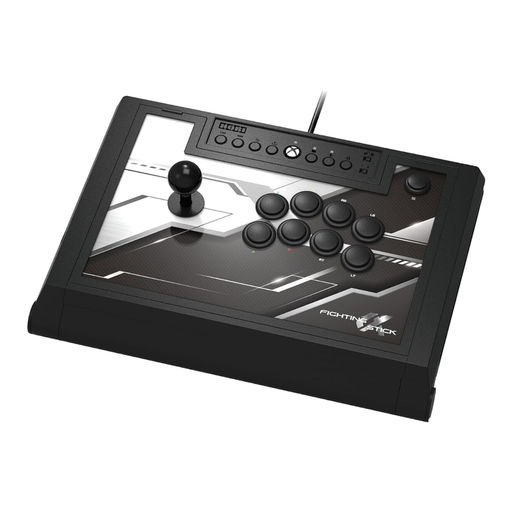 Image unavailable
Consider this lever-based stick if Xbox Series X/S is your main fighting-game setup. Confirm compatibility with each game and any other platform you intend to use.
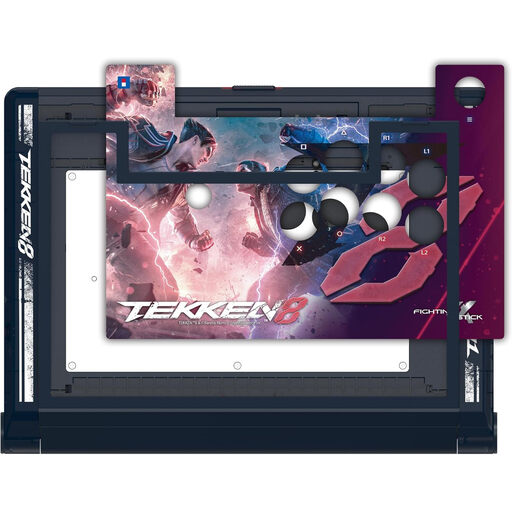 Image unavailable
Consider this lever-based Tekken 8 Edition for a PS5 fighting-game setup. If you also play on PS4 or PC, check compatibility with your specific games before ordering.
No: a USB connection alone does not establish compatibility with a PS5 game. PlayStation says officially licensed arcade sticks work with PS5 games and supported PS4 games; also check the exact controller’s stated support and required platform mode.
A leverless layout is not, by itself, an answer for every event. Evo’s published rules prohibit hardware-programmable input entry, rapid-fire, modifiers, macros and other hardware-assisted mechanisms; check your organiser’s current rules and how they apply to the controller’s input settings.
For an applicable UK distance-sale contract for goods, the Consumer Contracts Regulations provide a cancellation period ending 14 days after you, or a person you nominate other than the carrier, take physical possession. Check any applicable exception and the seller’s cancellation instructions; cancellation for a change of mind is distinct from remedies for faulty goods.
Contact the retailer and describe the fault rather than relying solely on a manufacturer warranty. The Consumer Rights Act 2015 provides a short-term right to reject goods that fail statutory standards, generally with a minimum 30-day period; when that period begins depends on the relevant ownership, delivery and any required trader-performed installation conditions.