
24/7 Customer Support

Free returns

Same-day & Next-day Delivery

Quality Guaranteed

Unlock Your Welcome Offers: FREE Delivery | Up to 80% OFF | Free 30-day JoyPlus trial
Download the APP
A 300mm combination square can handle far more than basic length measurements. With the right design, it can help you check 90° and 45° angles, mark timber, measure depth and width, and confirm whether a surface is level. It is useful for carpentry, woodworking, engineering, construction layout and general home improvement.
However, product listings often focus on length and appearance while leaving out details that affect everyday usability. Before buying, watch for these common pitfalls.
A 300mm ruler may show metric measurements, imperial measurements or both. If the markings are faint, crowded or printed on only one side, taking quick readings can become frustrating.
For UK users working with existing plans, timber sizes or older tools, a metric and imperial measuring tool can be more convenient. Check whether both scales are clearly marked and whether they remain visible when the ruler is inserted into the square head.
The ruler needs to slide smoothly for adjustment, but it must also remain fixed once positioned. A weak clamp can allow the head to move during marking, creating an inaccurate line or angle.
Look for a combination square with a practical screw-clamping system. The mechanism should be easy to loosen, reposition and tighten without excessive force. It is also worth checking whether the ruler can be removed for cleaning or storage.
“Metal construction” does not explain which parts are made from which material. The ruler, head and locking mechanism experience different types of wear.
A stainless steel combination square ruler offers resistance to everyday corrosion and is less likely to deform under normal workshop use. A zinc alloy head can provide a substantial feel while keeping the tool manageable. Even with corrosion-resistant materials, storing the square clean and dry remains important, particularly in an unheated garage or shed.
A 300mm combination square is also commonly described as a 12-inch combination square. Its length is suitable for many furniture, joinery, shelving and construction tasks without becoming as cumbersome as a larger layout tool.
Check the actual graduation range rather than relying only on the headline measurement. The WORKPRO model listed below has a 0–300mm graduation range and a 32cm overall product length, allowing room for the square head and adjustment components.
A useful combination square should do more than measure straight distances. For general workshop use, check for:
This combination of functions makes the tool a practical woodworking square, carpenter’s measuring tool and construction layout tool. It does not replace a calibrated precision instrument where a project specification requires certified accuracy, so check the product information for any stated tolerances or calibration documentation.
A square intended for frequent use should have a ruler that resists bending, a head that sits firmly against the workpiece and markings that are easy to read. A combination square with bubble level is particularly useful when positioning shelves, checking small frames or setting out light construction work.
For everyday maintenance, wipe away dust and adhesive residue after use. Keep the tool dry and avoid storing it where moisture can collect on the ruler or inside the locking mechanism.
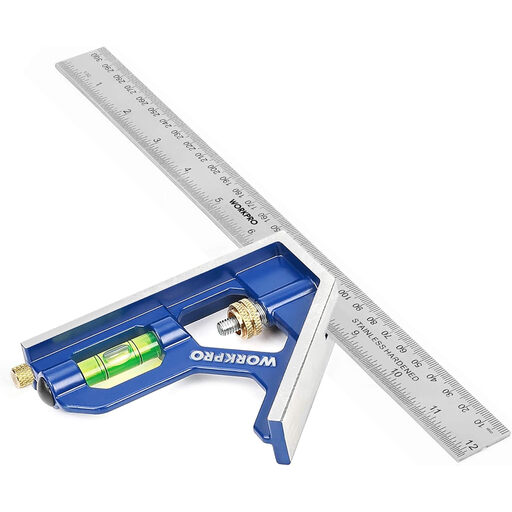
Why This Fits Their Persona: It brings several workshop functions into one tool, making it suitable for DIY users building a basic measuring and marking kit for repairs, shelving and small woodworking projects.
The dual-sided metric and imperial graduations are specified, while the spring screw clamp helps hold the ruler at the selected position.
300mm measuring range; integrated bubble level and scriber; stainless steel ruler with zinc alloy head.
Why This Fits Their Persona: Suitable for users who prefer a metal measuring tool with clearly defined materials and several built-in functions for regular workshop use.
The product description identifies stainless steel for the ruler and zinc alloy for the head, rather than using only general metal terminology.
Rust-resistant stainless steel ruler; 410g listed weight; adjustable head with spring screw clamping system.
Why This Fits Their Persona: The combination of angle checking, adjustable measurement and marking functions suits carpenters, engineers and construction users who repeat layout tasks across different materials.
The ruler can be loosened, positioned and tightened, while the built-in scriber avoids relying on a separate marking pen.
Measures 90° and 45° angles, length, depth and width; includes a bubble level; dual-sided scales support mixed-unit work.
To set the tool, loosen the spring screw, slide the ruler to the required position and tighten the screw. Place the square head firmly against the edge of the material before marking.
For a basic right-angle check:
If the lines do not align, inspect the workpiece edge, ruler seating and locking mechanism before assuming the square is inaccurate. For demanding engineering work, compare the tool with a known reference or use an instrument appropriate to the required tolerance.
Keep the ruler free from sawdust and metal filings. Wipe it with a dry or slightly damp cloth, then dry it thoroughly. Store it flat or in a dry toolbox to reduce the risk of damage.
They refer to approximately the same nominal size. A 300mm ruler is commonly marketed as a 12-inch combination square, although the overall tool length may be slightly longer because of the square head and end components.
Yes. A suitable model can check 90° and 45° angles, measure dimensions and mark materials. For heavy site use, prioritise a secure clamp, readable graduations and a durable ruler. For precision engineering, check whether the stated accuracy meets your project requirements.
Lifespan depends on frequency of use, storage and handling. A metal ruler and sturdy head can support regular DIY or workshop work, but accuracy may suffer if the ruler is bent, the head is dropped or the clamp no longer holds firmly. Cleaning and dry storage help preserve the tool.
We have compiled a complete, real-time list of products that fully satisfy these strict selection criteria and UK safety regulations.