
24/7 Customer Support

Free returns

Same-day & Next-day Delivery

Quality Guaranteed

Unlock Your Welcome Offers: FREE Delivery | Up to 80% OFF | Free 30-day JoyPlus trial
Download the APP
As a Joybuy Product Recommendation Officer, my role is to help you navigate the crowded market of car accessories. When it comes to powering your valuable electronics on the move, choosing the right vehicle power converter is critical. A common search is for a 300W pure sine wave car inverter, a device that promises to turn your car's 12V socket into a mobile mains outlet.
However, the path to reliable on-the-go power is filled with pitfalls. Many buyers end up with a device that either fails to perform or, worse, causes irreversible damage to their laptops, cameras or drones. Before you make a purchase, let's look at the common traps to avoid.
The "Modified Sine Wave" Deception: The single biggest mistake is buying a modified sine wave (MSW) inverter thinking it's suitable for all electronics. MSW inverters are cheaper because they produce a choppy, stepped electrical current. While fine for simple motors or heaters, this type of power can cause sensitive electronics like laptops, digital cameras and audio equipment to run hot, make a buzzing noise or suffer long-term damage. A pure sine wave output is smooth and stable, just like the electricity from your wall sockets at home, making it the only safe choice for your expensive gadgets.
Misleading Power Ratings: Many products advertise a high "peak power" figure (e.g., 700W) in bold, while the much more important "continuous power" rating (e.g., 300W) is in the small print. Peak power is only available for a fraction of a second to handle initial start-up surges. For running a device like a car laptop charger, you must ensure its wattage requirement is below the inverter's continuous rating.
Ignoring Your Vehicle's Limits: Most car cigarette lighter sockets are protected by a 15-amp fuse, which means they can safely deliver about 150-180 watts. A 300W pure sine wave car inverter can draw more power than the socket is designed for under full load. While many will work for lower-power items, attempting to run a 250W device continuously through a cigarette lighter plug can lead to blown fuses or damage to your vehicle's wiring.
To ensure you get a safe and effective 12v to 230v inverter, focus on these non-negotiable specifications.
As mentioned, this is the most critical factor. For any device with a microchip, a screen or a rechargeable battery (laptops, tablets, cameras, drones, medical equipment), do not compromise. The clean power from a pure sine wave inverter protects your device's internal components and ensures it runs efficiently and quietly. A modified sine wave unit is only suitable for basic tools or resistive loads, not modern electronics.
Check the power label on your devices. A typical laptop charger might draw between 65W and 100W. A drone battery charger could be around 50W. A 300W inverter provides a comfortable buffer to power a laptop and charge a phone simultaneously without being strained. Always add up the wattage of all devices you plan to use at once and ensure the total is well under the inverter's continuous rating.
A modern in-car inverter with USB C is a significant advantage. A USB-C Power Delivery (PD) port can fast-charge compatible laptops and smartphones directly, freeing up the AC outlet. Also, look for key safety certifications and features like built-in fuses, cooling fans and automatic shutdown protection for overload, overheating and low battery voltage. These are not luxuries; they are essential for protecting both your devices and your vehicle.
Based on these practical criteria, we've matched a few standout options to different user needs. These selections prioritise safety, performance and real-world usability for UK drivers.
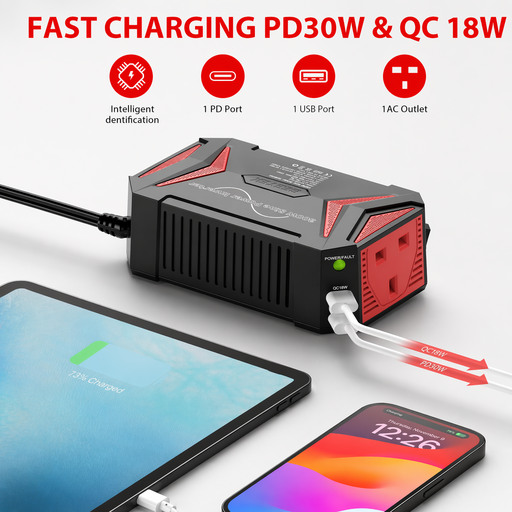
Why This Fits Their Persona: Ideal for the professional working from their car. The integrated USB-C PD port can directly fast-charge a modern laptop (like a MacBook or Dell XPS) or tablet, keeping them productive between meetings without needing the bulky mains adapter.
It provides a true pure sine wave output, safeguarding expensive work equipment. The inclusion of modern, high-wattage USB-C PD avoids the need to rely solely on the AC outlet for charging compatible laptops.
The PD 30W Type-C port is the standout feature, offering efficient charging for the latest devices. It also includes a QC 18W USB-A port and a full suite of safety protections.
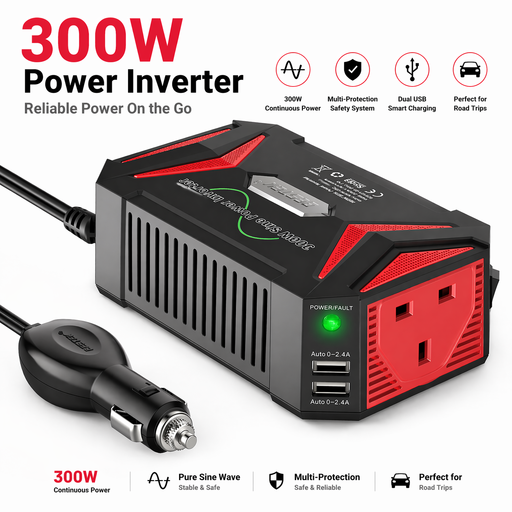
Why This Fits Their Persona: Perfect for those needing reliable **portable power for camping** or road trips. It can safely power a laptop for watching films, charge camera batteries and keep multiple phones topped up via the two capable USB-A ports.
This unit delivers clean pure sine wave power, ensuring that camera gear and other sensitive electronics are not at risk. It offers a solid 300W continuous output without over-hyping its peak power.
A straightforward and reliable choice. The dual 4.8A (total) smart USB ports provide ample charging for phones and accessories, while the AC outlet handles the more demanding items. It's a dependable all-rounder.
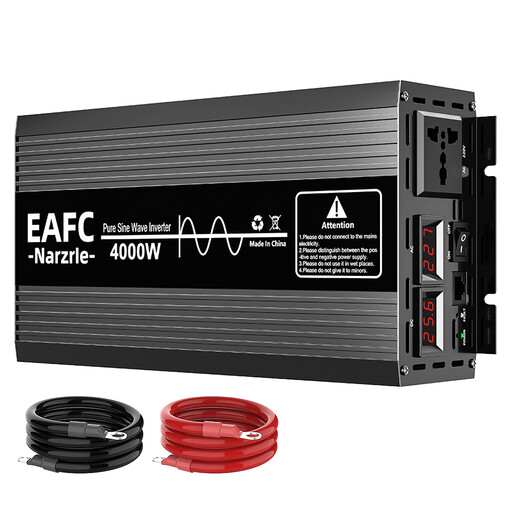
Why This Fits Their Persona: For those in a caravan, motorhome or work van who need to power more than just a laptop. This unit's 2000W continuous rating can handle small kitchen appliances, power tools or a small fridge, providing true off-grid capability.
This inverter correctly requires a direct connection to the vehicle's battery, avoiding the pitfall of overloading a cigarette lighter socket. It delivers high-wattage pure sine wave power for demanding applications.
Massive 2000W continuous power output. It features dual intelligent cooling fans for sustained use and a digital display to monitor battery voltage and output, giving you full control over your power system.
We have compiled a complete, real-time list of products that fully satisfy these strict selection criteria and UK safety regulations.
Yes, any device drawing power can drain your battery. A 300W inverter under full load is a significant draw. To prevent being stranded with a flat battery, it is highly recommended to only use the inverter for extended periods while the engine is running. Many quality inverters also feature a low-voltage shutdown to automatically turn off before the battery is depleted too far to start the car.
Technically, no. A phone's small AC adapter is generally robust enough to handle a modified sine wave. However, a cigarette lighter power adapter with direct USB ports is a much more efficient and compact solution for charging phones. You should invest in a pure sine wave inverter for its ability to safely power more sensitive and expensive devices like laptops, not just for phone charging.
The lifespan of a car inverter depends on its build quality, usage and operating environment. A well-made unit from a reputable brand, with proper cooling and safety features, should last for many years if used within its specified limits. Avoid running it at maximum capacity for long periods and ensure it has good ventilation to prevent overheating, which is the primary cause of premature failure.