
24/7 Customer Support

Free returns

Same-day & Next-day Delivery

Quality Guaranteed

Unlock Your Welcome Offers: FREE Delivery | Up to 80% OFF | Free 30-day JoyPlus trial
Download the APP
A 30W USB-C charger UK shoppers can rely on needs to do more than advertise “fast charging”. The wrong model may have an unsuitable plug, share its power between several ports, or lack the output profile your phone requires.
Before buying, check three common traps:
This guide explains the practical specifications to check, followed by our top recommendations for different UK lifestyles.
A USB-C Power Delivery charger communicates with a compatible device and selects an appropriate voltage and current. Common output profiles include 5V, 9V, 12V, 15V and 20V, although the exact combinations vary between products.
For everyday phone charging, a 30W output commonly includes profiles such as 5V/3A, 9V/3A and 12V/2A. This can suit many iPhone, Samsung Galaxy and Google Pixel models when paired with a suitable USB-C cable. However, the phone itself determines the charging rate.
If you want an iPhone fast charger or Samsung fast charger, check both the charger’s supported protocols and your phone’s requirements. A USB-C cable is also essential; older cables may not support the intended current or charging performance.
A proper UK wall charger should be suitable for UK sockets and should not require a loose travel adaptor for ordinary home use. Foldable pins, where provided, can make a compact travel charger easier to pack, but check that the product is actually supplied with the plug format you need.
GaN, or gallium nitride, technology allows manufacturers to produce smaller high-power chargers than many traditional silicon-based designs. A 30W GaN charger is therefore useful for commuters, students and frequent travellers who want to reduce the space taken by their charging kit.
Compact dimensions should not be the only consideration. Keep the charger ventilated, avoid covering it with bedding or clothing, and stop using it if the casing is damaged, it emits smoke or it becomes unusually hot.
A single USB-C port is often the most straightforward choice for one phone or tablet. A multi-port USB charger is more useful when you regularly charge a phone, earbuds and another accessory together.
Read the power table carefully. Some multi-port models provide 30W through USB-C when used alone but reduce the available power when USB-A ports are connected. This is normal power management, not necessarily a fault, but it may affect charging speed.
Also consider what the charger is not designed to do. A 30W plug can suit many phones, tablets and smaller USB-C accessories, but it may be unsuitable for laptops requiring 45W or more.
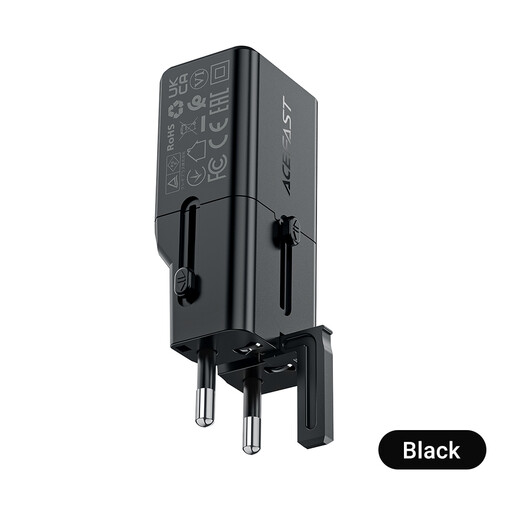
Why This Fits Their Persona: Its mini GaN format provides a simple single-port option for students, first-time fast-charger buyers and anyone replacing a standard phone plug.
It specifies 30W USB-C PD output rather than relying only on a vague fast-charging label. Its protection information includes over-current, over-voltage and short-circuit protection.
GaN mini construction; USB-C PD output up to 30W; compact design for everyday carrying.
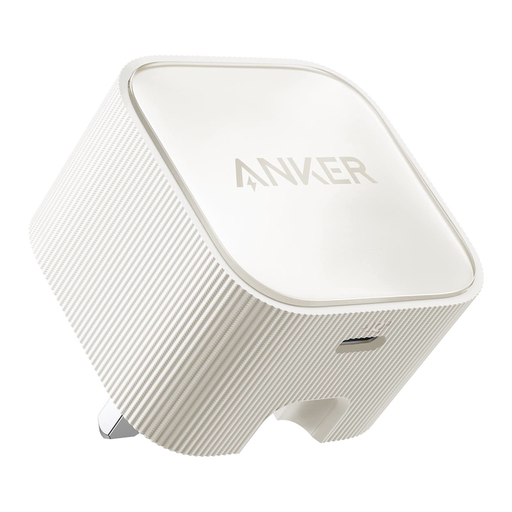
Why This Fits Their Persona: A foldable design suits users who want a neat charger for work bags, overnight stays and regular rail or air travel.
The stated output is 30W, while the foldable format addresses the common problem of bulky chargers taking up space in a travel pouch.
Foldable construction; USB-C connectivity; ActiveShield 3.0 protection feature stated in the product information.
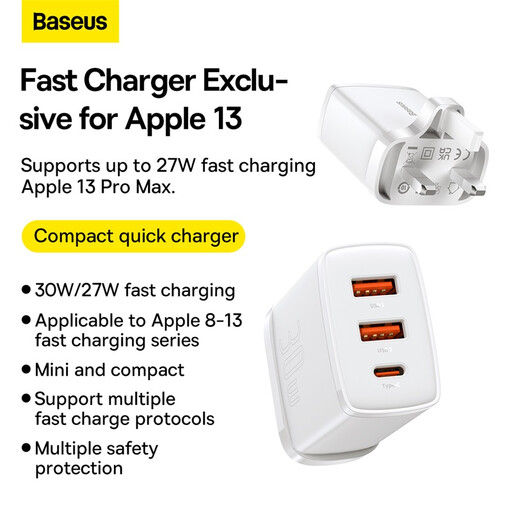
Why This Fits Their Persona: This UK-plug model is suitable for couples, families or students charging several smaller devices from one socket.
Its specification clearly states three ports and a 30W maximum total output, helping buyers understand that power may be shared.
One USB-C and two USB-A ports; UK plug; 30W maximum total output with stated safety protections.
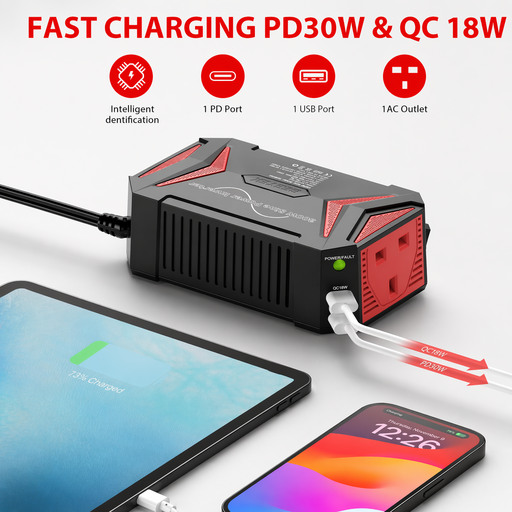
Why This Fits Their Persona: Drivers, campers and van users may need vehicle power as well as phone charging during longer journeys.
It is designed for a standard 12V vehicle socket and states a PD 20W maximum Type-C port, so buyers can distinguish it from a full 30W mains charger.
300W continuous AC output; USB-C PD and USB-A ports; stated fuse, temperature, under-voltage and over-voltage protection.
We have compiled a complete, real-time list of products that fully satisfy these strict selection criteria and UK safety regulations.
It can be suitable for many recent USB-C or USB-C-compatible phones, provided the charger and cable support the relevant charging standard. The device controls the negotiated power, so a 30W plug does not guarantee that every phone will draw 30W.
The charger only draws the power required by the connected device, plus a small amount of conversion loss. Actual running cost depends on charging frequency, device battery capacity and your electricity tariff. Unplugging it when it is not needed can reduce standby consumption.
Some small USB-C laptops may accept charging at 30W, particularly during light use, but many laptops require 45W, 65W or more. Check the laptop manufacturer’s input requirement before purchase. A 30W phone charger should not be treated as a universal laptop power supply.