Panoramic PC space-sim players
If you want a broader cockpit or map view on one screen, a 34-inch 21:9 ultrawide is worth considering. Check its full width against your desk and whether your PC can drive its native resolution.


For PC space-sim play, choose a 34-inch 21:9 ultrawide if a panoramic single-screen view matters most and the monitor and stand fit your desk. A 27-inch QHD screen gives up that extra width but is the route to consider when placement is tighter; whichever format you choose, check the resolution and refresh mode against your PC and connection. If you favour OLED, weigh its image characteristics against the risk from persistent HUDs and other static content.
If you want a broader cockpit or map view on one screen, a 34-inch 21:9 ultrawide is worth considering. Check its full width against your desk and whether your PC can drive its native resolution.
If keeping room for a keyboard and controls is the priority, consider a 27-inch QHD monitor. Compare dimensions with the stand fitted, or check mounting compatibility if you plan to use an arm.
If contrast and motion clarity draw you towards OLED, account for how often fixed HUD elements, maps or desktop windows remain on screen. RTINGS notes a burn-in risk with prolonged static content, so the exact model’s care guidance and warranty matter.
Measure the available desk space before settling on a screen format, then check whether your PC and chosen connection can deliver the mode you want.
| Concern | What to check | Who this matters to |
|---|---|---|
| Panoramic view | For PC play, compare a 3440×1440 21:9 screen with a 2560×1440 16:9 screen, and check that the game supports the view you want. | If one screen must give me room to follow a cockpit view or star map, horizontal space comes first. Around 40% of consumers put that panoramic view first. |
| Desk fit | Measure clear width and depth against the monitor’s dimensions with its stand; check the VESA pattern and arm load rating if mounting it. | When my keyboard and controls already fill the desk, I need a screen I can place without crowding them. Around 30% of consumers put compact placement first. |
| Motion and connections | Check the maximum refresh mode by input and match the resolution, port and variable refresh rate support to your graphics hardware. | If frame rates vary during play, I want the display mode and PC connection to work together rather than choosing by the headline refresh rate alone. Roughly 20% of consumers prioritise this match. |
| OLED and static content | Read the exact OLED model’s panel-care guidance and warranty; consider how often HUDs or desktop windows stay fixed on screen. | If I leave maps, HUDs or desktop windows visible for long stretches, the ownership trade-off matters as much as the image. Around 10% of consumers put OLED care first. |
A diagonal measurement will not tell you how much desk width and depth the monitor and stand occupy, or what space remains for controls.
Measure the clear desk area and compare it with dimensions for the assembled monitor. As one compact reference, ASUS lists a 61.48 × 21.88 cm stand footprint and 100 × 100 mm VESA mounting for the ROG Strix XG27ACS-W; check the load rating of any arm you intend to use.
RTINGS states that gaming consoles do not support ultrawide aspect ratios, which limits the reason to choose a 21:9 screen for console-first play.
Choose panoramic width chiefly for PC use. If a console will also be connected, check its output behaviour with the intended monitor and game.
The monitor’s maximum rate does not establish what a game will deliver through your PC, cable and chosen input.
Check supported modes by port. Dell specifies QHD at up to 180 Hz over DisplayPort for the Alienware AW2725DM; ASUS specifies up to 180 Hz over DisplayPort or USB-C and 144 Hz over HDMI for the ROG Strix XG27ACS-W.
RTINGS notes that prolonged exposure to static elements can cause OLED burn-in. A fixed game interface or frequently displayed desktop needs consideration alongside image quality.
Review the exact model’s panel-care settings and warranty, avoid leaving static images displayed unnecessarily, and consider an IPS model if static content dominates your use.
Dell lists both 34-inch ultrawide and 27-inch QHD Alienware monitors, giving buyers two formats to compare within the range.
The LG UltraGear 34GX900A-B is a 34-inch ultrawide option for a single-screen PC setup.
ASUS ROG has distinct ultrawide OLED and 27-inch Fast IPS models for buyers deciding between panoramic width and a smaller setup.
Samsung’s Odyssey OLED models include conventional-format alternatives to a 34-inch ultrawide.
These choices cover wide single-screen monitors for panoramic PC play and 27-inch QHD alternatives for a smaller setup. Compare each monitor’s stand dimensions and input modes with your own space and PC before deciding.
 Image unavailable
Consider this model when a panoramic PC view is the priority and you have room for an ultrawide. LG specifies 3440×1440 resolution and 240 Hz for the 34GX900A-B; check the assembled dimensions, your intended input mode and the OLED-care guidance for persistent HUD use.
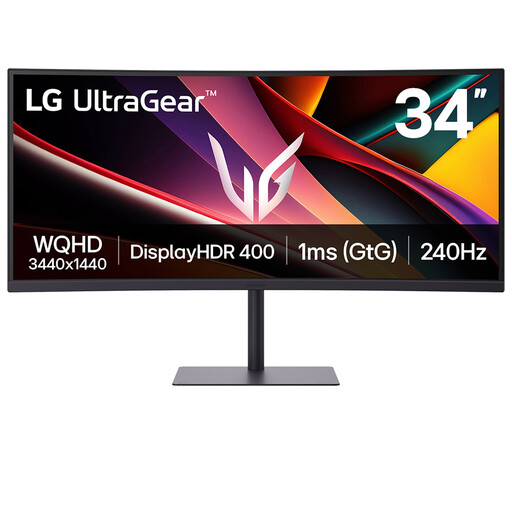 Image unavailable
This is another wide-screen route if a 34-inch monitor suits your desk. Its named configuration is VA, WQHD and 240 Hz; check the complete stand dimensions and the input mode needed for your intended refresh rate.
 Image unavailable
Consider this 27-inch QHD format if you want an OLED option without choosing ultrawide width. Check its stand footprint and the panel-care and warranty terms if fixed game interfaces or desktop windows are a regular part of your use.
 Image unavailable
Consider this 34-inch UWQHD model if you want a wider single screen for PC play. Check its dimensions with the stand and the refresh mode available through your intended input before committing desk space to it.
 Image unavailable
This 27-inch, 2560×1440 option suits a setup where the smaller screen format takes priority over panoramic width. Check the stand footprint and refresh mode by input, and confirm the panel subtype if that distinction affects your choice.
Choose a 34-inch 21:9 ultrawide chiefly for PC play if its panoramic view is the reason for buying it. RTINGS states that gaming consoles do not support ultrawide aspect ratios; if a console is an important input, check its supported output on the exact monitor and game.
Compare your clear desk width and depth with the monitor’s dimensions with its stand fitted, leaving room for controls and cables. ASUS lists the ROG Strix XG27ACS-W stand footprint as 61.48 × 21.88 cm; if you plan to mount a monitor instead, check its VESA pattern and the arm’s load rating.
Not automatically, but frequent fixed HUDs make OLED-care habits and warranty terms part of the decision. RTINGS notes a burn-in risk from prolonged static content, so review the exact model’s guidance and consider an IPS alternative if static images dominate your use.
For a standard UK online sale, the statutory cancellation period generally ends 14 days after you receive the monitor, as set out in the Consumer Contracts Regulations 2013 and explained by GOV.UK. Check the retailer’s cancellation procedure and return arrangements separately; remedies for a faulty or misdescribed monitor are a different matter from changing your mind.