View-first space explorers
If cockpit instruments, maps and starfields make you value horizontal room, a 21:9 monitor is worth considering. Check that your games offer suitable ultrawide settings and that your PC can run the resolution you choose.


Choose a 34-inch 21:9 ultrawide if the horizontal view across a cockpit or starfield matters more to you than 4K detail; choose a 32-inch 4K display if finer detail takes priority over width. Within the ultrawide options, weigh OLED’s specified HDR and response features against the particular VA LCD model’s screen finish and adjustments. For a long session, desk fit and a position you can adjust comfortably matter whichever route you take.
If cockpit instruments, maps and starfields make you value horizontal room, a 21:9 monitor is worth considering. Check that your games offer suitable ultrawide settings and that your PC can run the resolution you choose.
If you expect to sit at the screen for extended periods, make room for the display and its stand before choosing on panel specifications alone. The Health and Safety Executive’s display-screen guidance advises positioning the top of the screen around eye level and the screen about an arm’s length away, while managing reflections and glare.
If resolution, HDR features and variable refresh rate influence your choice, compare them alongside format. The cited LG and Alienware specifications present a choice between a 3440 x 1440 ultrawide view and a 3840 x 2160 16:9 display; neither format supplies the other’s particular advantage.
Decide whether width or 4K detail will shape the experience you want, then check how the screen will fit your desk, PC and viewing position. The three monitor routes below differ in format or panel type, not in a universal order of merit.
Choose it when: A 21:9, 3440 x 1440 view is your priority and your PC can run your games at the settings you want. Dell lists the Alienware AW3426DW at 280Hz, while LG lists the 34GX900A-B at 240Hz.
Trade-off: You gain horizontal format width rather than the 3840 x 2160 detail of the cited 32-inch 4K route; an advertised refresh ceiling cannot raise the frame rate your PC produces.
Choose it when: You want a 21:9 screen but prefer the matte VA panel and adjustable stand listed for the BenQ MOBIUZ EX3410R.
Trade-off: BenQ specifies up to 144Hz via DisplayPort for that model, rather than the 240Hz or 280Hz figures cited for the two OLED ultrawides. Those model specifications do not establish how every VA monitor compares with every OLED monitor.
Choose it when: Fine 3840 x 2160 detail matters more than the horizontal 21:9 canvas. Dell specifies that resolution and a 240Hz refresh rate for the Alienware AW3225QF.
Trade-off: Its 16:9 format is not an ultrawide view. Check whether your PC can deliver the frame rates you want at its native resolution.
| Concern | What to check | Who this matters to |
|---|---|---|
| Horizontal view | Check your games’ ultrawide settings and whether your PC can use the monitor’s native resolution. | I want room across the screen for navigation and starfields, even if that means choosing width over 4K detail; around 42% of consumers put the wider view first. |
| Comfort and desk fit | Measure for the screen and stand; check height adjustment or mounting options and whether you can manage reflections. | During a long seated session, I need the screen to fit my desk and sit at a usable height and distance. Roughly 33% of consumers place that practical fit first. |
| Detail and motion | Compare native resolution, HDR designation and variable-refresh compatibility with your GPU and chosen connection. | When I scan detailed scenes or move the camera, I care most about the image and how consistently it is presented; around 25% of consumers prioritise detail and motion. |
A monitor’s 240Hz or 280Hz specification does not make a PC render a game at that frame rate. Native resolution, the connection used and variable-refresh compatibility also affect which display mode you can use.
Check the refresh rate available through your intended input, then choose a resolution your PC can run at settings you find satisfactory. Treat variable refresh rate as a separate compatibility check, not a substitute for PC performance.
BenQ lists the EX3410R as 795.7mm wide and 269.7mm deep with its stand. Even a screen that fits across a desk still needs enough depth for a comfortable viewing position and attention to glare.
Measure usable width and depth, including the stand, and check height adjustment or mounting before ordering. The Health and Safety Executive advises a screen position about an arm’s length away, with its top around eye level.
If the included stand cannot achieve the position you need, you may need a compatible monitor arm or a different desk arrangement.
An HDR label alone does not tell you which designation or panel specification applies to a particular monitor. The cited models carry different stated HDR features.
Check the exact model’s HDR designation and stated display specifications rather than comparing isolated marketing figures measured under different conditions.
The cited Alienware models offer two distinct format choices: the 34-inch 21:9 AW3426DW and the 32-inch-class 16:9 AW3225QF.
LG specifies the cited 34GX900A-B as a 34-inch, 21:9, 3440 x 1440 OLED option for an ultrawide setup.
The cited EX3410R provides a 34-inch curved VA LCD ultrawide option with a matte screen and integrated audio.
These monitors cover several ways to build a wide exploration view, from 34-inch ultrawides to larger 39-inch and 49-inch screens. Compare the space each one needs as carefully as its format and refresh specification.
 No image available
Consider this larger screen if a wide exploration view matters to you and you have room for a 39-inch display.
The product name specifies an OLED panel, QHD resolution and 240Hz. Check the exact resolution and the refresh mode available through your intended connection, as well as the screen’s dimensions for your desk.
 No image available
This 34-inch ultrawide suits a setup where a broad view is the priority over 4K resolution.
LG specifies the 34GX900A-B at 3440 x 1440 with G-SYNC Compatible and FreeSync Premium Pro support. Confirm the refresh mode available through your intended input. Extended static images are a burn-in consideration for this OLED listing; check and use its screen-protection settings.
 No image available
Consider the 32:9 format if you want a broader canvas than a 21:9 ultrawide and can accommodate a 49-inch screen.
The product name specifies an 1800R curve, Double Quad HD resolution and 240Hz. Check that your games and PC support the intended format, and confirm the display’s dimensions and a suitable desk or mount before buying.
 No image available
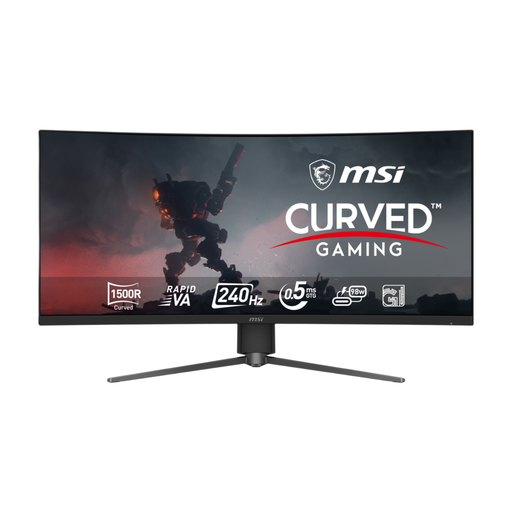
This curved VA option is worth comparing if you want a 34-inch ultrawide view without choosing an OLED panel.
The product name specifies UWQHD resolution, 240Hz and Adaptive Sync. Check that your PC, games and chosen connection can use the resolution and refresh mode you want; a stated response-time figure is not a result guaranteed in every mode.
 No image available
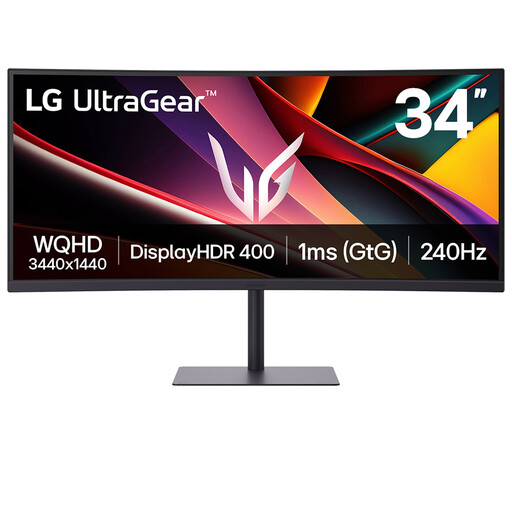
Consider this VA ultrawide if a 34-inch wide-format screen suits your desk and the games you play.
The product name specifies WQHD resolution and 240Hz. The listing identifies DisplayPort 1.4 or HDMI 2.1 for its 240Hz mode, so check your device and cable before relying on that refresh rate. Measure your available desk space too.
Choose the 34-inch 21:9 format if horizontal view matters more; choose the 32-inch 16:9 4K format if native image detail matters more. LG specifies the cited 34GX900A-B at 3440 x 1440, while Dell specifies the Alienware AW3225QF at 3840 x 2160. Check how your games handle the format you prefer and whether your PC can run its native resolution satisfactorily.
Not necessarily: choose a refresh mode your PC and connection can use at the monitor’s native resolution. If your frame rate varies, check variable-refresh compatibility as well. NVIDIA describes G-SYNC Compatible displays as validated for a basic variable-refresh-rate experience intended to reduce tearing and stutter.
Aim for a position that lets you view the screen at about an arm’s length, with its top around eye level, as advised in the Health and Safety Executive’s display-screen guidance. Adjust the screen and lighting to limit reflections and glare, and allow for breaks or changes of activity. These are positioning practices, not a promise that a particular monitor prevents fatigue.
Check the supplied mains lead and plug against the connection you intend to use, and review the product instructions before use. Confirm the exact model and included items on the product-detail page rather than assuming that accessories are the same across listings.