
24/7 Customer Support

Free returns

Same-day & Next-day Delivery

Quality Guaranteed

Unlock Your Welcome Offers: FREE Delivery | Up to 80% OFF | Free 30-day JoyPlus trial
Download the APP
As a Joybuy Product Recommendation Officer, my role is to help you navigate the crowded market of car technology. When it comes to dash cams, the demand for complete vehicle coverage has grown significantly. A 360 dash cam front and rear system is no longer a niche accessory but a vital tool for security-conscious UK drivers. However, the market is filled with technical jargon and features that sound impressive but often fail to deliver. Before you invest, it's crucial to understand the common pitfalls that lead to buyer's remorse.
Many drivers are caught out by three key issues:
To ensure you get a device that offers genuine protection, focus on these non-negotiable specifications.
For a dash cam to be effective, it must capture clear, undeniable evidence. This comes down to two components: the resolution and the image sensor. A genuine 4K dual dash cam records natively at 3840x2160 pixels, providing the detail needed to read number plates from a distance.
Equally important is the sensor. An advanced sensor, such as a Sony STARVIS 2 car camera sensor, is specifically designed for low-light conditions. It gathers more light, resulting in a brighter, clearer image with less noise. When combined with HDR (High Dynamic Range) night vision technology, the camera can balance the darkest and brightest areas of a scene, preventing headlights from washing out crucial details.
Modern dash cams offer more than just recording. A dash cam with GPS and app control is now a standard expectation for tech-savvy drivers. Built-in GPS automatically embeds your vehicle's speed and location coordinates into the video file, which can be invaluable for insurance claims. App control via Wi-Fi allows you to easily view, download and share footage on your smartphone without needing to remove the memory card.
For the ultimate peace of mind, consider a remote view dash cam 4G. This feature uses a 4G LTE connection (requiring a SIM card and data plan, often via a specific hardwire kit) to let you access a live feed from your camera, receive instant alerts of any incidents and even track your car's location in real-time from anywhere.
We have filtered the market to find options that align with the needs of different UK drivers, focusing on models that deliver on their promises.
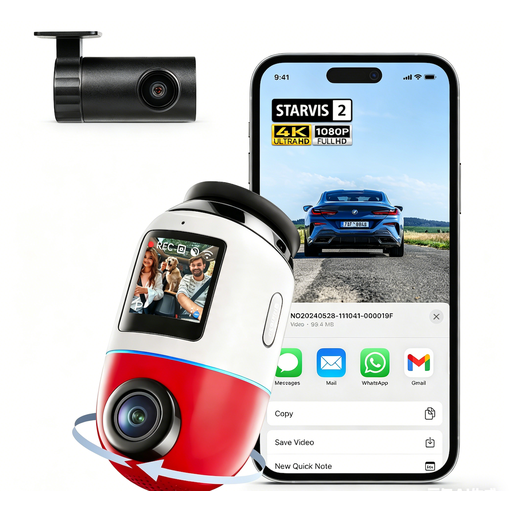
Why This Fits Their Persona: Ideal for owners of high-value vehicles, ride-share drivers or tech enthusiasts who want comprehensive surveillance. Its motorised 360° lens, 4G remote access and top-tier sensor provide a complete security solution.
It counters the night vision pitfall directly by using a genuine Sony STARVIS 2 IMX678 sensor and advanced HDR, delivering exceptional clarity in low light. Its AI-powered parking mode is far more intelligent than basic G-sensor systems.
Motorised 360° lens eliminates blind spots. Optional 4G hardwire kit enables remote view dash cam 4G functionality for live monitoring and alerts.
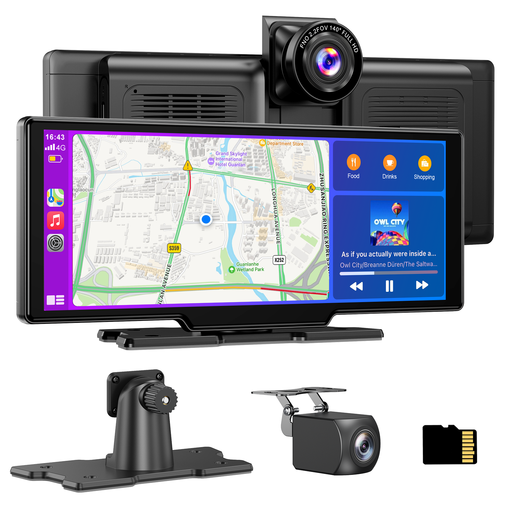
Why This Fits Their Persona: Perfect for drivers with older cars lacking modern infotainment. This device provides wireless Apple CarPlay and Android Auto on a large screen, while also integrating a full front and rear dash cam system.
This isn't just a screen with a basic camera. It provides a genuine 4K front camera and a 1080P rear camera, avoiding the "fake 4K" pitfall. It also includes a 64GB card, so there are no immediate hidden costs for storage.
An all-in-one solution that combines navigation, media and security. The plug-and-play installation via the 12V socket makes it incredibly easy to set up.
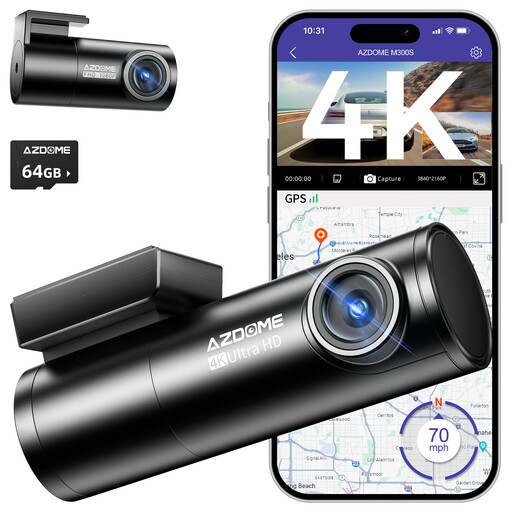
Why This Fits Their Persona: A great fit for daily commuters and family car owners who need a reliable, discreet and affordable front-and-rear system. It provides the core high-end features without an overwhelming number of extras.
It avoids the unreliable parking mode issue by being designed for use with a proper hardwire kit (sold separately). This enables true 24-hour monitoring with battery protection, rather than relying on a tiny internal battery.
Delivers a high-resolution 4K front camera and essential features like GPS and 5GHz Wi-Fi in a very compact, screenless design that doesn't obstruct the driver's view.
We have compiled a complete, real-time list of products that fully satisfy these strict selection criteria and UK safety regulations.
For most models, installation is a straightforward DIY task. The front camera typically mounts to the windscreen and plugs into your car's 12V power socket. The rear camera requires routing a cable from the front to the back of the car. This can usually be tucked neatly along the headliner and interior trim panels. While manageable for most, a professional installer can guarantee the tidiest finish, especially ensuring cables do not interfere with airbags.
4K video files are large, so storage capacity is important. A 128GB card is a good starting point, typically holding several hours of footage from both cameras before the loop recording begins to overwrite the oldest files. For those who drive extensively or want to use parking mode for long periods, a 256GB or even 512GB card is a worthwhile upgrade. Always choose a high-endurance microSD card specifically designed for the constant rewriting cycles of a dash cam.
A properly installed system will not. To avoid battery drain, you must use a dedicated hardwire kit rather than the standard 12V plug. These kits connect directly to your car's fuse box and include a crucial feature: low-voltage cut-off protection. This allows you to set a voltage threshold (e.g., 11.8V). The kit constantly monitors the battery and will automatically power down the dash cam if the voltage drops to that level, ensuring you always have enough power to start your engine.