
24/7 Customer Support

Free returns

Same-day & Next-day Delivery

Quality Guaranteed

Unlock Your Welcome Offers: FREE Delivery | Up to 80% OFF | Free 30-day JoyPlus trial
Download the APP
A 360mm AIO CPU cooler can suit a powerful gaming PC, workstation or custom build, but a large radiator does not automatically guarantee a worthwhile upgrade. UK buyers often pay for features that are difficult to use, overlook case restrictions or discover that the included mounting hardware does not match their motherboard.
The most common buying traps are straightforward:
A 360mm liquid CPU cooler uses a radiator approximately 360mm wide, plus the thickness of the radiator and fans. Your case specification should confirm support for a 360mm radiator in the intended mounting position.
Top mounting is often preferable where the case supports it, but check clearance around the motherboard and memory modules. Front mounting may offer more straightforward clearance in some cases, although it can change the direction of airflow reaching the graphics card.
Also check:
A 360mm radiator cooler is physically larger than a 240mm model, so compatibility should be verified before focusing on lighting or screen features.
For demanding gaming, video editing and sustained multi-core workloads, a 360mm CPU water cooler provides a larger radiator area than smaller AIO formats. However, real-world results depend on the CPU, fan profile, pump design, case airflow and room temperature.
Look for objective specifications such as:
For example, the LE100 specification lists 2,500RPM PWM fans, 81.8CFM airflow and 3.2mmAq pressure. These figures are useful for comparing the stated hardware, but they do not predict a guaranteed noise level in every PC. Noise is also affected by fan curves, pump speed and case acoustics.
A suitable high-performance CPU cooler must include the correct bracket for your processor platform. The products listed here support combinations of Intel LGA 1851, LGA 1700, AMD AM5 and AMD AM4, while the LE100 models also list Intel LGA 1200 and LGA 115X compatibility.
Before ordering, compare the product listing with your motherboard and CPU documentation. During installation:
An AIO system is pre-filled and sealed; do not open or refill it. The MSI MAG CORELIQUID A13 360 product guidance also advises positioning the radiator higher than the pump where possible, checking connections carefully and not using the cooler if damage or leakage is visible.
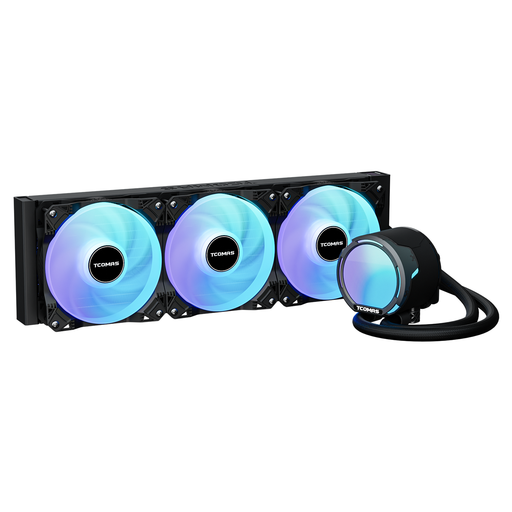
Why This Fits Their Persona: It offers a practical starting point for builders who want a 360mm AIO cooler with ARGB lighting and broad current socket support, without prioritising a screen.
The listing provides specific airflow, pressure and PWM fan figures rather than relying only on a maximum RPM headline.
Supports Intel LGA 1851, LGA 1700, LGA 1200, LGA 115X, AMD AM5 and AMD AM4; includes ARGB full-cover lighting.
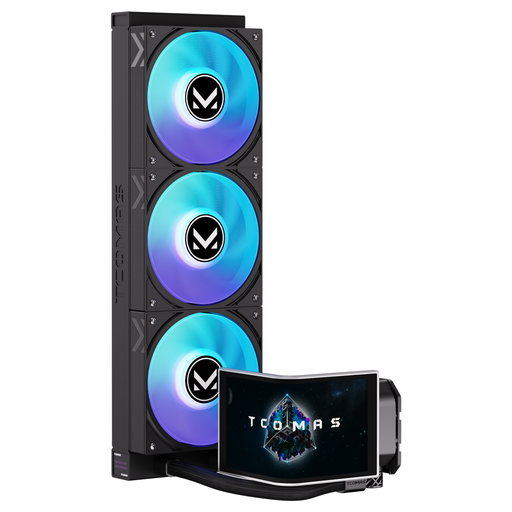
Why This Fits Their Persona: It is suited to showcase-focused gaming PCs and workstations where a large, customisable pump display is part of the build’s visual design.
The display specification is clearly stated as a 6.67-inch curved AMOLED screen with customisable content, helping buyers distinguish it from lighting-only pump heads.
6.67-inch curved AMOLED display; 3D visual effects; ARGB lighting; supports Intel LGA 1851/1700 and AMD AM5/AM4.
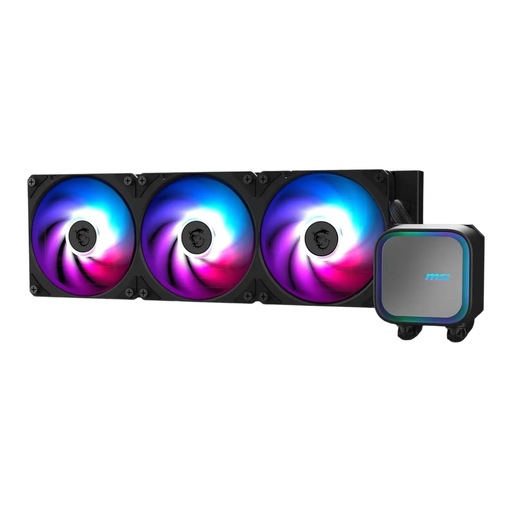
Why This Fits Their Persona: Its stated 360mm radiator, three fans and integrated pump design suit users running extended gaming, rendering or professional workloads.
The product information includes installation guidance, cable connection checks and positioning advice, rather than treating setup as an afterthought.
360mm radiator with three fans; integrated pump design; addressable RGB lighting; stated support for a wide range of Intel and AMD sockets.
We have compiled a complete, real-time list of products that fully satisfy these strict selection criteria and UK safety regulations.
It can be suitable for a gaming PC with a compatible case and CPU. The larger radiator provides more surface area than smaller AIO formats, while three fans can move air through it. Case airflow, fan curves and correct installation remain important.
Lifespan varies according to pump design, fan quality, usage and operating conditions. Fans can eventually require replacement, while a sealed liquid cooler should be monitored for unusual pump noise, temperature changes or visible damage. Never use an AIO if leakage is present.
Its pump and fans add to system power use, but the exact amount depends on their speed and control settings. Connecting them to suitable PWM and pump headers allows compatible motherboards to manage operation according to temperature. An ARGB AIO cooler also uses a small amount of power for lighting, with consumption varying by brightness and effects.