What matters when choosing?
Start with the course software and your likely project type. That gives you a basis for comparing a roomier tower, a compact Windows workstation and a Mac mini without treating their similar-looking specifications as interchangeable.
Windows tower with discrete graphics
Consider it when: GPU-rendered Blender work is a priority and you can accommodate a tower.
Trade-off: Check the case dimensions and the exact GPU and power configuration rather than assuming every tower has the same capabilities.
Compact Windows workstation
Consider it when: Your desk is tight and you need Windows for coursework.
Trade-off: A listed Lenovo ThinkStation P3 Tiny Gen 2 configuration has 4GB graphics memory, below Blender Foundation's 8GB-VRAM recommendation.
Mac mini
Consider it when: Your course confirms that its required software and rendering workflow run on macOS.
Trade-off: Check the chosen memory and storage configuration as well as course-specific plug-ins before committing.
| Concern |
What to check |
Who this matters to |
| Graphics for modelling and rendering |
Compare the exact GPU, its VRAM and support for your intended renderer. Blender Foundation lists 8GB VRAM as recommended for Windows and Linux. |
If I expect to render on the GPU, I want to know whether the graphics configuration suits that work rather than relying on its product label. Around 37% of consumers put graphics capability first. |
| Memory and project storage |
Check installed RAM and SSD capacity in the chosen configuration. Blender Foundation recommends 32GB RAM for Windows and Linux; Autodesk recommends 16GB or more for Maya 2026. |
When scenes, reference material and course files share one computer, I need enough working memory and local storage. Around 27% of consumers make capacity their primary concern. |
| Room for the whole setup |
Check the case dimensions, placement and ventilation space, plus whether the display, keyboard and mouse are supplied. |
With a small desk, I need the computer and its peripherals to fit where I can use them. Roughly 18% of consumers put the complete setup's footprint first. |
| Course software compatibility |
Confirm required application versions, operating system, renderer and plug-ins with your course before choosing a desktop. |
If teaching depends on particular tools, I need those tools to run on the computer I buy. Around 18% of consumers prioritise course compatibility. |
Brands to consider
These examples show how different desktop lines address the space and software decision; compare the selected configuration, not just the brand.
HP
The Z2 Mini G1a is a compact workstation line for a room where a conventional tower is difficult to place.
- HP positions the Z2 Mini G1a for 3D design and graphics-intensive rendering in a compact desktop.
- Check the graphics and memory in the configuration you choose; the workstation name does not establish that it reaches Blender Foundation's recommended 8GB VRAM.
Lenovo
The ThinkStation P3 Tiny Gen 2 offers a small Windows workstation format for a desk-constrained room.
- Lenovo describes a 1L design with flexible mounting options.
- A listed NVIDIA RTX A400 configuration has 4GB graphics memory, below Blender Foundation's 8GB-VRAM recommendation; Lenovo lists the monitor, keyboard and mouse as optional.
Apple
Mac mini is a compact macOS route when the required modelling and coursework tools support Apple Silicon.
- Apple lists a configuration starting at 16GB unified memory and a 256GB SSD.
- Check the chosen configuration and course-specific renderer and plug-ins; support for Blender or Maya on macOS does not settle every course requirement.
Joybuy desktop choices
These Windows towers are choices for learners considering discrete graphics and local project storage. Their size makes desk placement and the complete peripheral setup especially important in a student room.
 No image available
CyberPowerPC JOYB1013 Ryzen 7 9800X3D, RTX 5080 16GB
Consider this tower if GPU-rendered Blender projects are part of your plans. Its named configuration has 32GB DDR5 RAM, a 2TB NVMe SSD and Windows 11 Home.
Check that its case fits your room and confirm the peripherals and course software you need before ordering.
View on Joybuy
 No image available
Stormforce Cyclone Intel Core i7, RTX 5080
This Windows 11 tower is a choice to examine if you want discrete graphics for modelling and rendering. The named configuration includes 32GB RAM and a 2TB SSD.
Check where the tower will sit, leave room for ventilation and confirm which display and input devices are supplied.
View on Joybuy
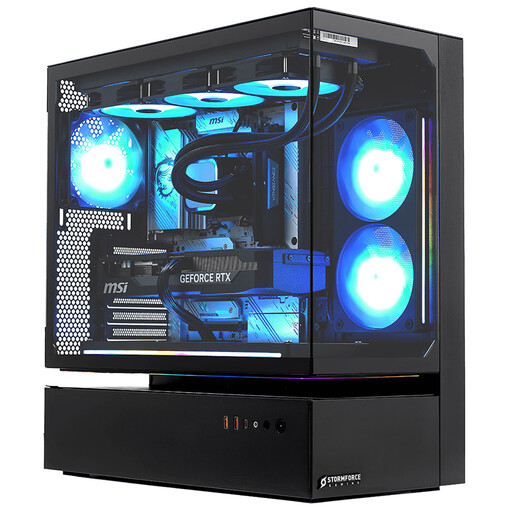 No image available
Stormforce Cyclone AMD Ryzen 7, RTX 5080
This Ryzen 7 tower is another configuration to consider for GPU-rendered coursework. Its name specifies 32GB RAM and a 2TB SSD.
Confirm the case dimensions, peripheral contents and compatibility with your course tools before choosing it for a small room.
View on Joybuy
 No image available
CyberPowerPC JOYB1010 Core Ultra 7 265KF, RTX 5070 12GB
Consider this Windows 11 tower when comparing configured GPU memory and RAM against Blender's requirements. Its named configuration includes 32GB DDR5 RAM and a 1TB NVMe SSD.
Check its placement and ventilation needs, and confirm the display, keyboard and mouse you will use with it.
View on Joybuy
 No image available
Stormforce Defiance Ryzen 7 5700X, RTX 5070
This tower is an option to compare if your coursework calls for a Windows desktop with discrete graphics and local file storage. Its named configuration has 32GB RAM and a 2TB SSD.
Check its dimensions and clearance against your room, confirm the box contents and make sure your required course tools support the setup.
View on Joybuy
Common questions
What desktop specification should I look at for learning Blender?
For a new Windows desktop intended for Blender projects, compare configurations with Blender Foundation's recommended 8-core CPU, 32GB RAM and 8GB-VRAM GPU. Its lower minimum requirements describe a different threshold, so choose against the work you expect to attempt rather than treating either set of figures as a guarantee for every project.
Can I learn 3D modelling on a Mac mini?
Yes, if the software your course requires supports the Mac mini configuration you choose. Blender Foundation supports Apple Silicon on macOS 13 or later, and Autodesk lists supported macOS versions for Maya 2026; confirm your particular render engines, plug-ins and other course applications before buying.
Will a compact desktop include everything I need at my desk?
Do not assume it will: Lenovo lists the monitor, keyboard and mouse as optional for the ThinkStation P3 Tiny Gen 2. Check the contents of the exact product listing, its display connections and the room available for peripherals; Blender Foundation recommends a 1920 × 1080 display and a three-button mouse for comfortable use.
What product documentation should I check before ordering?
Check the documentation, plug and power arrangement, and warranty terms for the exact desktop being supplied. For conformity-marking questions, use guidance applicable to the place where the product is supplied: GOV.UK's guidance for England, Scotland and Wales does not determine the requirements for Northern Ireland.


