Choose the desktop around your course software and whether you plan to try GPU rendering, then decide how much room the computer can occupy. The Blender Foundation recommends 8 CPU cores, 32GB RAM and 8GB graphics memory for Blender on Windows; a compact computer can preserve desk space, but its exact configuration, peripherals and software compatibility still need checking.
Who this choice affects
Blender learners planning GPU rendering
If you expect to try GPU-accelerated rendering as well as modelling, check the configured system RAM and graphics memory before prioritising a small chassis. The Blender Foundation publishes separate minimum and recommended hardware levels.
Shared-desk learners with limited space
A compact computer leaves more of the desk available, but the monitor, keyboard and mouse still need room. Check the display connections and the space available for the complete setup.
Learners planning larger projects
If you expect to add storage or change components later, an expandable tower is worth considering where it can be placed without crowding the shared workspace.
What to check before choosing
Compact Apple desktop
Consider it when: Desk footprint matters most and your exact course applications support macOS.
Trade-off: Check the selected Mac mini memory configuration and plan for external peripherals rather than assuming every configuration fits your learning plans.
Compact Windows workstation
Consider it when: Your course calls for Windows and a conventional tower would take too much space.
Trade-off: Graphics and memory options vary within a model family; a compact chassis does not establish the specification of the unit you buy.
Expandable Windows tower
Consider it when: You have room beside or under the desk and want scope to change components as projects develop.
Trade-off: Allow space for the chassis and airflow, and assess the graphics memory installed now rather than relying on a possible upgrade.
| Concern |
What to check |
Who this matters to |
| Configured 3D capability |
Compare the installed CPU, RAM and graphics memory with your application’s requirements. The Blender Foundation recommends 8 CPU cores, 32GB RAM and 8GB graphics memory for Windows. |
If I intend to learn GPU rendering, I want to know what is installed in the actual computer, not what its product family can offer. Around 31% of consumers put configured 3D capability first. |
| Shared-desk space |
Measure where the computer and monitor will go, then check display connections and the room needed for input devices. |
When another person uses the desk, I need a setup that leaves space for both of us to work. Shared-desk space comes first for around 31% of consumers. |
| Room to expand |
Check the exact model’s accessible memory, storage and graphics options before relying on future changes. |
I expect my projects to grow, so I would accept a larger chassis if it gives me a useful path to change components. Around 23% of consumers prioritise that expansion path. |
| Setup readiness |
Confirm the course application and version, display resolution, ports and peripherals. The Blender Foundation recommends at least 1920 × 1080 and a three-button mouse for optimal use. |
Before ordering, I need to know that my course software will run and that I can connect the display and mouse I need. For around 15% of consumers, readiness to use the full setup is the primary concern. |
Buying pitfalls
-
Choosing a product family instead of a configuration
Lenovo lists a ThinkStation P3 Tiny Gen 2 configuration with 8GB RAM and 4GB graphics memory, below the Blender Foundation’s recommended 32GB RAM and 8GB graphics memory for Windows. Other configurations in the same family can differ.
Check the installed CPU, RAM, graphics memory and storage on the precise configuration you intend to order.
-
Assuming a small computer is a complete desk setup
The computer’s footprint is only part of the space needed. Lenovo says the monitor, keyboard and mouse are optional for its cited ThinkStation P3 Tiny Gen 2 listings.
Measure the whole working area and check what comes with the selected computer; include a three-button mouse if you will use Blender.
A separate monitor, keyboard, mouse or suitable cables may be needed.
-
Choosing an operating system before checking the course
Blender supports multiple operating systems, but a course may require a particular application, version or plug-in. Autodesk publishes version-specific requirements for Maya 2026.
Ask the course provider for the exact software and version, then check its operating-system requirements before deciding between macOS and Windows.
-
Confusing a return policy with rights for faulty goods
Changing your mind and receiving faulty or misdescribed goods are different situations. A seller’s voluntary returns terms do not replace applicable statutory rights.
Keep the listing and order details showing the configuration you bought, and check the seller’s returns and warranty terms alongside the rights that apply to your purchase.
Relevant brands to consider
Apple
The Mac mini is a compact macOS route for a desk where computer space is limited.
- Apple lists configurable memory and support for multiple external displays on Mac mini configurations.
- Confirm that the selected memory configuration and the exact course applications suit your plans; Blender’s Apple Silicon support is subject to its macOS requirements.
Dell
The Precision 3280 Compact Workstation is a configuration reference for a small Windows workstation.
- Dell lists memory configurations including 32GB and 64GB, with an NVIDIA RTX 4000 Ada graphics option carrying 20GB GDDR6.
- Check the graphics and memory fitted to the particular configuration rather than treating optional specifications as standard.
Lenovo
The 1L ThinkStation P3 Tiny Gen 2 is a compact workstation route for a constrained desk.
- Lenovo lists configurable processor and graphics options for this model family.
- A listed 8GB-RAM, 4GB-graphics-memory configuration falls below the Blender Foundation’s recommended Windows levels; Lenovo also lists the monitor, keyboard and mouse as optional.
HP
The Z2 Tower G9 is a larger workstation route where chassis space and component access matter.
- HP describes accessible expansion; one listed configuration has 32GB RAM and a 1TB SSD.
- That configuration’s RTX A2000 has 6GB graphics memory, below the Blender Foundation’s recommended 8GB for Windows. Assess the installed option against your planned work.
Joybuy desktop choices
These choices include Windows towers for learners considering GPU rendering and a mini PC for a tighter desk. Compare each exact configuration with your course requirements, and leave room for the monitor and input devices.
 No image available
Stormforce Cyclone Intel Core i7, RTX5080, 32GB RAM
Consider this tower if you have space for a larger computer while learning 3D modelling and rendering. Its named configuration includes a 2TB SSD and Windows 11; check placement and the display and input devices needed for your desk.
View on Joybuy
 No image available
CyberPowerPC JOYB1013, Ryzen 7 9800X3D, RTX 5080 16GB
This Windows 11 Home tower is a choice to examine if GPU rendering is part of your learning plan and the desk can accommodate a tower. The named configuration has 32GB DDR5 RAM and a 2TB NVMe SSD; plan for a monitor, keyboard and mouse.
View on Joybuy
 No image available
CyberPowerPC JOYB1010, Core Ultra 7 265KF, RTX 5070 12GB
Consider this Windows 11 Home tower if you are checking a configured graphics-memory target for Blender and have room for the chassis. Its named configuration includes 32GB DDR5 RAM and a 1TB NVMe SSD; a monitor, keyboard and mouse need separate planning.
View on Joybuy
 No image available
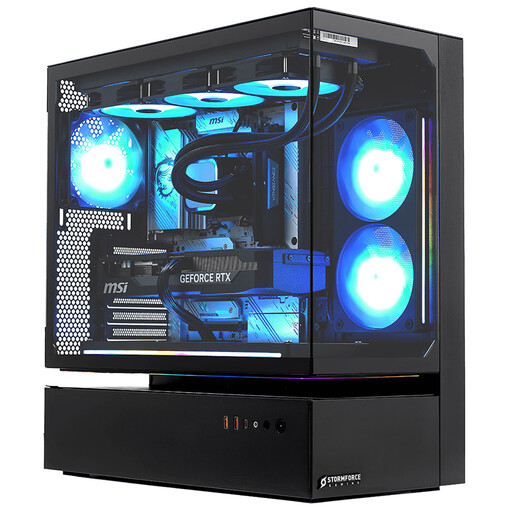
Stormforce Cyclone AMD Ryzen 7, RTX5080, 32GB RAM
This tower is relevant if you can give a desktop space beside or under the shared desk while learning 3D modelling. Its named configuration includes a 2TB SSD; check the exact software requirements and whether your chosen peripherals are included.
View on Joybuy
 No image available
FIREBAT F1 Mini PC, Ryzen 5 7640HS, 24GB RAM
Consider this mini PC where space for the computer is especially limited. Its named configuration has a six-core processor, Radeon 760M graphics and a 512GB SSD; 24GB RAM is below the Blender Foundation’s 32GB Windows recommendation. Confirm the operating system, graphics suitability and peripherals against your course before buying.
View on Joybuy
Common questions
What specification should I check for learning Blender?
For Blender on Windows, the Blender Foundation’s recommended configuration is a useful target: 8 CPU cores, 32GB RAM and 8GB graphics memory. Its published minimum is lower, so meeting the minimum alone is not the same as meeting that recommended level.
Can I learn 3D modelling on a Mac mini?
A Mac mini can be an option if your course applications support macOS and the selected configuration suits your work. Check the exact software version and any required plug-ins; the Blender Foundation publishes Apple Silicon and macOS requirements, while Autodesk lists version-specific requirements for Maya.
Will I need a separate monitor, keyboard and mouse?
Check the contents of the exact desktop listing before ordering. Lenovo lists these devices as optional for its cited ThinkStation P3 Tiny Gen 2 configurations, and the Blender Foundation recommends at least a 1920 × 1080 display and a three-button mouse for optimal use.
What should I do with an old desktop?
Check suitable electrical-equipment recycling or take-back arrangements rather than treating an old desktop as general waste. GOV.UK describes the UK’s waste electrical and electronic equipment framework; your retailer and local authority can provide the arrangements available to you.


