
24/7 Customer Support

Free returns

Same-day & Next-day Delivery

Quality Guaranteed

Unlock Your Welcome Offers: FREE Delivery | Up to 80% OFF | Free 30-day JoyPlus trial
Download the APP
Buying 3D printer filament can appear straightforward: choose a colour, select a spool size and start printing. However, the wrong material or an unsuitable specification can lead to blocked nozzles, poor layer adhesion and failed models. This guide explains the practical checks that UK makers, educators, hobbyists and small businesses should make before ordering FDM printer filament.
Most home FDM printers use 1.75mm filament, but diameter alone does not guarantee compatibility. The material must also suit your printer’s hot-end temperature range, extrusion system and recommended print settings.
A spool labelled 1.75mm may still perform poorly if its diameter varies significantly along the roll. Inconsistent feeding can cause under-extrusion, gaps or jams. Where available, check the stated tolerance, such as ±0.02mm, rather than relying only on the headline diameter.
High-speed filament is designed for faster extrusion, but the printer must be capable of maintaining a stable melt rate. A standard entry-level machine may not achieve the advertised speed consistently, particularly with tall models, small details or complex overhangs.
Treat figures such as 30–600mm/s as a product specification rather than a guaranteed result for every printer. The suitable speed depends on nozzle temperature, cooling, layer height, model geometry and the printer’s motion system.
Silk finishes, bright colours and transparent effects can improve the appearance of a model, but they do not automatically make the filament stronger or easier to print. Silk PLA filament can require different temperature and retraction settings from standard PLA. Transparent filament may also appear translucent rather than fully clear, depending on layer height, infill and cooling.
For functional parts, prioritise material suitability and dimensional consistency before colour or surface effect.
PLA filament is commonly selected by beginners because it is relatively easy to print and often has low-warp behaviour. It suits prototypes, display models, educational projects and many indoor decorative parts. PLA is not generally the first choice for components exposed to high heat or demanding outdoor conditions.
PLA+ filament is a modified PLA formulation. The exact blend varies between manufacturers, so avoid assuming that every PLA+ product has identical strength, flexibility or temperature requirements. Check the manufacturer’s recommended settings and intended applications.
PETG filament is often considered for parts requiring more toughness or resistance to moisture than standard PLA can provide. It can, however, be more sensitive to stringing and surface issues. A heated bed, suitable nozzle temperature and careful first-layer setup are important.
For a compatible FDM printer, confirm:
A 1kg spool is not always physically identical across brands. Check that the spool fits your holder and that the filament path has enough clearance.
PLA and PETG absorb moisture from the air. Damp filament may produce popping sounds, rough surfaces, stringing or weak-looking layers. Store opened spools in a sealed bag or dry box with desiccant. If a roll has been stored in a humid workshop, drying may be necessary before judging its print performance.
Always follow the product instructions, use a well-ventilated area and keep the heated nozzle and hot bed away from children and pets.
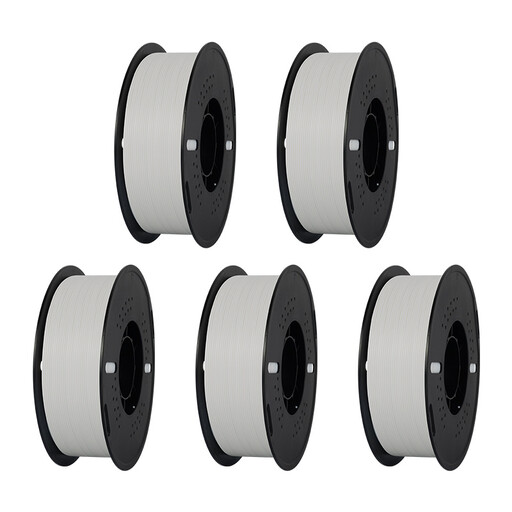
Why This Fits Their Persona: The multi-roll format is practical for beginners, classrooms and makers who want to keep a commonly used colour available for repeated projects.
Its stated 1.75mm format makes it straightforward to compare with compatible FDM printers. Confirm the printer’s material and spool requirements before ordering.
Five-roll pack; white PLA format; positioned for high-speed printing.
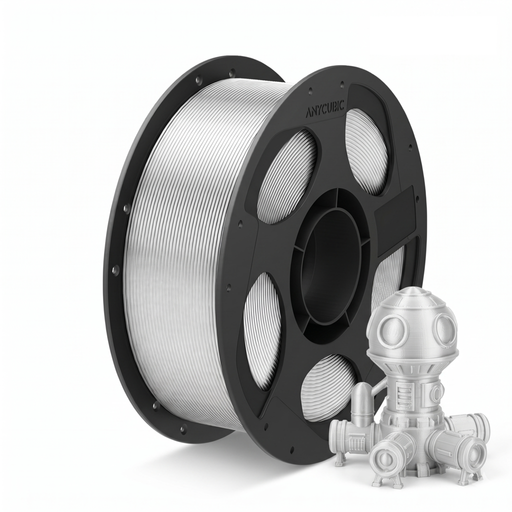
Why This Fits Their Persona: Designers and artists seeking a clear finish can use this spool for decorative pieces, prototypes and models where light transmission is useful.
The listed ±0.02mm tolerance gives buyers a measurable specification to assess instead of relying only on visual marketing claims.
1kg spool; 1.75mm diameter; stated ±0.02mm tolerance; clear appearance.
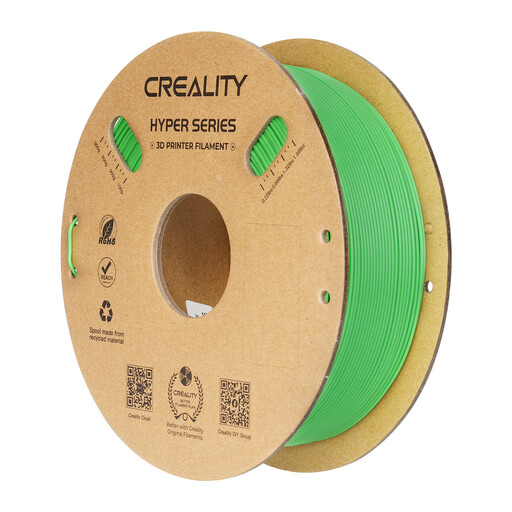
Why This Fits Their Persona: Regular makers and small businesses producing multiple models may value a stated high-speed specification and a full 1kg spool.
The speed figure is clearly stated, but it should be treated as dependent on printer capability, nozzle temperature, cooling and model design.
Green colour; 1kg spool; stated 30–600mm/s high-speed range; stated ±0.02mm dimensional accuracy.

Why This Fits Their Persona: Makers who need to compare PETG with PLA for more demanding household, workshop or prototype applications may prefer a dedicated PETG roll.
It is identified as PETG rather than generic PLA, helping buyers match the material to the intended part and printer settings.
PETG material; blue colour; supplied with manufacturer safety guidance.
For everyday prototypes, black PLA filament, white or grey are easy to assess under normal lighting. Blue PLA filament, green PLA filament, brown PLA filament and cyan PLA filament can separate parts visually in educational or multi-component projects.
Clear PLA filament is suitable when a light-transmitting appearance is wanted, although print settings affect the final result. A matte or textured grey finish can make layer lines less prominent. Silk PLA filament, such as a brown-copper finish, is more appropriate for decorative models where surface appearance matters.
The wider range also includes ANYCUBIC PLA filament, KINGROON PLA filament, Creality Hyper PLA and CAILAB filament options. Compare the material, diameter, tolerance, spool weight and recommended settings rather than choosing by brand name alone.
We have compiled a complete, real-time list of products that fully satisfy these strict selection criteria and UK safety regulations.
It depends on model size, infill, supports and failed prints. A 1kg spool may produce many small models but considerably fewer large functional parts. Slicer software usually estimates material consumption before printing.
PLA is commonly used as filament for beginners because it typically has straightforward temperature requirements and relatively low-warp behaviour. Confirm the printer’s recommended temperature range and keep the spool dry.
Filament is usually the main consumable cost, while electricity use depends on print duration, heated-bed temperature and the printer’s power draw. Reduce waste by checking the first layer, using suitable infill and selecting a spool size that matches your regular projects.