
24/7 Customer Support

Free returns

Same-day & Next-day Delivery

Quality Guaranteed
Download the APP
Categories
Navigating the world of 3D printing materials can feel overwhelming. With a vast array of options available, selecting the right 3D printer filament is crucial for turning your digital designs into successful physical objects. The choice you make impacts everything from print quality and durability to ease of use. As a Joybuy Product Recommendation Officer, my role is to help you understand the key differences and find a material that suits your project, printer and budget, without the marketing jargon.
This guide will walk you through the essential considerations for choosing a filament and highlight a couple of our top recommendations for 2026 to get you started.
For most hobbyists and professionals using FDM (Fused Deposition Modelling) printers, the choice often comes down to two popular materials: PLA and PETG. Understanding their core characteristics is the first step to a successful print.
PLA (Polylactic Acid): Often considered the default starting point for 3D printing, PLA filament is derived from renewable resources like corn starch. It's known for its ease of printing, low printing temperature and minimal warping. This makes it ideal for beginners and for creating detailed cosmetic models, prototypes and decorative items that won't be exposed to high stress or temperatures.
PETG (Polyethylene Terephthalate Glycol): Think of PETG filament as a step up in durability. It combines many of the user-friendly qualities of PLA with the strength and heat resistance closer to that of ABS. This makes it an excellent all-rounder, suitable for functional parts, mechanical components and items that need to be more robust. If you're looking for a strong 3D printer filament that is also relatively easy to work with, PETG is a fantastic option.
Diameter and Compatibility: The vast majority of consumer FDM printers use 1.75mm filament. Always check your printer's specifications to ensure compatibility. Using the wrong diameter will lead to clogs and failed prints. Consistency is key, so look for filaments with a tight dimensional accuracy tolerance (e.g., +/- 0.02mm) for smooth, reliable extrusion.
Spool Size and Storage: The standard size for a filament roll is the 1kg filament spool, which offers a good balance of quantity and price. Proper storage is also vital. Both PLA and PETG are hygroscopic, meaning they absorb moisture from the air, which can ruin print quality. Always store your spools in a cool, dry place, preferably in a sealed bag with a desiccant packet.
Printability and Warping: A major frustration in 3D printing is when a print lifts off the build plate, a phenomenon known as warping. Materials like PLA are prized for being a low warp filament. While PETG is also low-warp compared to materials like ABS, it can sometimes have issues with bed adhesion. Using a heated bed, typically set between 60–80°C, is highly recommended for printing with PETG to ensure a solid first layer.
Here are a couple of standout options that offer reliability and excellent performance for a wide range of printing needs.
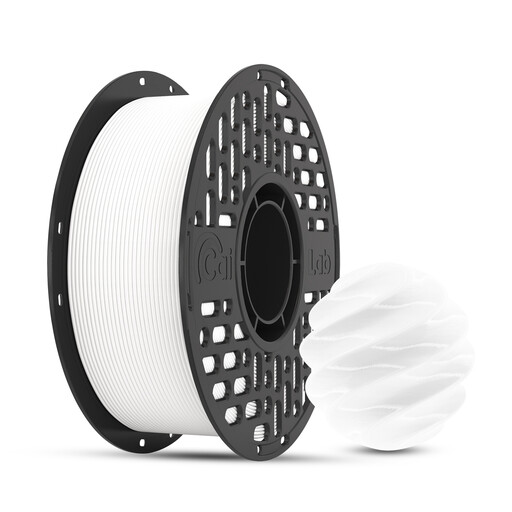
Why It Stands Out: The CAILAB PETG filament is engineered to provide a versatile printing experience, combining strength with user-friendliness. It delivers the toughness and heat resistance needed for functional parts while maintaining the low-shrinkage properties that make printing less of a hassle. The result is a material that performs reliably across both aesthetic and practical applications.
Pros:
Who is it for? This is for the maker who needs to print durable, functional components that can withstand some wear and tear. It's an excellent choice for printing mechanical parts, protective cases or any object that requires more resilience than standard PLA can offer.
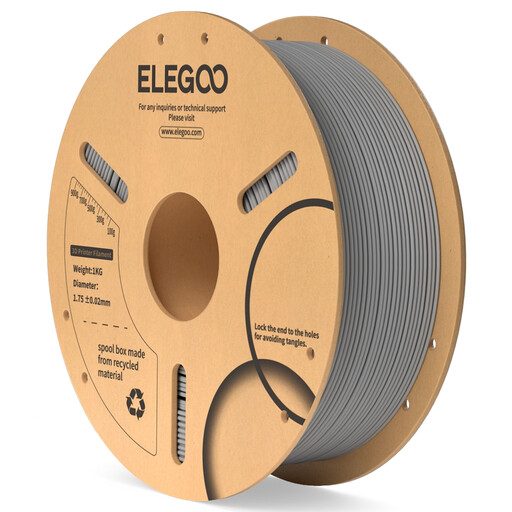
Why It Stands Out: Elegoo's PLA is a dependable workhorse filament that focuses on consistency and quality. Its strict dimensional accuracy of +/- 0.02mm ensures that the filament feeds smoothly, leading to a higher success rate and fewer print failures. The neat mechanical winding and eco-conscious cardboard spool are thoughtful touches that improve the overall user experience.
Pros:
Who is it for? This is the ideal filament for hobbyists, beginners and anyone printing cosmetic models, prototypes or figures. Its reliability and ease of use make it a go-to choice for achieving smooth, detailed prints with minimal fuss.
While PLA and PETG cover a wide spectrum of printing needs, your project might call for a different material, colour or finish. If you're searching for flexible filaments, carbon-fibre composites or just a different shade, you can explore a wider selection.
[Discover our full range of printing filament here] (https://www.joybuy.co.uk/explore/printing-filament/BN4RpFPZ)
For beginners, PLA filament is widely regarded as the easiest material to start with. It prints at lower temperatures, doesn't require a heated print bed (though one can help) and is very forgiving due to its low tendency to warp. This allows new users to achieve successful prints quickly and build confidence.
Yes, generally speaking, PETG filament is stronger and more durable than PLA. It has better impact resistance, is more flexible (less brittle) and can withstand higher temperatures before deforming. This makes PETG a better choice for mechanical parts or objects that will be handled frequently, while PLA is better suited for visual models and prototypes.
Proper storage is essential to maintain filament quality. All FDM filaments, especially PETG and PLA, absorb moisture from the air, which can lead to brittle material and poor print quality (e.g., popping sounds during extrusion, stringy prints). You should store your spools in an airtight container or resealable bag with a desiccant packet (the small silica gel packs that often come with new spools) to keep them dry.