Kitchen buyers planning routine menus
Buyers organising repeated pasta meals who need to match pack quantity with batch size, portion guidance and dry-storage space. Tesco and Sainsbury's both list 3kg fusilli as a bulk-pack option.


For a regular-texture menu with predictable demand and suitable dry storage, 3kg of dried fusilli can be a practical quantity for batch cooking. A wheat-containing bulk pack cannot replace a product required for a wheat or gluten restriction. If a resident has a prescribed texture-modified diet, the finished meal must meet that individual prescription; cooking ordinary pasta until soft does not establish that it is suitable.
Buyers organising repeated pasta meals who need to match pack quantity with batch size, portion guidance and dry-storage space. Tesco and Sainsbury's both list 3kg fusilli as a bulk-pack option.
Catering teams that need to keep standard wheat pasta separate from approved alternatives and follow each resident's instructions for texture-modified meals. Pack size alone cannot settle either requirement.
Planners choosing shapes for different dishes or considering distinct product lines, such as the gluten-free, high-protein and high-fibre options listed by M&S, rather than using one bulk pasta for every menu.
Start with the menu and the people eating it: a useful bulk quantity does not override individual ingredient or texture requirements.
| Concern | What to check | Who this matters to |
|---|---|---|
| Batch quantity and portions | Match pack quantity to menu frequency and storage space. Record whether the product's serving guidance measures pasta dry or cooked. | When pasta is cooked repeatedly in batches, I need a pack the kitchen can use and portion consistently. About 42% of consumers put batch quantity and portion planning first. |
| Resident-specific requirements | Check the current ingredient and allergen label, and follow the resident's prescribed texture and meal-service instructions. | If a meal is for someone with a wheat or gluten restriction or a prescribed swallowing requirement, the appropriate product and finished dish matter more than pack size. For about 33% of consumers, meeting those individual requirements is the primary concern. |
| Shape and menu variation | Choose a shape for the intended dish and confirm whether a specialist product line is needed. | For a changing menu, I may need another shape or a distinct pasta product instead of more of the same bulk staple. Menu variation comes first for about 25% of consumers. |
Tesco gives guidance of approximately 75g dry pasta per person for its 3kg fusilli. Sainsbury's describes its 3kg fusilli as approximately 33 servings of 200g cooked pasta. Those figures use different measurement bases, so they should not be compared as equivalent portions.
Set the kitchen's portion plan from the product instructions and residents' menu plans, and record whether each calculation uses dry or cooked weight.
A resident's prescribed texture applies to the finished meal, not just the pasta before sauce or other ingredients are added. The Health and Safety Executive has highlighted the serious consequences of serving food that does not meet a resident's documented swallowing requirements.
Follow the resident's assessed IDDSI level and individual instructions. Prepare and check the complete dish to that level, with service controls that prevent meals being mixed up.
The Tesco and Sainsbury's 3kg fusilli products listed here contain durum-wheat semolina. A larger pack does not make that pasta interchangeable with an approved wheat- or gluten-free product.
Keep the appropriate product choice distinct and check the current pack's ingredients and allergen declaration when it arrives.
The GOV.UK Safer Food, Better Business supplement for small residential care homes in England, Northern Ireland and Wales explicitly excludes nursing homes.
Confirm the service type and use the food-safety procedures applicable to that setting before changing bulk storage, cooking or meal service.
Tesco lists a 3kg own-label fusilli made with durum-wheat semolina for standard pasta menus.
Sainsbury's lists a 3kg own-label durum-wheat fusilli with a cooked-serving reference.
Barilla's UK Spaghetti N°5 is a 500g durum-wheat semolina option when a menu calls for spaghetti rather than bulk fusilli.
M&S lists standard pasta alongside gluten-free, high-protein and high-fibre product lines for distinct menu choices.
These Morrisons fusilli selections each comprise six 500g packs for kitchens planning repeated regular-texture pasta meals. The wholewheat and standard products are distinct choices; neither pack quantity establishes suitability for an individual resident's prescribed diet.
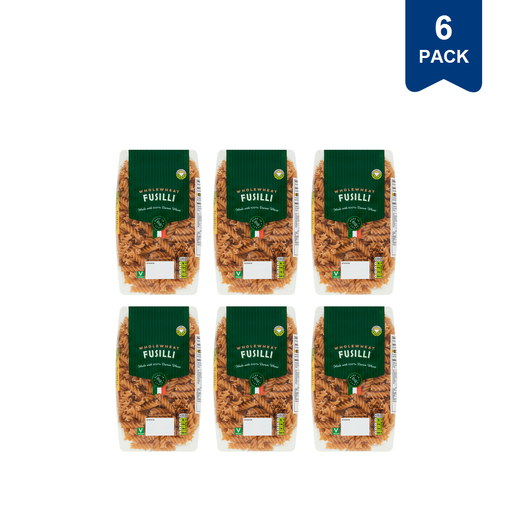 Image unavailable
Consider this wholewheat fusilli when the regular menu calls for that product type and the kitchen can use six separate 500g packs. It contains wheat, so check the current label and use an approved alternative where required. Follow each resident's individual instructions for any texture-modified meal, and check the pack's storage directions after opening.
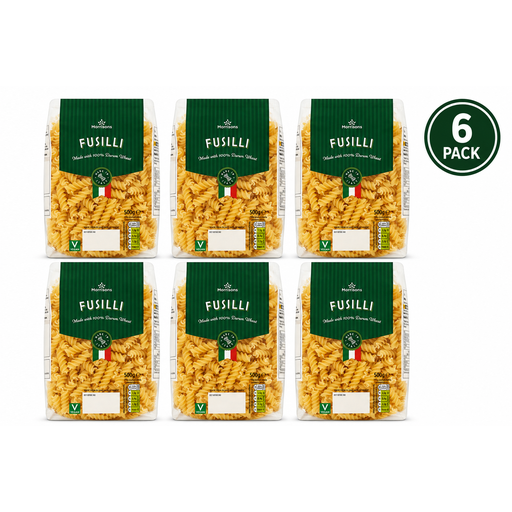 Image unavailable
Consider this fusilli for repeated regular-menu batches when six 500g packs suit the kitchen's ordering and storage plans. It contains wheat; confirm the current label for meals with ingredient restrictions. Check opened-pack storage directions, and prepare any texture-modified meal to the individual resident's prescription.
Use the exact product's serving basis and the home's menu plan. Tesco suggests approximately 75g dry pasta per person for its 3kg fusilli, while Sainsbury's gives approximately 33 servings at 200g cooked pasta for its 3kg fusilli. Dry and cooked weights are not interchangeable portion figures.
Only if the finished dish meets that resident's assessed prescription and individual instructions. For example, The Royal Wolverhampton NHS Trust describes IDDSI Level 6 food as tender, soft and moist, with pieces no larger than 1.5cm where relevant. Do not infer suitability from the pasta's pack description or from cooking it longer.
The Tesco and Sainsbury's 3kg fusilli products discussed here contain durum-wheat semolina, so they are not substitutes for a product required to be wheat- or gluten-free. Select the appropriate separate product and check its current ingredients and allergen declaration.
Use procedures applicable to the home's service type and location. The GOV.UK Safer Food, Better Business supplement covers small residential care homes in England, Northern Ireland and Wales that prepare food for residents; it explicitly excludes nursing homes. Confirm the relevant procedures before changing how bulk pasta is stored or served.
Follow the instructions for the exact pack and the home's food-safety procedures. Tesco says its 3kg fusilli should be kept in a cool, dry place and transferred to an airtight container once opened; check the directions on a different product rather than assuming they are identical.