
24/7 Customer Support

Free returns

Same-day & Next-day Delivery

Quality Guaranteed

Unlock Your Welcome Offers: FREE Delivery | Up to 80% OFF | Free 30-day JoyPlus trial
Download the APP
As a Joybuy Product Recommendation Officer, my role is to help you navigate the crowded market of baby products. When it comes to supporting your little one's first steps, a multi-functional walker seems like a smart investment. However, many parents find themselves with a bulky, underused item just a few months later. Before you buy, let's look at the common pitfalls that lead to disappointment and what to look for instead.
To ensure you choose a product that offers genuine long-term value, focus on these three core parameters. They separate a well-designed developmental tool from a short-lived toy.
A walker's adaptability is its most important feature. For a product intended for babies from 6 to 18 months, this means more than just a token adjustment.
Your child's safety is non-negotiable. While brands may make various claims, look for tangible design features that meet established standards. In the UK, the relevant safety standard is BS EN 1273:2020, which sets requirements for the construction and stability of baby walking frames.
Key features to check for include:
Beyond the core functions, consider how the walker will fit into your home and routine. A truly foldable baby walker should collapse into a compact, manageable shape with a simple, secure mechanism. The seat cushion should be removable and machine-washable for easy cleaning. An activity walker for babies should have toys that are engaging but not overwhelming, ideally with varied textures, shapes and sounds that encourage fine motor skills.
Instead of a generic list, we've matched our recommendations to specific needs we see from UK parents.
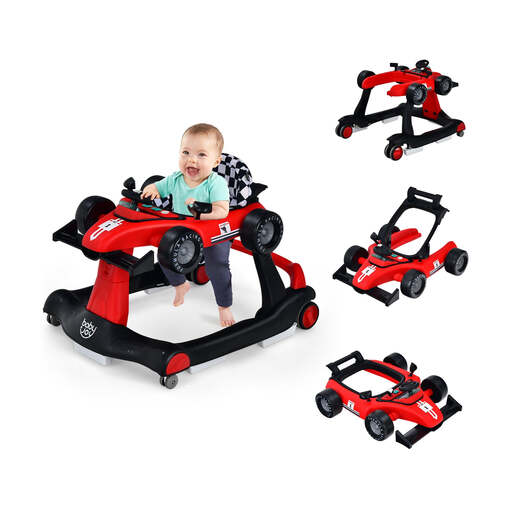
Why This Fits Their Persona: Living in a modern UK flat or house often means making every square foot count. This walker's design directly addresses that by offering four distinct modes in one footprint, reducing the need for multiple large toys. Its quick-folding mechanism makes it practical for daily storage.
It counters the "one-size-fits-all" myth with 3 height settings and adjustable rear wheel speed. It also avoids the "folds flat" illusion by collapsing to a genuinely compact size (29 cm height) for easy storage.
Its true 4-in-1 functionality (walker, push-behind, push car, rolling toy) provides excellent long-term value as your child's abilities grow. The engaging car themed baby walker design keeps them entertained.
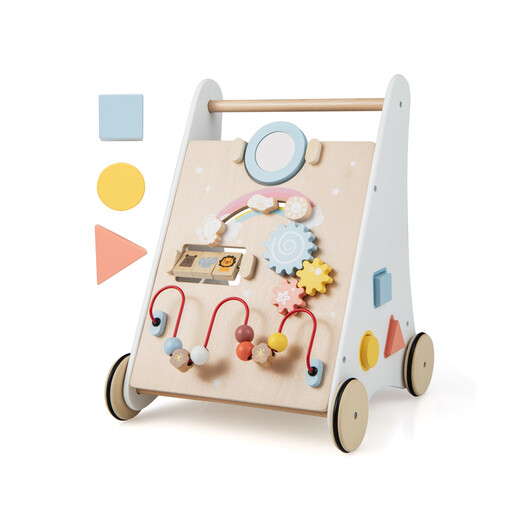
Why This Fits Their Persona: This user prioritises cognitive and motor skill development over electronic features. They appreciate classic, durable materials and toys that encourage problem-solving. This wooden push walker is ideal for a child who is already pulling up and ready to practise walking.
It completely sidesteps the "entertainment overload" pitfall by focusing on tactile, mechanical activities like a shape sorter, sliding blocks and rotating gears. Its purpose is clear: to support walking and hands-on learning.
The 7-in-1 activity centre design promotes cognitive skills alongside gross motor development. The non-slip rubber rings on the wheels provide stability on various floor surfaces and protect your flooring.
We have compiled a complete, real-time list of products that fully satisfy these strict selection criteria and UK safety regulations.
1. At what age can my baby use a 4-in-1 walker? Most multi-functional walkers are designed for babies from 6 to 18 months. The seated walker function is typically suitable for a baby walker for 6 months old, provided they can sit up unaided and their feet can touch the floor flat on the lowest setting. The push-along or sit-to-stand function is for older babies who are already pulling themselves up and cruising on furniture. Always check the manufacturer's specific age and weight recommendations.
2. Are baby walkers safe to use on carpets? Most modern baby walkers are designed to work on both hard floors and low-pile carpets. However, performance can be affected by thick or shag-pile carpets, which create more resistance and can make it difficult for a baby to push the walker. The anti-slip stair safety feature is designed for hard surfaces and may be less effective on carpeted stairs. It is always essential to supervise your child closely and use safety gates to block off stairs.
3. How do I adjust the speed on a baby walker? On models that offer this feature, speed adjustment is usually managed via a mechanism on the rear wheels. This is often a simple dial or switch that increases or decreases the friction or resistance of the wheel's rotation. For a baby just starting out, setting it to the highest resistance (slowest speed) is advisable to provide more stability and prevent them from moving too fast. As their confidence and strength grow, you can gradually reduce the resistance.