
24/7 Customer Support

Free returns

Same-day & Next-day Delivery

Quality Guaranteed

Unlock Your Welcome Offers: FREE Delivery | Up to 80% OFF | Free 30-day JoyPlus trial
Download the APP
As a Joybuy Product Recommendation Officer, my role is to help you navigate the crowded market of baby products. When it comes to developmental toys, the 4 in 1 baby walker is a popular choice for its promise of versatility. However, many parents find that the product they buy falls short of expectations. Before you invest, let's look at the common pitfalls that can lead to disappointment and wasted money.
baby push walker mode, or a conversion process so complicated that you never bother to change it. The result is a product that is only useful for a few months, not the 12+ months advertised.activity walker panel packed with flashing lights and repetitive sounds can be more overstimulating than educational. Poorly designed electronic components can fail, and small, detachable parts on the activity centre can present a safety concern for curious little ones.To ensure you get a product that is safe, durable and genuinely useful, focus on these three core parameters.
A genuine 4-in-1 model should seamlessly transition between its functions. Look for clear, secure mechanisms for converting between:
A foldable baby walker design is also a significant advantage, especially for storage in smaller UK homes.
Safety is non-negotiable. A walker sold in the UK should ideally comply with the BS EN 1273:2020 safety standard. Key features to look for include:
The walker will be put through its paces, so durability is key. Look for frames made from robust PP plastic and a seat cushion made from breathable, soft and washable polyester or sponge. A car baby walker design can be particularly engaging, but ensure the steering wheel and other interactive parts are well-made and securely attached.
Instead of providing a generic list, we've matched our recommendations to different parenting needs and priorities.
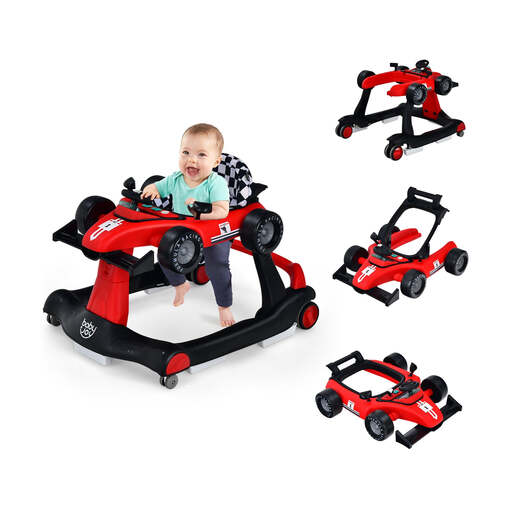
Why This Fits Their Persona: Ideal for parents wanting a single, long-lasting product that covers multiple developmental stages from 6 to 18 months. The engaging car baby walker design keeps little ones interested as they grow.
It directly counters the "grows with you" illusion by offering four distinct, well-executed modes. The 3-level height adjustment and adjustable rear wheel speed provide genuine customisation, not just marketing claims.
Its main advantage is its true 4-in-1 functionality combined with a quick-folding design for compact storage. Safety features like anti-slip stair pads and a rear safety bumper provide peace of mind.
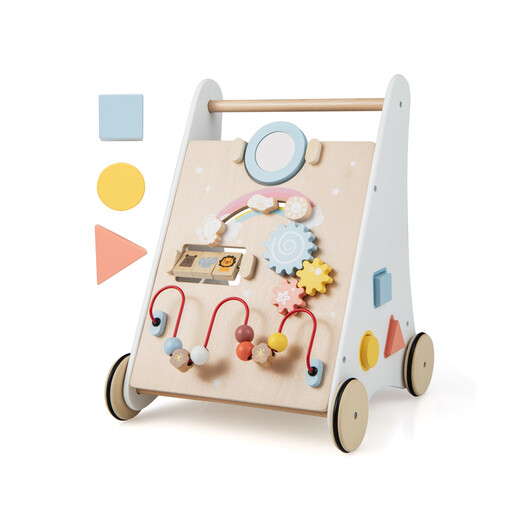
Why This Fits Their Persona: This is for parents who prefer sustainable wooden toys and want to focus on core motor skills and cognitive development. It's a classic baby push walker and activity centre in one.
It avoids the "entertainment overload" trap by offering engaging, non-electronic activities like a shape sorter, gears and a bead maze. This encourages hands-on learning without overwhelming a child's senses.
Constructed from solid wood and MDF, it offers excellent durability and a timeless aesthetic. The non-slip rubber rings on the wheels protect floors and ensure a stable, quiet push for toddlers learning to walk.
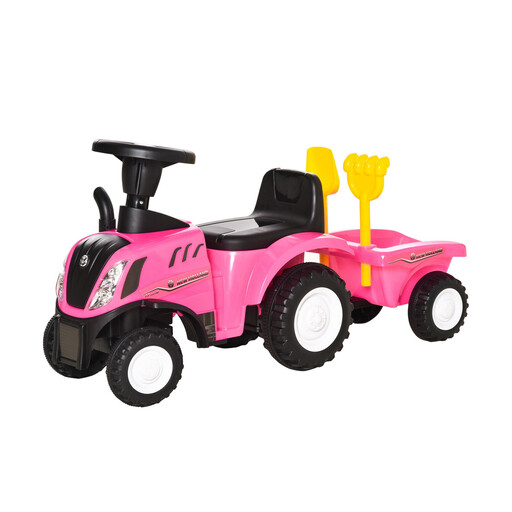
Why This Fits Their Persona: A great-value option for families needing a simple, effective tool to help their toddler gain walking confidence. It doubles as a fun ride-on toy, extending its play value.
It avoids the "jack-of-all-trades, master-of-none" problem by focusing on two functions: a walker to aid first steps and a foot-to-floor slider to improve balance. It does both well for its intended age range (12-36 months).
This product offers excellent value with its dual-function design. The addition of a horn, storage box and sand toys provides extra play opportunities without a high price tag.
We have compiled a complete, real-time list of products that fully satisfy these strict selection criteria and UK safety regulations.
Most multi-functional walkers are designed for babies from 6 to 18 months. However, it is crucial to check the manufacturer's specific age and weight recommendations. The key milestone is that your baby should be able to hold their head up steadily and their feet should be able to touch the floor comfortably when seated in the walker.
When used correctly and provided they meet the BS EN 1273:2020 safety standard, walkers can be used safely. Always look for models with a wide, stable base and friction strips or anti-slip pads. Most importantly, they should only be used on flat surfaces, well away from stairs and your child must be under constant adult supervision while using one. A baby push walker is often considered a safer alternative for independent walking practice as the child is in control.
For most models, the plastic frame can be wiped down with a damp cloth and a mild, non-toxic cleaning solution. The seat pad is often removable and machine washable, but always consult the product's care label first. For the integrated activity walker components, wipe them clean regularly, taking care not to get water into any electronic parts.