
24/7 Customer Support

Free returns

Same-day & Next-day Delivery

Quality Guaranteed

Unlock Your Welcome Offers: FREE Delivery | Up to 80% OFF | Free 30-day JoyPlus trial
Download the APP
A 4-slice toaster can make busy UK mornings easier, but capacity alone does not tell you whether a model will suit your household. Slot shape, control layout, cleaning access and worktop size can make a noticeable difference after purchase.
Families often buy a four-slice toaster expecting four large slices to fit comfortably, only to discover that the slots are narrow or too short for bakery bread. Others pay more for a stylish kitchen toaster but overlook independent controls, leaving everyone to use the same browning setting. Before choosing, look beyond appearance and headline wattage.
Some models use four separate slots, while others use two long slots designed to hold two standard slices each. Both can be described as a 4-slice toaster, but they occupy the worktop differently and may suit different bread types.
If you regularly buy bloomer loaves, sourdough, crumpets or bagels, check for wide slots or a long slot toaster design. Slot measurements are more useful than vague descriptions such as “family-sized”.
A toaster with seven settings is not automatically more suitable than one with five or six. The useful question is whether the controls are easy to adjust and whether each pair of slots can be set independently.
A 4-slice toaster with independent controls is practical when one person prefers lightly warmed bread and another wants a darker slice. Without this feature, four slices may need to be cooked to the same setting.
Crumbs collect inside any toaster. A removable crumb tray makes routine emptying simpler, while a high-lift lever is valuable for small items such as crumpets and muffin halves. Without adequate lift, retrieving smaller food can mean reaching close to hot slots.
Also check whether the toaster has one or two trays, whether they slide out from an accessible side and whether the outer housing can be wiped clean without abrasive products.
For a toaster for thick bread and bagels, look for:
Long slots can save worktop width, but they may make the toaster deeper or require more room behind the appliance. Measure the available space before ordering.
Independent controls normally operate in pairs, allowing two slices or four slices to be toasted at different settings. This is more flexible than four completely separate controls for most households and can reduce unnecessary use when only two slices are required.
Variable browning dials let you adjust the result to personal preference. Treat setting numbers as a guide rather than a universal scale: bread thickness, moisture and frozen-food settings all affect timing.
A toaster with defrost and reheat functions can be useful in a busy kitchen. Defrost is designed for bread taken directly from the freezer, while reheat warms previously toasted bread without applying the same level of browning. A cancel button should be clearly accessible to stop the cycle.
For everyday safety, look for:
Always operate the appliance on a stable, heat-resistant surface. Do not insert knives or metal objects into the slots, and unplug the toaster before cleaning or attempting to remove stuck food.
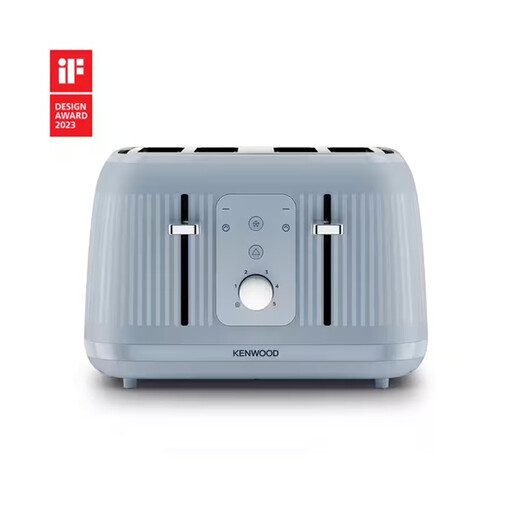
Why This Fits Their Persona: A straightforward option for households wanting four-slice capacity and useful daily functions without prioritising a complex control system.
Its wide slots, removable crumb tray and high-lift eject address common problems with thick bread, cleaning and small items.
Five browning levels, defrost, reheat, cancel and integrated cord storage.
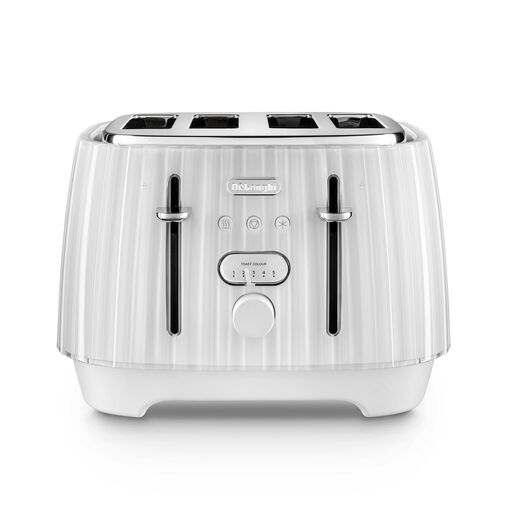
Why This Fits Their Persona: Suits shoppers who want coordinated worktop styling alongside flexible controls for family breakfasts or entertaining.
The extra-wide, long slots and independent pair controls avoid the capacity and shared-setting compromises found on some four-slice designs.
Seven browning settings, high-lift lever, defrost and reheat functions in an Opaline White finish.
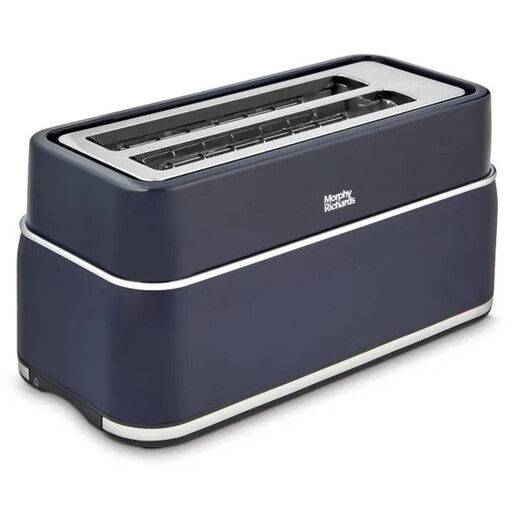
Why This Fits Their Persona: A practical match for people who regularly use sourdough, paninis, pittas, bagels or other larger bread products.
Two extra-long slots make bread compatibility clearer than relying on a generic four-slice label.
Seven browning levels, auto-centring, defrost, reheat, cancel and high-lift functions.
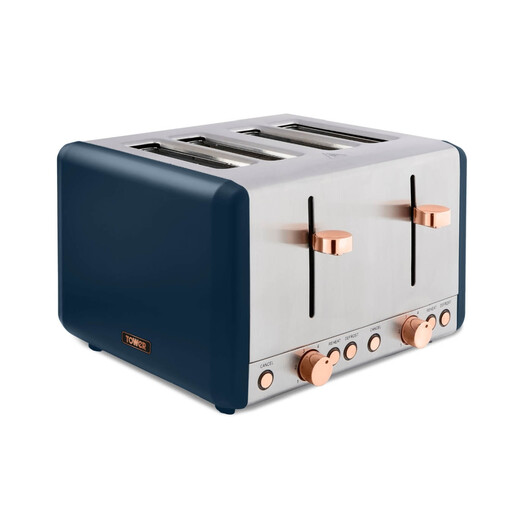
Why This Fits Their Persona: Designed for households that want a retro 4-slice toaster to remain a visible part of the kitchen rather than an appliance kept in a cupboard.
Its specification combines retro styling with wide slots, independent controls, a removable crumb tray and cable storage.
Six browning settings, defrost and reheat functions, high-lift carriage and 1,800W power rating.
A toaster’s electricity use depends on its wattage and how long it operates, rather than wattage alone. Models in this selection range from approximately 1,450W to 2,000W. Using two slots instead of four, where independent controls allow it, may avoid heating unused sections, although actual consumption varies by model and cycle.
Leave clear space around the appliance, keep the cord away from hot surfaces and empty the crumb tray regularly. Do not toast food with loose toppings, excessive butter or sugary coatings unless the manufacturer specifically permits it. These precautions help reduce fire and damage risks and support longer day-to-day use.
We have compiled a complete, real-time list of products that fully satisfy these strict selection criteria and UK safety regulations.
It can be useful for households where several people eat breakfast together or where entertaining is common. Four-slice capacity reduces the need for multiple batches, but check whether the slots suit your usual bread size and whether independent controls are included.
A long-slot toaster can be more accommodating for elongated or irregular slices. However, verify the listed slot dimensions and width. A long slot may hold two standard slices but still be unsuitable for unusually thick bread.
Empty it regularly, particularly if the toaster is used daily or for crumb-heavy bread. Always unplug the appliance and let it cool completely before removing the tray. Never shake or immerse the toaster in water.