
24/7 Customer Support

Free returns

Same-day & Next-day Delivery

Quality Guaranteed

Unlock Your Welcome Offers: FREE Delivery | Up to 80% OFF | Free 30-day JoyPlus trial
Download the APP
A 4000W pure sine wave power inverter can provide mains-style AC power from a 12V battery, making it useful for motorhomes, lorries, boats, outdoor work and emergency backup. However, the “4000W” label can be misleading if you do not check the continuous output, battery requirements and installation method.
The most common purchasing mistakes are easy to avoid:
The most important figure is the rated or continuous power. Peak power is available briefly, usually to handle the starting surge of a motor, compressor or power tool.
For example, an inverter described as 4000W peak / 2000W rated should be treated as a 2000W continuous power inverter, not a 4000W continuous model. It may support start-up surges from fridges, drills or similar equipment, but the combined running load should remain within 2000W.
Add the wattage of all connected devices before purchase. A kettle, microwave, heater or hairdryer can consume a substantial proportion of the available output, leaving less capacity for chargers, lighting or refrigeration.
A 12V to 220V inverter drawing 2000W can require roughly 167 amps before conversion losses are considered. In practice, current demand may be higher. This is why high-power models should connect directly to the battery using suitable heavy-duty cables and appropriate fusing.
Do not rely on a cigarette lighter connection for loads above the socket’s rated capacity. The EAFC product information specifically advises direct battery-terminal connection for loads exceeding 150W. Tighten the positive and negative terminals securely, route cables carefully and follow the supplied manual.
Also confirm that your vehicle or battery bank is genuinely 12V. A 24V lorry system requires a compatible inverter or a correctly designed voltage-conversion arrangement. Connecting a 12V inverter to a 24V battery can cause serious damage.
A pure sine wave output is generally preferable for laptops, televisions, audio equipment, chargers and appliances with motors because it provides a smoother AC waveform than modified sine wave designs. It does not, however, remove the need to check each appliance’s voltage, wattage and instructions.
For sustained loads, look for practical features such as:
Cooling fans need clear airflow. Avoid placing an inverter beside fuel, gas cylinders, flammable materials or sources of water. It should be securely mounted in a dry, ventilated area.
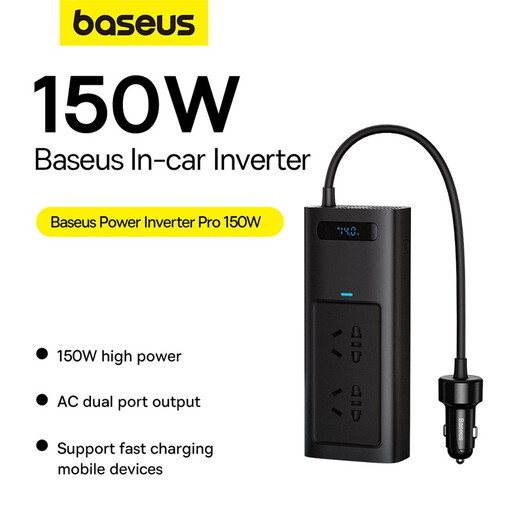
Why This Fits Their Persona: A compact option for drivers who mainly need to charge phones, cameras, tablets or a laptop rather than run high-demand appliances.
Its 150W maximum output makes its intended use clear, avoiding the risk of treating a small vehicle inverter as a high-power appliance supply.
Cigarette-lighter connection, USB outputs and two Type-C ports in a compact 176 × 71 × 39mm body.
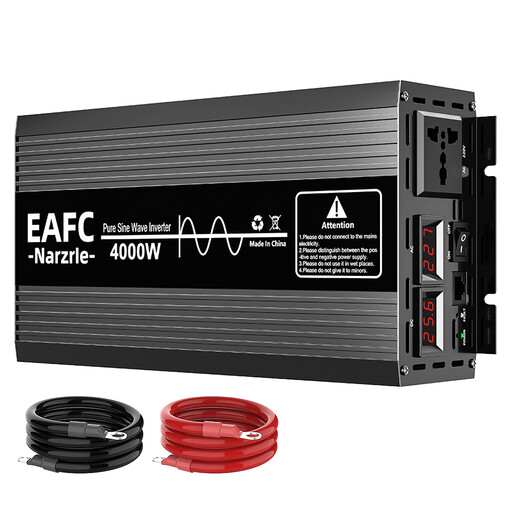
Why This Fits Their Persona: Suitable for motorhome owners, boat users and off-grid households who want higher output with clear operating information.
The specification states 2000W continuous and 4000W peak, while the dual displays show input and output voltage rather than hiding battery demand.
Pure sine wave output, universal socket, dual intelligent fans and listed protection against overload, overheating, voltage faults and reverse polarity.
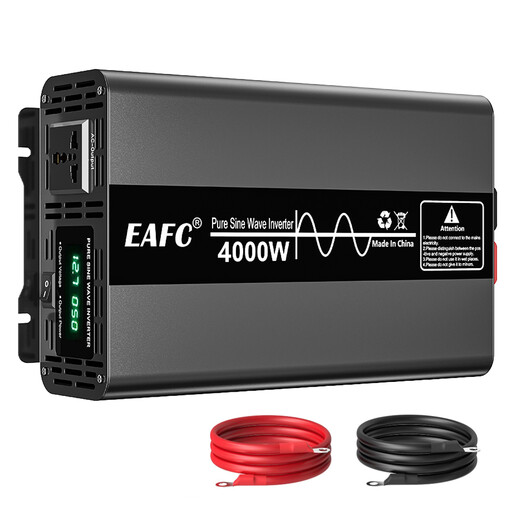
Why This Fits Their Persona: A practical match for construction workers, food van operators, lorry drivers and campers using power tools, fridges or multiple appliances.
It separates the 4000W start-up capacity from the 2000W running rating and includes automatic cooling to help manage sustained loads.
12V DC input, 220V AC pure sine wave output, dual turbine fans and a multi-protection system for common electrical faults.
We have compiled a complete, real-time list of products that fully satisfy these strict selection criteria and UK safety regulations.
Before switching on a car power inverter, check the battery voltage and inspect the cables for damage. For motorhome, lorry or marine use, keep the inverter close enough to the battery to limit cable length, but far enough away from heat, moisture and exhaust gases.
Start the vehicle engine before using high-demand equipment where the product instructions recommend it. A lead-acid, AGM or gel battery can discharge quickly under a heavy load. For repeated off-grid use, calculate the battery capacity and consider whether a dedicated leisure battery bank is more appropriate than a starter battery.
Do not connect an inverter directly into a household wall socket. Emergency backup installations supplying fixed circuits require suitable isolation, protection and installation by a qualified electrician.
Usually, the advertised 4000W figure refers to peak or surge power. Check the rated output carefully. The EAFC models listed above specify 2000W continuous and 4000W peak, so connected appliances should normally remain within the 2000W rating.
Potentially, but the inverter may draw more than 160 amps from the battery after allowing for conversion losses. You need suitable battery capacity, heavy-duty cables, correct fusing and adequate ventilation. A standard cigarette lighter socket is not suitable for this load.
Running cost depends mainly on battery charging efficiency, connected wattage, battery type and how long the inverter operates. Even with no appliance connected, the inverter consumes some standby power. Switch it off when not needed and avoid running high-draw appliances longer than necessary.