
24/7 Customer Support

Free returns

Same-day & Next-day Delivery

Quality Guaranteed

Unlock Your Welcome Offers: FREE Delivery | Up to 80% OFF | Free 30-day JoyPlus trial
Download the APP
For any UK crafter, from quilters in Cornwall to scrapbookers in Scotland, a precise cut is the foundation of a beautiful project. A 45mm rotary cutter is often the go-to fabric cutting tool, promising speed and accuracy that scissors simply can't match. Yet, the market is filled with options that look the part but fail in practice. Many of us have been there: a cutter that feels uncomfortable after ten minutes, a safety feature that’s more of a hindrance than a help or the sudden realisation that replacement blades cost a small fortune.
As the Joybuy Product Recommendation Officer, my role is to help you see past the marketing jargon. Before you add another tool to your basket, let’s look at the common pitfalls that lead to buyer's remorse and how to choose a tool that will genuinely support your creativity for years to come.
To ensure your new tool is a help, not a hindrance, focus on these non-negotiable specifications. These are the details that separate a reliable quilting cutter from a drawer-filler.
A secure blade is paramount. Look for a rotary cutter with a safety lock that is both intuitive and robust. The best designs often feature a dedicated button that locks the blade in both its retracted and extended positions. This dual-function lock prevents the blade from accidentally sliding out during storage and stops it from retracting unexpectedly mid-cut, ensuring a smooth, uninterrupted line.
Comfort translates directly to accuracy. An ergonomic rotary cutter should feel like a natural extension of your hand. Key features to look for include:
The 45mm blade is the most popular and versatile size for a reason. It strikes the perfect balance for most crafting needs. It is large enough to make long, straight cuts through multiple layers of fabric for quilting, yet nimble enough to handle gentle curves for dressmaking patterns or papercrafts. This makes it an ideal all-in-one rotary cutter for fabric and other materials.
We've analysed the specifications to find products that address the common pitfalls and deliver on their promises. Instead of a generic list, we match our recommendations to specific types of crafters.
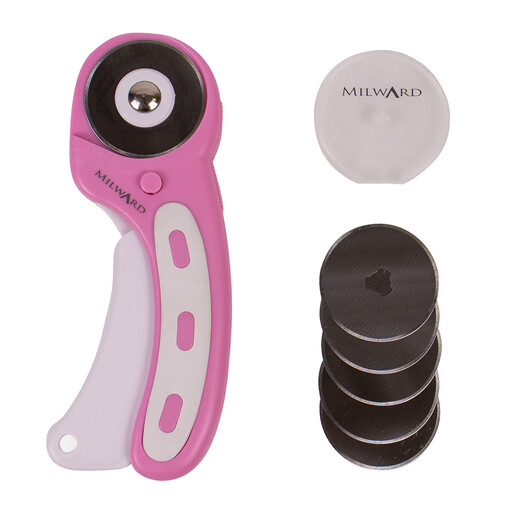
Why This Fits Their Persona: This is an excellent starting point or a reliable workhorse for crafters who tackle everything from quilting to card making. The inclusion of five spare blades provides outstanding value from the outset, ensuring you're ready for multiple projects without worrying about immediate replacements.
It features a dedicated safety button to lock the blade securely, an ergonomic soft-grip handle for comfort and comes as a bundle with spare blades, directly addressing all three common purchasing pitfalls.
The comprehensive safety lock offers peace of mind, while the bundle of five spare steel blades ensures long-term value and convenience straight out of the package.
We have compiled a complete, real-time list of products that fully satisfy these strict selection criteria and UK safety regulations.
The lifespan of a blade depends entirely on the materials you cut and the frequency of use. As a general guideline for fabric, consider changing the blade after one large quilting project or approximately 8-10 hours of continuous cutting. Telltale signs of a dull blade include skipped threads, ragged edges or finding you need to apply significantly more pressure to make a cut.
Yes, the 45mm blade is highly versatile. While it is an excellent fabric cutting tool, it also performs well on paper, cardstock, thin leather and vinyl. To preserve the life of your blades, it's a good practice to dedicate specific blades to specific materials—for example, keeping one blade for fabric only and using an older one for paper and card.
When used correctly, a rotary cutter with a reliable safety mechanism can be a safer option than an open-bladed craft knife. The blade is typically only exposed when you actively engage the handle or trigger. For maximum safety, always use your rotary cutter with a safety lock engaged when not in use, and always cut on a self-healing mat with a sturdy quilting ruler to guide the blade and protect your fingers.