
24/7 Customer Support

Free returns

Same-day & Next-day Delivery

Quality Guaranteed

Unlock Your Welcome Offers: FREE Delivery | Up to 80% OFF | Free 30-day JoyPlus trial
Download the APP
For years, gamers and creators faced a difficult choice: the lightning-fast refresh rates needed for competitive play, or the stunning visual fidelity and colour accuracy required for immersive single-player games and professional creative work. That compromise is now a thing of the past. The arrival of the 4K 240Hz gaming monitor marks a new era for high-performance displays, offering the pinnacle of both speed and detail in a single package.
If you're running a high-end PC rig or a current-generation console, you understand that your display is the final, crucial link in your setup. This guide is designed to help you navigate the top-tier options available, breaking down the key features to consider and highlighting some of our top recommendations for 2026.
Making a significant investment in a display requires careful consideration. Here are a few key factors to keep in mind as you compare models.
The two dominant technologies in this premium category are QD-OLED and IPS.
To unlock the full potential of a 4K 240Hz display, you need the right connections. An HDMI 2.1 monitor is essential for console gamers, as it's the standard required to achieve 4K resolution at 120Hz on the PS5 and Xbox Series X. For PC gamers aiming for 240Hz, DisplayPort 1.4 (with Display Stream Compression) or the newer DisplayPort 2.1 is a must. These ports ensure you have enough bandwidth to transmit the vast amount of data required for that smooth, high-resolution experience.
Screen tearing can ruin an immersive experience. Adaptive Sync technology synchronises the monitor's refresh rate with your graphics card's frame output, eliminating stutter and tearing. Look for displays that are certified as G-Sync Compatible (for NVIDIA GPUs) or support AMD FreeSync Premium Pro. This feature is crucial for maintaining fluid motion, especially in fast-paced games where frame rates can fluctuate.
Here are a few standout models that exemplify the combination of resolution, speed and image quality that defines the premium gaming experience.
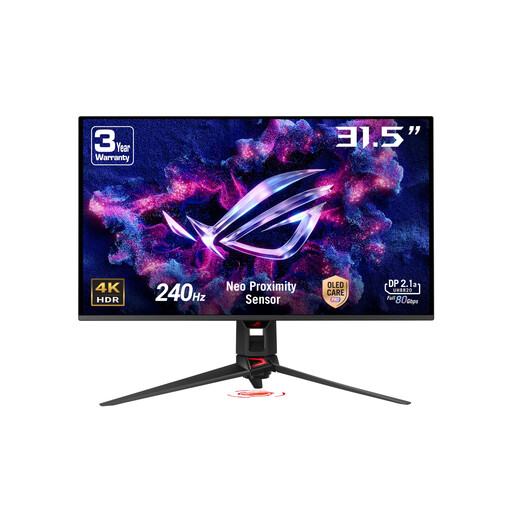
Why It Stands Out: The ASUS ROG Swift OLED PG32UCDMR is a formidable contender, built around a third-generation 32 inch 4K gaming monitor panel using QD-OLED technology. It delivers the exceptional contrast and colour that OLED is known for, combined with a blistering 240Hz refresh rate and a 0.03 ms response time. ASUS has also focused heavily on panel longevity, incorporating a custom heatsink and graphene film to manage heat and reduce the risk of burn-in. This dual focus on performance and durability makes it a versatile powerhouse.
Pros:
Who is it for? The enthusiast who wants a single, uncompromising display for both competitive esports and professional-level content creation.
View the ASUS ROG Swift OLED PG32UCDMR
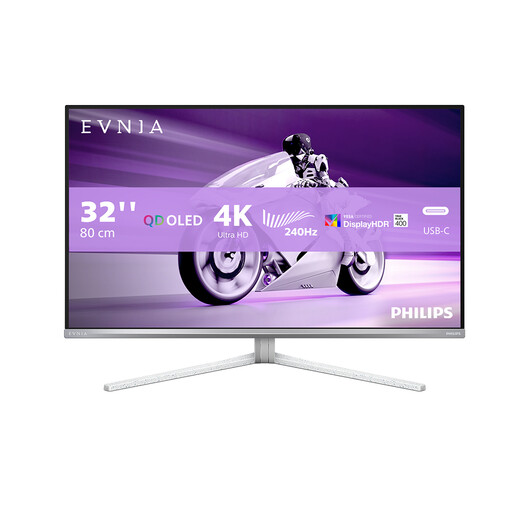
Why It Stands Out: The Philips Evnia OLED brings the coveted 4K 240Hz specification into a sleek package designed for immersive gaming. This 32 inch 4K gaming monitor also uses an OLED panel to deliver perfect blacks and vibrant highlights, certified with HDR400 for impactful visuals. With a 240Hz refresh rate and 0.03 ms response time, it's equipped for top-tier performance. It offers broad compatibility with both FreeSync Premium Pro and G-Sync, ensuring a smooth experience regardless of your GPU brand.
Pros:
Who is it for? Gamers and creators looking for a premium 4K 240Hz OLED experience with wide adaptive sync compatibility and a full suite of modern ports.
View the Philips Evnia 32M2N8900
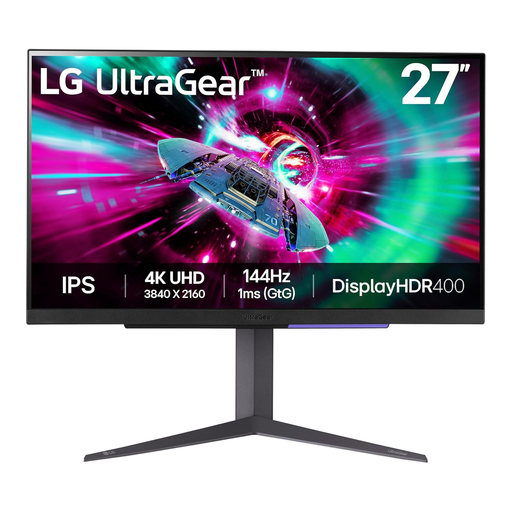
Why It Stands Out: While the other recommendations focus on the 240Hz peak, the LG UltraGear 4K 27GR93U offers a compelling alternative with its high-performance IPS panel. It delivers a crisp 4K resolution with a very smooth 144Hz refresh rate and a fast 1ms GtG response time. This combination provides an excellent balance of visual detail and fluid gameplay, making it a strong choice for those who prioritise 4K fidelity for both PC and console gaming but may not require the absolute highest refresh rate available.
Pros:
Who is it for? The versatile gamer who splits their time between a PC and a PS5 or Xbox Series X and wants a high-performance 4K display that excels at both without needing to push for 240Hz.
The world of high-performance displays is constantly evolving. If these specific models aren't quite what you're looking for, or if you'd like to explore different sizes and specifications, we have a wider selection available.
Explore Our Full Range of Compatible Monitors
1. Is a 4K 240Hz monitor worth it for a PS5 or Xbox Series X? While a 4K 240Hz monitor is an excellent display, current-generation consoles like the PlayStation 5 and Xbox Series X are limited by their hardware and HDMI 2.1 port to a maximum output of 4K at 120Hz. Therefore, while you can certainly use one of these monitors, you won't be able to take full advantage of the 240Hz refresh rate. A monitor with 4K and at least 120Hz (or 144Hz) is a great choice as a monitor for PS5 and PC setups.
2. What kind of graphics card do I need to run games at 4K 240Hz? Achieving 240 frames per second at 4K resolution is extremely demanding. You will need a top-of-the-line graphics card, such as an NVIDIA GeForce RTX 4090 or an equivalent high-end model from AMD. Even with such powerful hardware, you may need to adjust in-game settings for the most graphically intensive titles to consistently hit that frame rate target.
3. How important is QD-OLED for gaming versus content creation? For gaming, the primary benefits of a QD-OLED gaming monitor are its near-instantaneous response times, which eliminate motion blur, and its infinite contrast, which makes dark scenes incredibly detailed and immersive. For content creation, its key strengths are its wide colour gamut and per-pixel accuracy, allowing for precise colour grading and photo editing. This makes it a technology that excels in both domains, bridging the gap between a gaming display and a professional creative monitor.