
24/7 Customer Support

Free returns

Same-day & Next-day Delivery

Quality Guaranteed

Unlock Your Welcome Offers: FREE Delivery | Up to 80% OFF | Free 30-day JoyPlus trial
Download the APP
A 4K dash cam front and rear system can provide useful video evidence on motorways, urban roads and while your car is parked. However, higher resolution alone does not guarantee a practical or reliable setup. The rear camera may record at a much lower resolution, the parking function may require extra wiring and advertised viewing angles can be misunderstood.
This guide explains the main buying traps, the specifications worth checking and which type of dual dash cam, 3-channel dash cam or multi-camera system may suit different UK drivers.
Many products advertise 4K recording but only offer it on the front camera. The rear unit may record in 1080P or 2K. That can still be suitable for documenting traffic behind you, but buyers should compare the resolution of each channel rather than focusing only on the headline figure.
For taxi drivers, families and fleet operators, an interior camera may be more useful than maximum rear resolution. A front and rear dash camera with a cabin channel can document passenger-area incidents, though local privacy responsibilities should be considered before recording inside a vehicle.
A parking mode dash cam usually needs continuous power when the ignition is off. Several models require a separate hardwire kit connected to the fuse box. Without it, the camera may switch off with the vehicle or offer only limited monitoring through the 12V socket.
Before buying, check whether the hardwire kit is included, whether professional installation is advisable and whether the system has low-voltage protection to help reduce the risk of draining the vehicle battery.
A 170° front lens or a claimed 360-degree dash cam view can capture a broad area, but lens placement, reflections, obstructions and image quality still matter. Side cameras can improve coverage at junctions and in car parks, while a conventional dual dash cam is usually simpler to install.
Also check whether the rear camera is waterproof for external mounting, whether the cable is long enough for your vehicle and whether the mount remains secure in cold, damp UK conditions.
A front 4K car camera records more image detail than Full HD when lighting and focus are suitable. This can help with reading road signs or identifying surrounding vehicles, although plates may still be difficult to capture if a car is moving quickly, too far away or affected by glare.
For night driving, look for practical features such as HDR, WDR, a wide aperture and a Sony STARVIS dash cam sensor. These specifications can support more balanced exposure in mixed lighting, but they should not be treated as a guarantee of perfectly clear night footage.
A loop recording dash cam automatically replaces older files when the memory card is full. A G-sensor can lock footage after a detected impact, helping prevent an important clip from being overwritten.
Check:
For regular commuting, a supplied 64GB card may be a convenient starting point. Drivers covering long distances or operating a taxi may prefer a system supporting larger capacity or built-in storage.
A GPS dash cam can record route, speed and location data for later playback. A Wi-Fi dash cam allows clips to be viewed or downloaded through a smartphone app without removing the card.
ADAS features may provide warnings for lane departure, forward collision or vehicle movement. These are driver aids rather than substitutes for attention and their performance can vary according to road markings, weather, traffic and camera alignment. Voice control can be useful when locking a clip without reaching towards the screen.
Installation should not obstruct the driver’s view. Route cables away from airbags and controls and check the product instructions for suitable mounting positions. For products used on public roads, verify applicable approval markings and vehicle-use guidance before fitting.
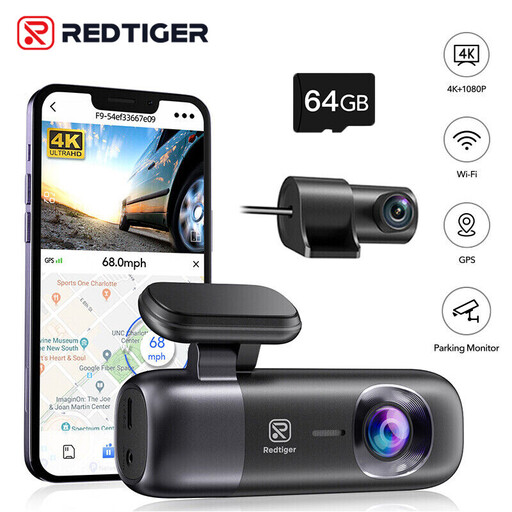
Why This Fits Their Persona: A straightforward dual-camera option for commuters and everyday drivers who want front and rear coverage with app access rather than a larger mirror display.
The product description clearly identifies the front and rear cameras, 12V operation and the separate hardwire requirement for parking monitoring.
4K front and 1080P rear recording, 64GB card, Wi-Fi, GPS, night vision and loop recording.
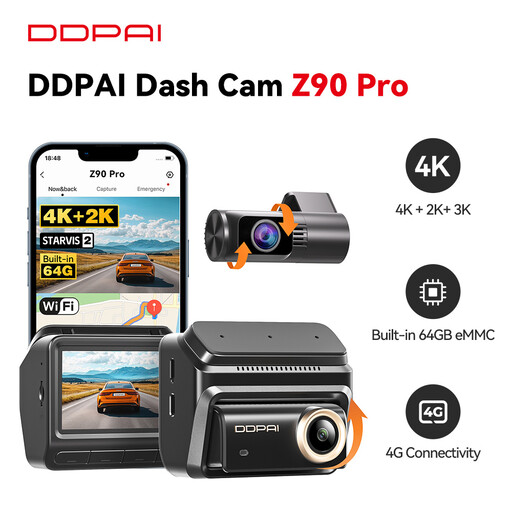
Why This Fits Their Persona: Suitable for drivers who value high-resolution recording, fast file transfer and the option to expand from two channels to a cabin-facing third camera.
It specifies separate front and rear resolutions, built-in 64GB eMMC storage and a hardwire requirement for 24-hour parking monitoring.
4K front, 2K rear, Sony STARVIS 2 IMX678 front sensor, GPS, 5GHz Wi-Fi and voice control.
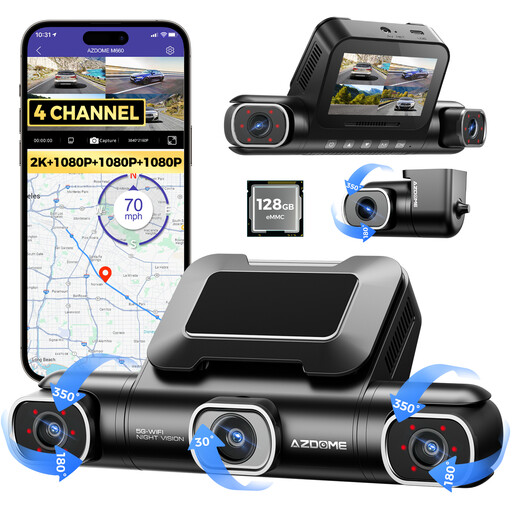
Why This Fits Their Persona: A practical match for taxi drivers, fleet operators and owners who want front, rear and side coverage for incidents around the whole vehicle.
Its four-channel design is specified as front, rear, left and right recording, rather than relying only on a wide front lens.
2.5K front and 1K additional channels, 128GB eMMC storage, GPS, 5G Wi-Fi, voice control and several parking modes.
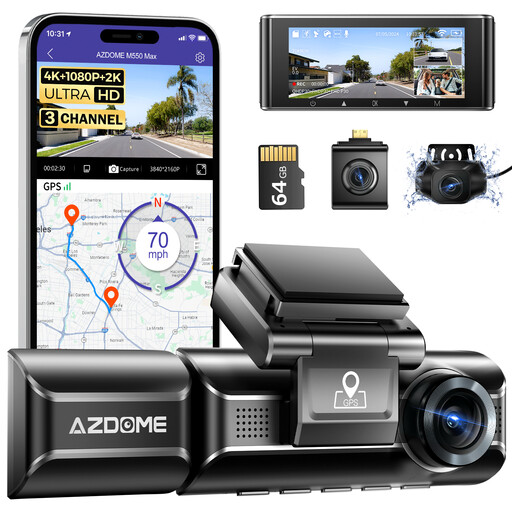
Why This Fits Their Persona: The front, rear and interior arrangement suits family vehicles and professional drivers who need cabin evidence as well as road coverage.
The three recording channels and six infrared lights are listed separately, making the interior-monitoring purpose clearer than a generic 360-degree claim.
4K front, 2.5K rear and 1080P interior recording, dual STARVIS sensors, GPS, Wi-Fi and a 64GB card.
We have compiled a complete, real-time list of products that fully satisfy these strict selection criteria and UK safety regulations.
It can be worthwhile if you regularly drive on motorways, commute at night or want more detail from the front recording. A dual system also documents incidents behind your vehicle. Compare the rear resolution, low-light specifications, storage and installation requirements before choosing.
A camera operating only from the ignition-switched 12V socket normally stops when the car is turned off. Parking monitoring may use a hardwire kit and the vehicle battery. Choose a kit with low-voltage cut-off where supported and follow the manufacturer’s installation instructions.
Service life depends on heat exposure, vibration, memory-card quality and installation. Formatting the card as instructed, replacing worn cards and keeping lenses clean can support reliable operation. Supercapacitor-based models may be preferable where temperature changes are a concern, but no device is maintenance-free.