
24/7 Customer Support

Free returns

Same-day & Next-day Delivery

Quality Guaranteed

Unlock Your Welcome Offers: FREE Delivery | Up to 80% OFF | Free 30-day JoyPlus trial
Download the APP
A 4K dash cam front and rear setup can provide useful footage of the road ahead and incidents behind your vehicle. However, high resolution alone does not guarantee a practical recording system. UK drivers should also consider night-time detail, storage, installation, power requirements and whether the rear camera will fit their vehicle.
As the Joybuy Product Recommendation Officer, I focus on separating useful specifications from features that may sound impressive but create extra cost or installation work.
Many dual dash cam systems advertise 4K for the front camera while the rear unit records at 1080P or 2.5K. This is not necessarily a problem, but buyers should check the resolution of each channel rather than relying on the headline specification.
Rear footage may be especially important in a collision, parking incident or insurance dispute. Confirm whether the system records both cameras simultaneously and whether using a third camera reduces the front resolution.
A parking mode dash cam usually needs power while the ignition is off. In many products, this requires a separate hardwire kit connected to the vehicle’s fuse box. A cigarette-lighter socket generally stops supplying power when the car is parked.
Hardwiring may also require professional installation, particularly where airbags, modern vehicle electronics or warranty conditions are involved. Check whether the kit is included before comparing prices.
High-resolution footage uses more storage space. Loop recording normally overwrites the oldest unlocked files when the dash cam with SD card becomes full, while G-sensor events are locked to reduce the risk of automatic deletion.
A high-endurance microSD card is preferable for frequent recording. Some models include a 32GB, 64GB, 128GB or 256GB card; others require a separate purchase. Formatting the card in the camera and checking locked files regularly can help avoid recording interruptions.
For a front and rear dash camera, look for the actual resolution of both channels, sensor type, field of view and low-light features. A 4K front camera can capture more fine detail than a lower-resolution model, but number plates may still be affected by glare, movement, weather, tinting and lens position.
HDR or WDR can help balance bright and dark areas in challenging scenes. A night vision dash cam may use a sensitive image sensor or infrared lighting, particularly for interior recording. These features improve the camera’s ability to record visible detail, but they cannot guarantee clear footage in every lighting condition.
A dual dash cam records the front and rear. A 3-channel dash cam adds an interior camera, which can suit taxi drivers, rideshare operators and families who want cabin footage. A 4-channel dash cam can record the front, rear, left and right sides for broader vehicle coverage.
A mirror dash cam may provide a large rear-view display and can be useful where the rear view is obstructed by passengers or cargo. Before buying, check cable length, rear-window mounting options and whether tinted glass may affect image quality.
A GPS dash cam can record route, speed and location data alongside video. This may help organise journey footage, although drivers should check local requirements before relying on recorded data for any formal purpose.
A Wi-Fi dash cam allows clips to be viewed or transferred to a smartphone without removing the card. 5GHz Wi-Fi may offer faster local transfers than standard 2.4GHz connections, provided the phone and camera are compatible.
Voice control dash cam functions can reduce the need to touch the unit while driving. ADAS dash cam alerts may provide warnings relating to lanes or forward hazards, but they are assistance features and should not replace attentive driving.
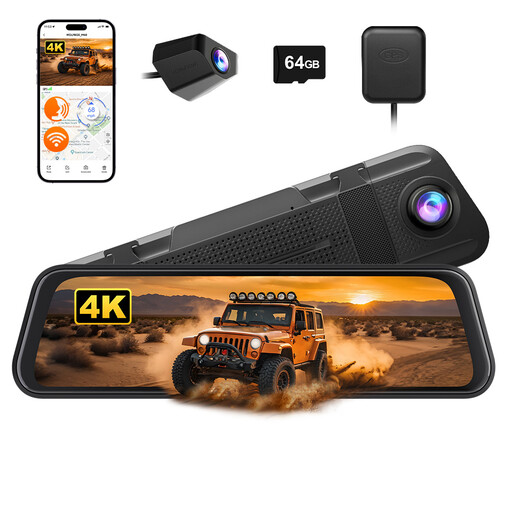
Why This Fits Their Persona: A straightforward front-and-rear mirror dash cam for drivers who want a larger display and an included 64GB card without moving to a multi-camera system.
The listing specifies 4K front and 1080P rear recording, making the channel split clear. Parking monitoring requires a separate hardwire kit, so the extra cost is visible before purchase.
10-inch display, adjustable viewing angle, GPS, Wi-Fi and universal rubber-strap mirror mounting.
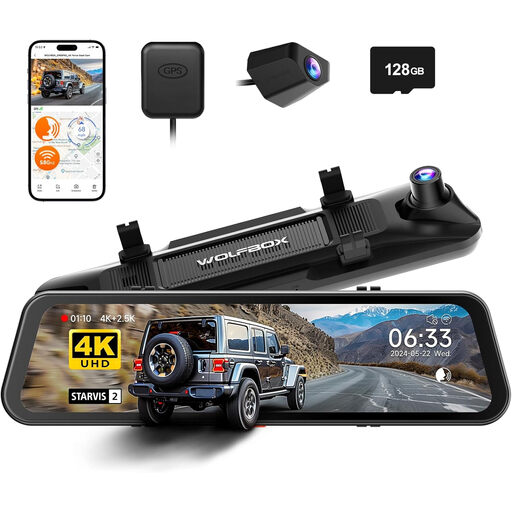
Why This Fits Their Persona: Suitable for regular commuters and motorists who want higher-resolution front and rear recording, app access and a generous included memory card.
The specification identifies 4K front and 2.5K rear resolution, plus a 128GB card. The listing also notes that heavily tinted rear windows may affect rear-camera image quality.
5GHz Wi-Fi, built-in GPS, voice control, G-sensor event locking and 128GB included storage.
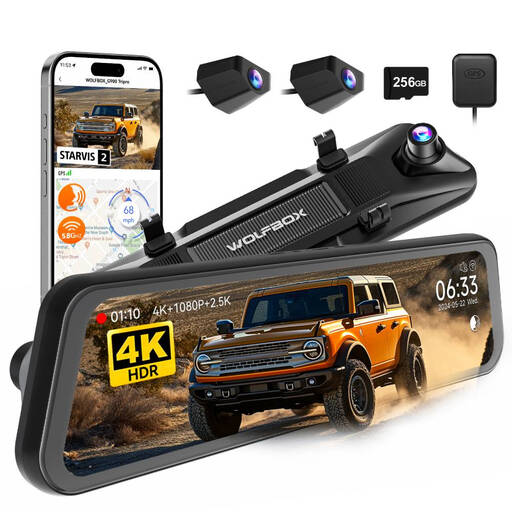
Why This Fits Their Persona: A practical match for taxi, rideshare and family drivers who want front, cabin and rear-bumper coverage rather than a standard dual dash cam.
The three recording channels are clearly specified as 4K front, 2.5K interior and 1080P rear bumper. Buyers can assess the additional cable routing and installation needs in advance.
Sony STARVIS 2 IMX678 front sensor, 5.8GHz Wi-Fi, voice control, GPS and a 256GB card included.
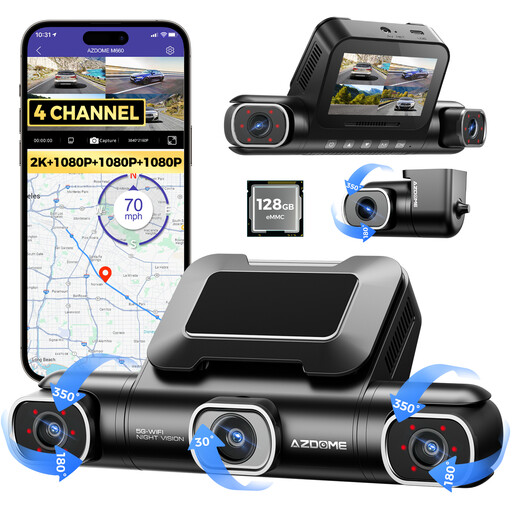
Why This Fits Their Persona: Designed for motorists prioritising side coverage, parking incidents and a wider view around the vehicle.
The four-channel arrangement records front, rear, left and right views. It uses built-in eMMC storage, so buyers do not need to budget for a separate SD card.
128GB eMMC storage, built-in GPS, 5G Wi-Fi, voice control and multiple parking modes.
We have compiled a complete, real-time list of products that fully satisfy these strict selection criteria and UK safety regulations.
It can be useful for drivers who want more front-camera detail and clear rear coverage. The practical benefit depends on lens quality, lighting, storage capacity and correct installation. Check the rear resolution separately, as it may be lower than the front.
A camera recording only while the vehicle is running normally draws power from the 12V socket. Parking mode can continue recording after the ignition is off and usually needs a hardwire kit. Choose a kit with suitable battery protection and consider professional installation.
It depends on resolution, number of channels, card capacity and recording length. Loop recording replaces older unlocked clips once storage is full. Event files protected by the G-sensor may remain until manually removed, so review and format the storage periodically.