
24/7 Customer Support

Free returns

Same-day & Next-day Delivery

Quality Guaranteed

Unlock Your Welcome Offers: FREE Delivery | Up to 80% OFF | Free 30-day JoyPlus trial
Download the APP
A 4K dash cam can provide clearer footage than lower-resolution models, but image quality is only one part of a reliable in-car recording system. UK drivers also need to consider rear coverage, night-time performance, storage, parking protection, installation and whether the camera suits the vehicle.
Many buyers are drawn to impressive specifications, only to discover that the camera is difficult to use, the rear image is too small or essential accessories are sold separately. The following guide explains the practical details to check before choosing a dash cam for a car, van, taxi, truck or caravan.
A product described as a 4K dash cam may only record the road ahead in 4K, while its rear camera records at 1080P or lower. This is not necessarily a problem, but buyers should understand the difference.
A front and rear dash cam gives broader incident coverage than a front-only model. A mirror dash cam can also improve rear visibility through a digital display, while a dedicated rear-view mirror camera or reversing camera kit may be more suitable for larger vehicles.
Check each camera’s individual resolution rather than relying on the headline specification.
Parking monitoring commonly requires a hardwire kit connected to the vehicle’s fuse box. A camera powered only through the 12V socket may stop recording when the ignition is switched off.
Before buying a parking monitor dash cam, check whether the hardwire kit is included, sold separately or unavailable. Professional installation can be sensible where wiring must be routed near airbags or where battery protection settings need careful adjustment.
4K video creates larger files than 1080P footage. A low-capacity or unsuitable memory card can fill quickly, fail to record properly or require frequent formatting.
Look for support for a Class 10 or U3 microSD card, check the maximum supported capacity and confirm whether a card is included. Loop recording normally overwrites the oldest unlocked footage, while the G-Sensor can lock clips when it detects a collision or sudden movement.
A 4K front camera records at approximately 3840 × 2160 pixels, which can make number plates and road details more discernible in suitable lighting. However, resolution does not guarantee clear footage in every condition.
Also check:
A mirror dash cam mounts over the existing rear-view mirror and may provide a larger digital rear image. Before ordering, measure the original mirror. For example, the WOLFBOX G850 PRO is designed for most vehicles with an existing mirror height of no more than 3.5 inches for strap mounting.
Check the power system too. Several models support 12V–24V, making them more suitable for vans and trucks, while some reversing camera kits are specifically designed for commercial vehicles.
Any screen must be positioned so it does not obstruct the driver’s forward view or create distracting glare. Drivers should also check their vehicle’s requirements and ensure that a replacement-style display still provides an appropriate rear view when needed.
A GPS dash cam can record location and speed data alongside video, which may help organise footage. Wi-Fi allows clips to be viewed or transferred to a compatible app without removing the card, although transfer speed depends on the device and phone.
For reversing assistance, check whether the rear camera includes guidelines, a reverse-trigger wire or dynamic steering lines. These features assist visibility but should not replace direct observation of the surroundings.
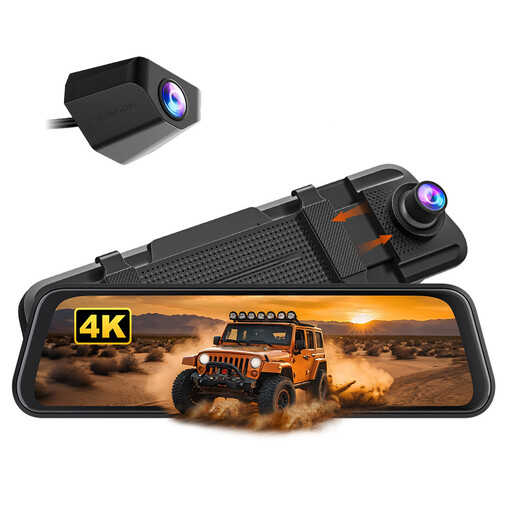
Why This Fits Their Persona: A practical starting point for UK car owners wanting front and rear recording with a touchscreen mirror format rather than a more complex multi-camera system.
The listed specifications clearly separate its 4K front camera from the 1080P rear camera. It also states a microSD limit of 256GB, helping buyers choose storage correctly.
10-inch IPS touchscreen, 170° front viewing angle, loop recording and G-Sensor emergency locking.
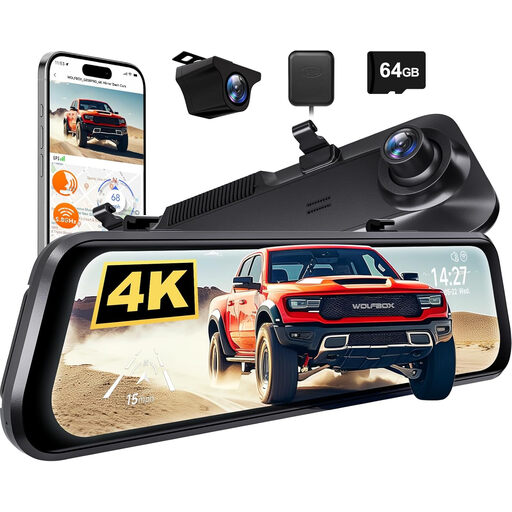
Why This Fits Their Persona: Suitable for drivers seeking a large digital rear-view display, app connectivity and additional driver-assistance features in one mirror-mounted unit.
It includes a 64GB card and external GPS module, while parking monitoring still clearly requires a separate hardwire connection.
12-inch IPS touchscreen, 5.8GHz/2.4GHz Wi-Fi, GPS, voice control, ADAS and BSD features.
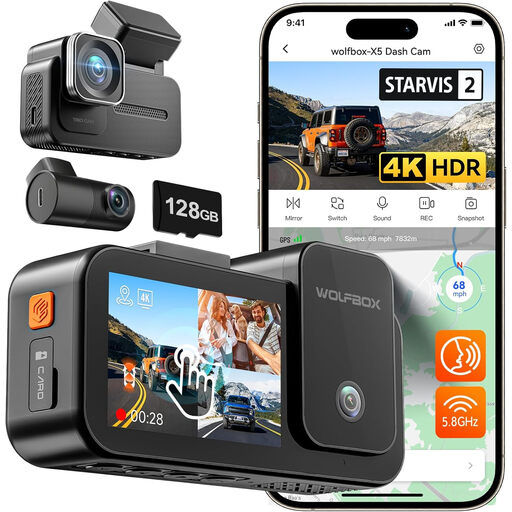
Why This Fits Their Persona: A logical match for taxi drivers, commercial users and motorists who want footage from the road ahead, behind and inside the cabin.
A triple-channel design avoids the limitation of assuming that front and rear cameras cover the cabin. Check storage capacity carefully because three simultaneous streams create more footage.
Three-channel recording, 4K front capability, STARVIS 2 IMX678 sensor and 5.8GHz Wi-Fi.
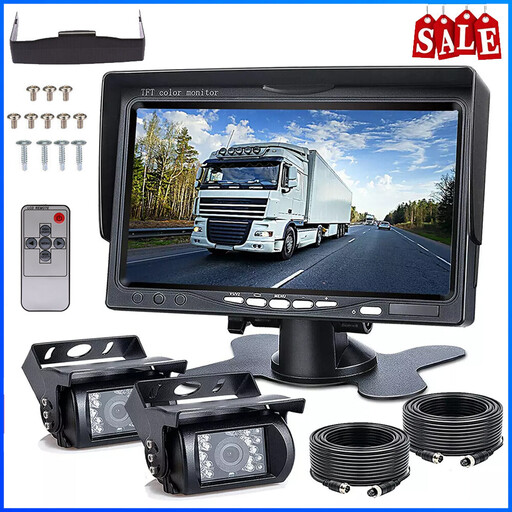
Why This Fits Their Persona: Designed for trucks, buses, vans, caravans and RVs where a dedicated reversing camera kit may be more useful than a mirror-style recorder.
Its 12V–24V supply and two-camera inputs are stated clearly, making it easier to match with larger vehicles than a standard car-only system.
Includes two cameras, a 7-inch monitor, 10-metre video cable, IP67-rated camera housing and infrared LEDs.
We have compiled a complete, real-time list of products that fully satisfy these strict selection criteria and UK safety regulations.
A straightforward 12V installation may only require routing the cable neatly along the headliner and A-pillar. Do not place wiring where it could interfere with airbags, pedals or steering controls. Rear camera cables may need to pass through a hatch or tailgate rubber grommet, so waterproof connections and careful sealing matter.
Budget for:
Keep the lens clean, format the card according to the manufacturer’s instructions and periodically check that recordings are actually being saved. If cabin recording is used for work, consider privacy and data-protection responsibilities, particularly when passengers or employees may be captured.
It can be useful when you want more detailed front footage, particularly for reading road signs or identifying details at a suitable distance. However, a 4K front camera does not automatically provide 4K rear footage. Compare the complete front-and-rear specification before purchasing.
Only models with a suitable parking-monitor function and continuous power connection can normally record with the ignition off. A hardwire kit is often required and installation should include suitable battery-protection settings to reduce the risk of draining the vehicle battery.
The required capacity depends on recording resolution, number of channels and loop duration. A dual dash cam records more data than a front-only camera, while a triple-channel dash cam creates still more. Use the manufacturer’s stated capacity and speed requirements, such as Class 10 or U3, rather than selecting a card based solely on its advertised size.