
24/7 Customer Support

Free returns

Same-day & Next-day Delivery

Quality Guaranteed

Unlock Your Welcome Offers: FREE Delivery | Up to 80% OFF | Free 30-day JoyPlus trial
Download the APP
A 4K front and rear dash cam can provide useful video evidence, but resolution alone does not determine whether a system is suitable for everyday driving. A busy London commute, rural night journey, school-run traffic or taxi work can expose weaknesses that are not obvious on a product listing.
The main buying pitfalls are usually:
A front 4K car camera records at approximately 3840 × 2160 pixels, allowing more image detail than standard Full HD. This can help when reviewing road signs or number plates, although clarity also depends on lens quality, lighting, vehicle speed and distance.
The rear channel is equally important. A system described as 4K + 1080P provides different resolutions front and rear, while a 4K + 2K model offers a higher-resolution rear image. Check the specification rather than relying on the phrase “4K front and rear dashcam”.
For night driving, look for HDR night vision, a wide aperture and a suitable image sensor. A Sony STARVIS 2 dash cam may offer stronger low-light specifications, but real-world footage can still be affected by glare from headlights, rain on the lens and dirty windscreens. WDR or HDR processing helps balance bright and dark areas, but it is not a guarantee that every number plate will be readable.
A wide field of view can capture more lanes, but an excessively wide lens may make distant objects appear smaller. Front viewing angles around 150–170 degrees and rear coverage around 130–150 degrees are common specifications in this category.
Check the cable length, mounting method and available space behind the rear number plate or window. A dash cam with rear camera normally needs a cable routed through the vehicle trim. Mirror-mounted systems also need sufficient clearance around the original rear-view mirror.
For a 4K mirror dash cam, confirm that the straps or mounting brackets fit your vehicle. The WOLFBOX models use adjustable straps and are designed for many cars, SUVs and trucks, but the physical dimensions of the original mirror still matter.
4K footage uses more storage than 1080P footage. Look for loop recording, emergency file locking and a high-endurance memory card requirement. Some products include storage, while others require a compatible card to be purchased separately.
A GPS dash cam can record speed, time and route information. A Wi-Fi dash cam allows footage to be previewed or transferred to a mobile app without removing the card. Voice control can be useful when you need to lock a clip or take a still image without reaching towards the unit.
For 24-hour parking mode, check whether a hardwire kit is included. Parking functions may use time-lapse, collision detection or motion detection, and the vehicle’s battery protection settings should be considered carefully.
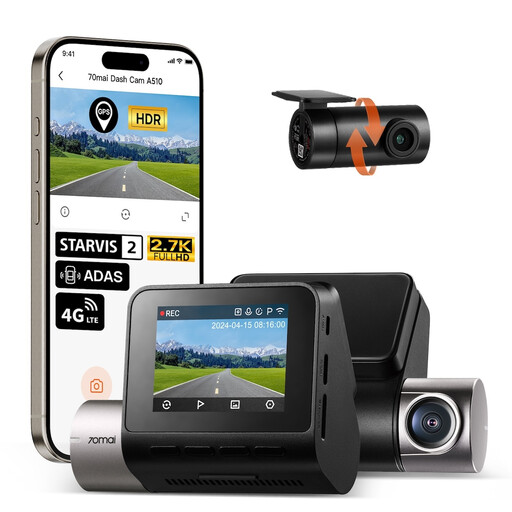
Why This Fits Their Persona: A practical option for commuters and family drivers who want front and rear coverage without moving directly to a 4K system.
The specification clearly separates 1944P front recording from 1080P rear recording, while the microSD card is not included, making the storage requirement clear before purchase.
Sony STARVIS 2 IMX675 front sensor, built-in GPS, ADAS alerts and optional parking monitoring with the required hardwire kit.
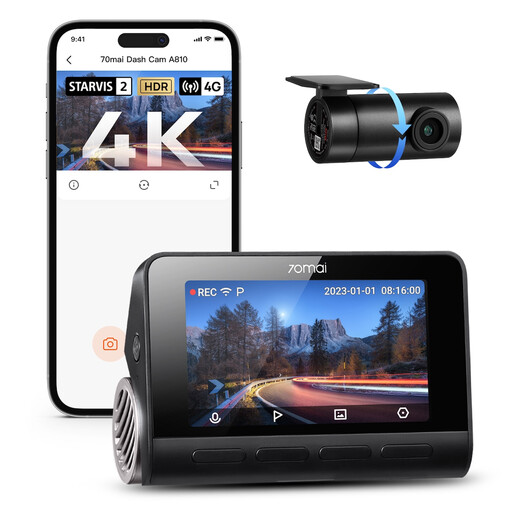
Why This Fits Their Persona: Suitable for drivers prioritising front-image detail, rear coverage and connected features for regular motorway or urban use.
It identifies the front 4K IMX678 sensor and rear 1080P IMX662 sensor separately, while stating that 4G and parking functions require the UP04 hardwire kit.
Dual HDR recording, GPS, voice control, 150° front and 130° rear lenses, plus optional AI parking monitoring.
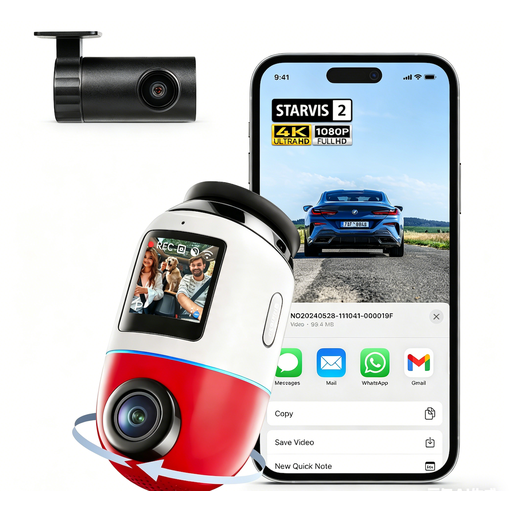
Why This Fits Their Persona: Designed for fleet users, private-hire drivers and vehicle owners wanting broad coverage and remote monitoring options.
The front and rear channels are specified separately, and the listing states that the microSD card and hardwire kit are not included.
4K front at 60FPS, 1080P HDR rear recording, 360-degree rotation, GPS, 5G Wi-Fi 6 and optional 4G remote alerts.
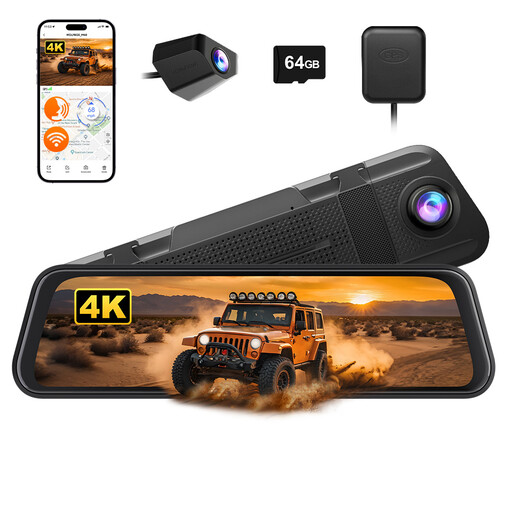
Why This Fits Their Persona: A convenient match for drivers who prefer a large display and a mirror-style installation in a car, SUV or truck.
The rear camera can be fitted externally or internally, and the product notes that 24-hour parking monitoring needs a separate hardwire kit.
10-inch screen, 4K front and 1080P rear recording, GPS, Wi-Fi, voice control, ADAS and a 64GB card included.
It can be worthwhile if you regularly drive on motorways, work as a taxi or private-hire driver, or want more front-camera detail. However, a 4K front camera paired with 1080P rear recording may offer a more balanced price than dual 4K hardware.
Normal recording usually stops when the vehicle is switched off. Parking mode can draw power and commonly requires a hardwire kit with low-voltage protection. Check compatibility and installation requirements before leaving it active for extended periods.
Storage time depends on resolution, frame rate, card capacity and whether both cameras record simultaneously. Loop recording replaces older unlocked clips when the storage is full, while impact-locked files are normally retained until manually deleted or the card is formatted.