
24/7 Customer Support

Free returns

Same-day & Next-day Delivery

Quality Guaranteed

Unlock Your Welcome Offers: FREE Delivery | Up to 80% OFF | Free 30-day JoyPlus trial
Download the APP
A 4K front and rear dash cam can provide clearer evidence of road incidents, number plates and changing traffic conditions than a basic single-camera recorder. However, resolution alone does not determine whether a system will be useful in daily UK driving.
Commuters, families, taxi drivers and van users should look beyond headline specifications. Some dash cams advertise 4K recording but use a lower-resolution rear camera, while others require extra purchases for parking monitoring, storage or professional installation.
Many dual dash cam systems record in 4K at the front and 1080P or 2K at the rear. This is not necessarily a problem, but buyers should understand the coverage they are getting. A front-facing 4K camera may capture more detail ahead, while the rear unit provides supporting evidence behind the vehicle.
Check the resolution of each channel, not just the largest number in the product title. If you need interior coverage as well, look for a triple-channel dash cam, which may record the front, cabin and rear simultaneously.
A Wi-Fi dash cam normally uses wireless connectivity to preview or download clips through a smartphone app. The camera still needs a power cable, and a rear camera usually connects to the front unit with a physical cable.
This means installation involves routing wires around the headlining, A-pillar and trim. Cables should not interfere with airbags, pedals or the driver’s view. A camera advertised as a “front and rear car camera” is not automatically cable-free.
A parking mode dash cam needs power while the ignition is off. A standard 12V socket often stops supplying power when the car is parked, so continuous monitoring usually requires a compatible hardwire kit. This may be sold separately and is commonly best fitted by someone familiar with vehicle electrics.
Hardwiring incorrectly can drain the battery or interfere with vehicle systems. Check whether the product includes the kit, supports low-voltage cut-off and is suitable for your vehicle before purchase.
For a 4K dashcam with GPS, check the actual recording format, frame rate and viewing angle. A front resolution of 3840 × 2160 can capture useful detail, but image clarity also depends on lens quality, lighting, compression and movement.
A wide viewing angle can cover several lanes, although extremely wide lenses may make distant number plates appear smaller. The rear camera should be suitable for your vehicle: internal mounting may work well in a hatchback, while an external waterproof camera may be more appropriate for some vans, SUVs or vehicles with tinted rear glass.
A night vision dash cam should be assessed by its sensor, aperture and exposure features rather than by the phrase “night vision” alone. Sony STARVIS or STARVIS 2 sensors are found in several models and are designed for low-light image capture, but results can still vary with street lighting, headlights, rain and windscreen reflections.
Features such as WDR or HDR can help balance bright headlights and darker surroundings. They do not guarantee that every number plate will be readable at night, so sensible camera positioning and a clean windscreen remain important.
GPS can record speed, location and route information alongside footage. Mount the external GPS receiver where it has a reasonably clear view of the sky, while remembering that speed overlays may not always be suitable for every type of evidence or insurance discussion.
Loop recording automatically replaces older files when the dash cam with memory card becomes full. A high-endurance Class 10 or U3 microSD card is generally more suitable for continuous recording than a basic card designed for occasional file transfers. Format the card in the camera and check the maximum supported capacity.
In the UK, ensure the camera is mounted without obstructing your view. If using a mirror dash cam, the display should not distract you, and the rear view must remain usable when the screen is not displaying camera footage. Recording identifiable people or vehicles may also involve privacy and data-protection responsibilities, particularly for commercial drivers.
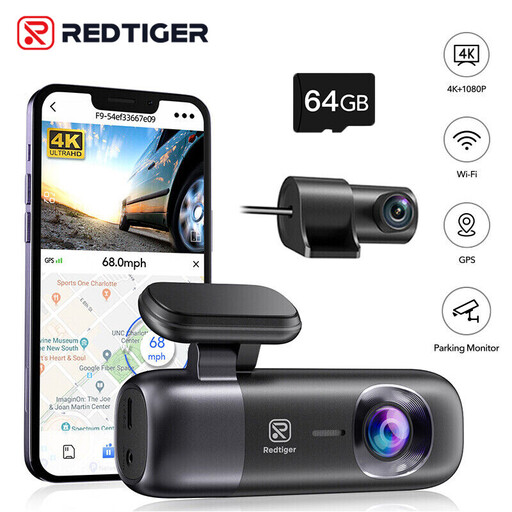
Why This Fits Their Persona: A practical dual dash cam option for commuters and first-time buyers who want front and rear recording, app access and GPS without choosing a larger mirror display.
The listing states the front camera records in 4K and the rear in 1080P, making the channel split clear. Parking mode requires a separate hardwire kit.
4K front recording, 1080P rear recording, Wi-Fi, GPS and support for microSD cards up to 256GB.
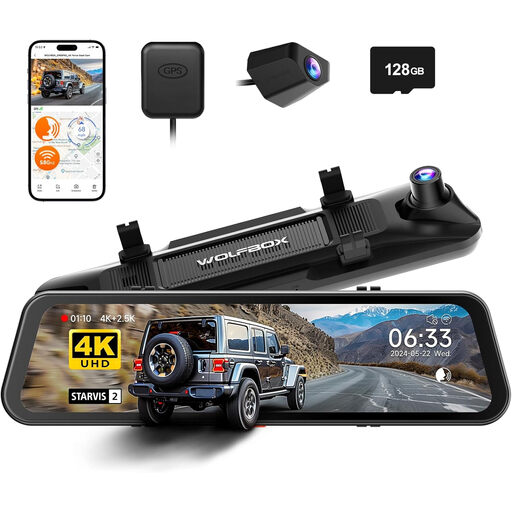
Why This Fits Their Persona: Suits drivers who want a higher-resolution rear view and convenient smartphone transfers for regular review of footage.
Its stated specification identifies both front and rear resolutions, while the included 128GB card reduces the need for an immediate storage purchase.
4K front, 2.5K rear, 5GHz Wi-Fi, GPS, voice control and loop recording.
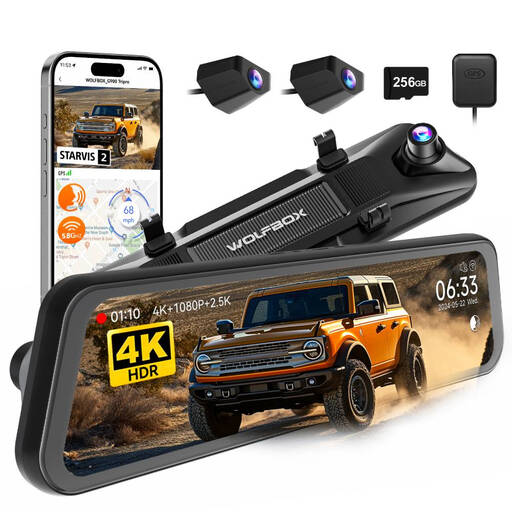
Why This Fits Their Persona: Designed for drivers needing front, cabin and rear bumper coverage, including families, taxi users and vehicles where a rear-mounted camera is useful.
The specification clearly lists three channels and separate resolutions, rather than presenting one front-camera figure as total system performance.
4K front, 2.5K interior and 1080P rear bumper recording, with Sony STARVIS 2 IMX678, GPS, 5GHz Wi-Fi and a 256GB card.
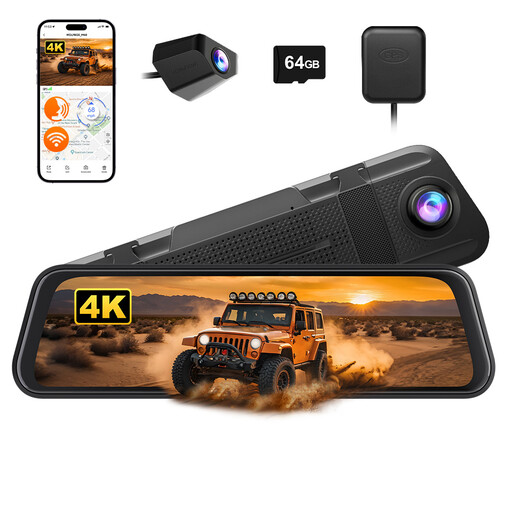
Why This Fits Their Persona: Suitable for drivers who want a larger live rear view, reverse assistance and a mirror-style installation across cars, SUVs and lorries.
The rear camera can be mounted inside or externally, and the product information states that 24-hour parking monitoring normally needs a separate hardwire kit.
10-inch display, 4K front and 1080P rear recording, ADAS/BSD features, GPS, Wi-Fi and an included 64GB card.
We have compiled a complete, real-time list of products that fully satisfy these strict selection criteria and UK safety regulations.
Most systems connect to a 12V socket and can be installed using adhesive mounts, straps or suction mounts. The main task is routing the rear-camera cable neatly without crossing airbag deployment areas. External rear cameras and hardwire kits may require additional work.
This depends on card capacity, resolution, frame rate and whether one, two or three channels are recording. Loop recording replaces the oldest unlocked files when storage is full. Impact-protected clips may remain until manually deleted, so format the card periodically after backing up important footage.
No. An ADAS dash cam may provide alerts for lane departure or forward collision conditions, depending on the model and setup. These alerts can be affected by weather, road markings, camera alignment and traffic conditions. They should support, not replace, careful driving and direct observation.